

Scan your genome and you’ll find bits of Neanderthal scattered through it like old furniture in an attic. A stretch here on chromosome 3, another on chromosome 12. Roughly 2 percent of the DNA in most people of non-African descent traces back to those stocky Eurasians who went extinct around 40,000 years ago. But there is one place the Neanderthal traces are conspicuously thin. Your X chromosome is, genetically speaking, almost a Neanderthal-free zone.
Geneticists have known about these “Neanderthal deserts” for over a decade, and most reckoned the explanation was straightforward. Neanderthal genes on the X chromosome were probably harmful when dropped into a human genetic background, so natural selection scrubbed them out over thousands of generations. Case closed. Except it wasn’t.
A new analysis by Alexander Platt, Daniel Harris, and Sarah Tishkoff at the University of Pennsylvania has turned that assumption inside out. Their study, published this week in *Science*, finds that the barren X chromosome isn’t primarily a product of natural selection at all. It’s a signature of who was sleeping with whom. The interbreeding between our species and Neanderthals, it turns out, was heavily lopsided: predominantly Neanderthal males pairing with human females. And the pattern seems to have persisted for generations, possibly across encounters separated by 200,000 years.
“Along our X chromosomes, we have these missing swaths of Neanderthal DNA we call ‘Neanderthal deserts,'” says Platt. “For years, we just assumed these deserts existed because certain Neanderthal genes were biologically ‘toxic’ to humans … so we thought the genes may have caused health problems and were likely purged by natural selection.”
To test that assumption, the team did something clever. Rather than staring at the human genome and speculating about what got removed, they looked at the problem from the other direction. An earlier episode of interbreeding, perhaps 250,000 years ago, had left traces of modern human DNA inside Neanderthal genomes. If the old “toxic genes” explanation held up, you’d expect Neanderthal X chromosomes to be depleted of human DNA too, a mirror image of the pattern we see in ourselves. Genomic incompatibility should work both ways.
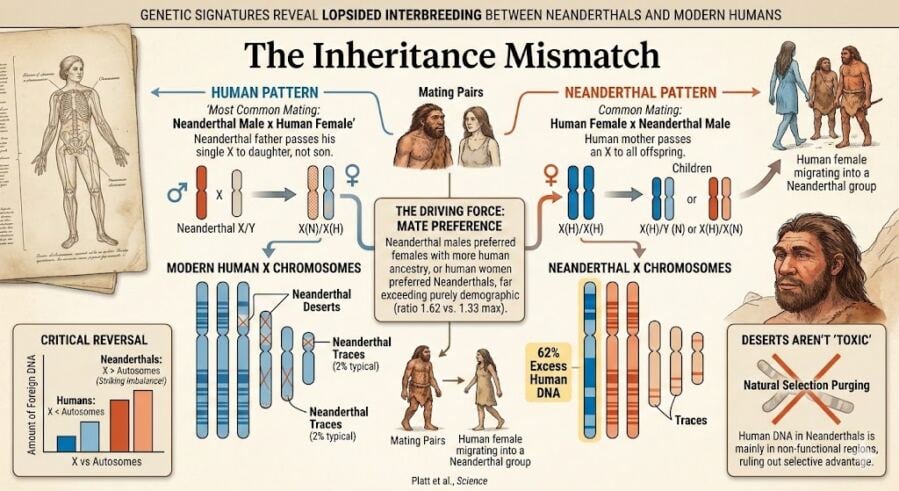
That is not what they found. Not even close. “What we found was a striking imbalance,” says Harris. “While modern humans lack Neanderthal X chromosomes, Neanderthals had a 62% excess of modern human DNA on their X chromosomes compared to their other chromosomes.” The team focused mainly on the Altai Neanderthal, a female specimen from Siberia dated to about 122,000 years ago, but the same pattern showed up in two other Neanderthal genomes from Chagyrskaya and Vindija as well.
This mirror-image reversal is the key to the whole puzzle, and it comes down to some basic inheritance maths. Women carry two X chromosomes; men carry one X and one Y. A father passes his single X only to daughters, never to sons. So if the cross-species pairings were mainly Neanderthal men with human women, the Neanderthal men would hand very few X chromosomes to the mixed human gene pool (since they’ve only got one, and it only goes to daughters). Meanwhile, human women moving into Neanderthal groups would flood the Neanderthal X chromosome pool with their own versions, because mothers pass an X to every child regardless of sex.
The team then asked whether purely demographic explanations could account for the strength of this signal. In many human societies, one sex is more likely to relocate to a partner’s community. If human women were migrating into Neanderthal groups, that alone would shift the X chromosome balance somewhat. But the maths puts a hard ceiling on how far demographics can push things. Even the most extreme scenario, one where every single interbreeding female was a modern human, only produces a ratio of about 4:3. The observed ratio of 1.62 blows past that limit. “You need a strikingly strong phenomenon to get us there,” Platt told the *New York Times*.
What does fit is mate preference. Computer simulations showed that if Neanderthal males consistently favoured females with more human ancestry, or if human women consistently favoured Neanderthal partners, the X-to-autosome ratio climbs above that 4:3 ceiling within just a few generations. “Mating preferences provided the simplest explanation,” Platt says. The team also checked whether the human DNA enriched on Neanderthal X chromosomes might have been preserved because it was useful, coding for proteins or regulating gene activity. It wasn’t. The retained sequences sat mostly in non-functional stretches of the genome, which rules out the idea that Neanderthals were somehow benefiting from superior human X chromosome genes.
None of this means natural selection played no role at all. There is still a depletion of human introgression in the functional regions of the Neanderthal X, suggesting that something like the “faster X effect,” where sex chromosomes accumulate genetic incompatibilities more rapidly than other chromosomes, was probably layered on top of the mating bias. The two forces aren’t mutually exclusive. But sex bias, not selection, appears to be doing the heavy lifting.
What we can’t know, at least from genetics alone, is why this pattern existed. “I think there’s very little we can say,” Platt admits. “The meaningful thing we can say is that it was something that happened for generations.” Was it Neanderthal men preferring the look of human women? Human women drawn to Neanderthal partners? Something about social structure or opportunity? Tishkoff puts it bluntly: “One can only speculate!” And not everyone is fully persuaded. Arev Sümer at the Max Planck Institute for Evolutionary Anthropology in Leipzig says the evidence is intriguing but wants more before accepting such a strong behavioural claim.
Still, the consistency of the signal across admixture events separated by roughly 200,000 years is hard to dismiss. Whatever drove these pairings, it wasn’t a one-off accident of geography. With the broad strokes of who and how now sketched in, the Penn team is turning to the why, investigating whether comparing X chromosome and autosome diversity can reveal the social dynamics of Neanderthal groups: whether females stayed put while males wandered, or the other way round. The answer might tell us something unexpected about the inner lives of our closest evolutionary cousins. And about ourselves, too, given that every one of us carries the genetic consequences of those ancient preferences, written right there in the empty stretches of our X chromosomes.
Study link: https://www.science.org/doi/10.1126/science.aea6774