

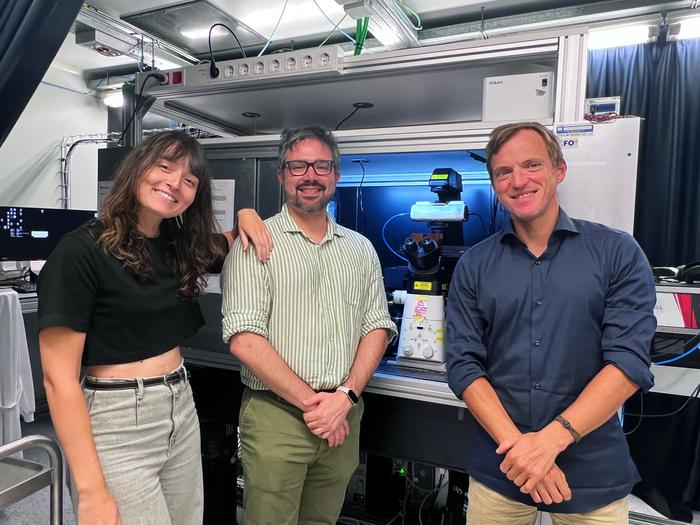
Scientists have long wondered how the brain converts touch and movement into electrical and chemical signals. A new study from ICFO-The Institute of Photonic Sciences shows that the way mechanical forces travel through neurons depends not just on membrane composition but on how microscopic obstacles are arranged within it. Published in Nature Physics, the work brings unprecedented clarity to how tension spreads through the neural membrane, shaping how the brain senses and responds to the physical world.
To trace these invisible forces, researchers led by Prof. Michael Krieg, together with Dr. Frederic Catala-Castro and Dr. Neus Sanfeliu-Cerdan, used a laser-based optical tweezer system that can both tug and measure forces on single neurons with picoNewton precision. By attaching tiny plastic beads to the axons of the roundworm Caenorhabditis elegans, they watched how mechanical tension moved between two points on the same cell in real time.
A Laser Tug-of-War Inside a Worm Neuron
The team found that tension spread faster in touch-sensitive neurons than in those that monitor the body’s own movement, known as proprioceptors. The finding suggested that sensory neurons may be physically optimized to transmit mechanical cues with speed and precision. Yet what most surprised the team was that the spatial arrangement of proteins embedded in the cell membrane controlled how far the tension traveled.
Using mathematical models from Prof. Padmini Rangamani’s lab at the University of California San Diego, the researchers discovered that when membrane proteins are organized in neat, repeating patterns, they restrict how far tension can propagate. When the same proteins are scattered randomly, however, the force travels much farther across the membrane, almost like ripples moving through a calm pond.
“Developing the 3D model changed everything. It gave us the consistency we needed to draw solid conclusions, turning an idea into one exciting insight,” said Prof. Michael Krieg of ICFO.
This interplay of order and disorder could have deep implications for how neurons localize and interpret physical stimuli. A tightly confined spread of force might help the cell pinpoint exactly where touch occurs, while a more diffuse spread could allow the neuron to integrate mechanical signals across its structure. Either way, the physics of the membrane appears to tune the neuron’s sensory precision.
Bridging Mechanics and Biology
The study began almost by accident, after conflicting reports in the literature led the ICFO team to ask whether the plasma membrane itself could carry mechanical information. The experiments, once refined, revealed that physical forces move through neurons far more dynamically than previously thought, with their reach shaped by both molecular crowding and architecture.
Independent experts say the findings could transform how scientists think about cellular signaling.
“This is a very timely paper. Given the important part that membrane tension has been shown to play in the regulation of cell function, it is very important to understand how localised this parameter is or how far it propagates,” said Dr. Eva Kreysing of the University of Cambridge.
Looking forward, the team plans to explore how membrane tension interacts with its surroundings and how cells might regulate these physical pathways in real time. If successful, the research could illuminate how touch, growth, and movement all begin at the same molecular level of physics.