

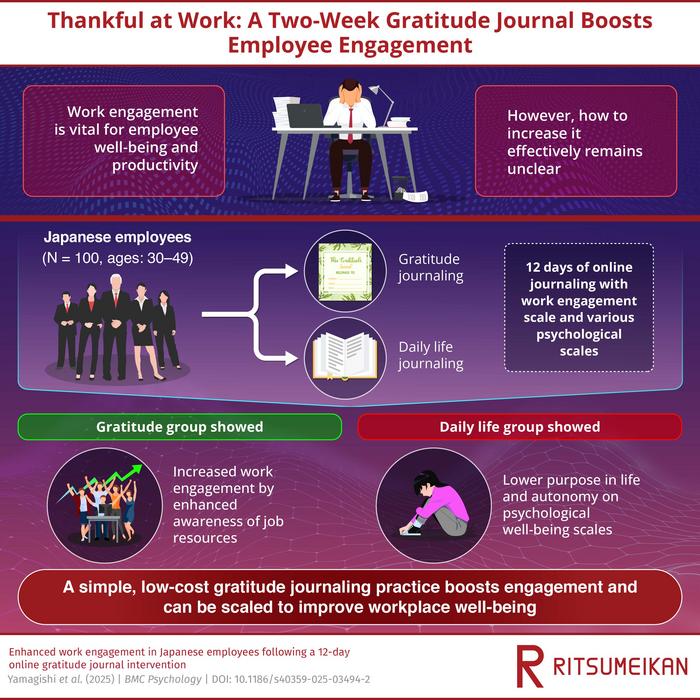
What if a small notebook could make you feel more connected to your job? A new study from Ritsumeikan University suggests that it can. In just 12 days, a simple gratitude journaling routine helped Japanese employees feel more positive and deeply engaged in their work, according to findings published in BMC Psychology.
The research, led by Professor Noriko Yamagishi in collaboration with Dr. Norberto Eiji Nawa of the National Institute of Information and Communications Technology and Mr. Shota Isomura from NTT Data Institute of Management Consulting, recruited 100 employees from industries including IT, logistics, and manufacturing. Half were asked to write daily about what they were grateful for; the other half simply recorded events from their day. By the end of the two-week period, the gratitude group showed a marked increase in overall work engagement, especially in the absorption dimension—how deeply they became immersed in their tasks.
Writing As A Mirror For The Mind
Analysis of the journals revealed a subtle shift in perception. Participants who practiced gratitude became more aware of positive workplace resources, from supportive supervisors to collaborative colleagues. The study’s authors linked this change to the Job Demands-Resources Model, which describes how recognizing personal and social resources can strengthen engagement.
“This study fills a key gap in the field,” said Professor Yamagishi. “Previous research has largely been correlational, whereas our results demonstrate a causal link between gratitude and increased work engagement.”
The journaling itself appeared to offer benefits beyond the gratitude condition. Both groups experienced mild improvements in general gratitude disposition, life satisfaction, and competitive motivation. Simply taking time each day to reflect brought a sense of order and self-awareness. Yet the researchers noticed an important difference: the control group, who merely described daily events, showed a slight decline in autonomy and purpose in life. This contrast hinted that unstructured reflection might draw attention to frustrations, while gratitude-focused writing guided participants toward balance and appreciation.
From Simple Exercise To Lasting Practice
These results suggest that gratitude is not just a byproduct of reflection but a habit that requires deliberate cultivation. The researchers argue that while journaling of any kind can encourage introspection, gratitude journaling specifically reinforces recognition of positive workplace experiences. Over time, this awareness may serve as a buffer against burnout and disengagement.
Professor Yamagishi believes the simplicity of the intervention is its greatest strength.
“Given its low-cost, scalable nature, gratitude journaling may serve as an accessible tool for fostering work engagement, well-being, and positive work culture,” she said.
The findings also expand the Job Demands-Resources Model by showing that gratitude can amplify employees’ perception of existing resources. In practice, even a short daily writing habit could help workers rediscover what makes their jobs meaningful. In the quiet space of a few written sentences, gratitude becomes more than emotion—it becomes an anchor for attention, connection, and purpose.