

Canadian engineers have built a device that captures airborne disease particles before they circulate through meeting rooms, clinics, and offices. The system works by steering exhaled breath into a compact cleaning zone, removing up to 94% of pathogens without blowing uncomfortable jets of air at people’s faces.
The prototype dramatically outperformed standard ventilation systems in computer simulations tracking 540,000 particles over 30 minutes, according to research from the University of British Columbia Okanagan published in Building and Environment. Under optimal conditions, it reduced infection probability to just 9.5%, compared with 47.6% for conventional personal ventilation, 38% for ventilation with exhaust systems, and 91% for typical room ventilation.
Clean air has become a modern survival need, especially as people spend close to 90% of their time indoors. In this study, the UBCO team demonstrates how reshaping local airflow, not simply increasing whole room ventilation, can protect people who sit face to face in clinics, classrooms, offices, or any setting where germs travel easily.
Why Existing Systems Fail Messy Reality
Traditional personalized ventilation works like airplane air nozzles, blowing filtered air toward your face from a fixed distance. These systems have dogged hospitals and offices for decades with fundamental problems. Move your head and protection vanishes. Sit under one too long and your eyes dry out. When researchers offset a conventional system by just 10 centimeters in their simulations, infection probability jumped to nearly 100% within 30 minutes, worse than having no special ventilation at all.
“Ensuring high air quality while indoors is crucial for mitigating the transmission of airborne disease, particularly in shared environments,” says study co-author Dr. Sunny Li, professor in the School of Engineering.
The UBC team, part of the university’s Airborne Disease Transmission Research Cluster, tried something different. Instead of creating an air barrier, their device manipulates airflow around a person to trap contaminated particles and pull them into a purification unit before they drift across the room.
Lead researcher Dr. Mojtaba Zabihi, a postdoctoral fellow, explains the induction-removal concept: “Our design combines comfort with control. It creates a targeted airflow that traps and removes exhaled aerosols almost immediately, before they have a chance to spread.”
A System Built For Real People, Not Perfect Posture
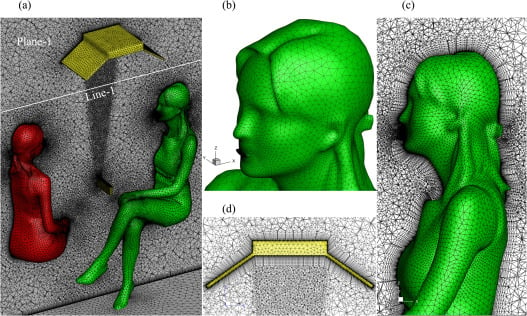
The system uses a paired jet and sink positioned near the aerosol source. As clean air streams from the jet, it expands and pulls surrounding air along with it, a bit like how smoke gets drawn toward an expanding plume. By positioning the intake hood at the right distance, the engineers created a flow pattern that funnels exhaled breath toward the cleaning zone rather than letting it disperse throughout the room.
A striking aspect of the study is how it handles messy reality. People do not sit perfectly. They turn their heads, lean back, pick up a pen. When the device was moved 10 centimeters off-center, its performance dipped yet remained comparable to the ideal placement of a conventional ventilation system. A system that maintains protection during ordinary movement fills a major gap in existing ventilation design.
The researchers modeled a 30-minute medical consultation between two seated people 86 centimeters apart. Their fully transient simulations accounted for body heat, breathing cycles, air circulation patterns, and realistic particle dispersion.
Under optimal placement, the device prevented any pathogen inhalation for the first 15 minutes of exposure. Only 10 particles out of 540,000 released reached the other person during the full half-hour. Standard room ventilation allowed 247 particles through in the same period.
“Traditional personalized ventilation systems can’t adapt when people move or interact,” explains study co-author Dr. Joshua Brinkerhoff. “It’s a smart, responsive solution for spaces like clinics, classrooms or offices where close contact is unavoidable.”
The research team tested their design across different room temperatures and positioning variables. The device removed at least 80% of airborne pathogens across various conditions, maintaining performance up to 26 degrees Celsius before thermal plume effects began to diminish slightly. By avoiding high velocity jets and using recirculated purified air, the device reduces common complaints such as drafts and dryness.
Dr. Zabihi serves on Canada’s National Model Codes Committee on Indoor Environment and hopes the research will influence future ventilation standards. The team plans to test physical prototypes in clinical and educational settings while evaluating thermal comfort metrics alongside safety.
As winter pushes people back into enclosed spaces during cold and flu season, this work suggests a new engineering strategy for indoor air quality: shape airflow at the scale of human breath, and let that small correction ripple outward into safer rooms.