
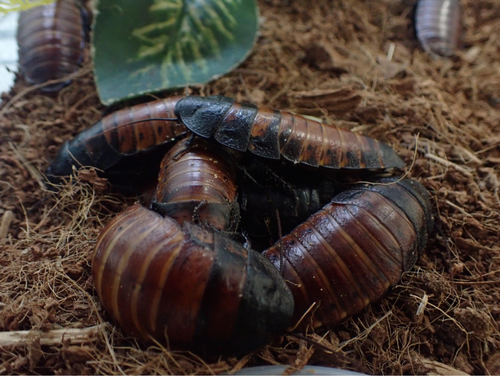
When the air around them turns desert dry, Madagascar hissing cockroaches do something surprisingly tender: they press their bodies together and ride out the stress as a crowd. In a new piece of research from Binghamton University, biologists show that these big, familiar classroom insects change how tightly they pack together depending on humidity, using their own bodies to build a tiny humid refuge when conditions get harsh.
In an observational study published October 30, 2025 in the journal Ethology, a team led by Binghamton University undergraduate Alison Kryger and assistant professor of biological sciences Lindsey Swierk exposed adult Madagascar hissing cockroaches (Gromphadorhina portentosa) to alternating “wet season” and “dry season” levels of relative humidity in the lab. Working with mixed sex groups of large, 5 to 8 centimeter long insects, they found that adults were significantly more likely to aggregate, and that a larger share of individuals took part in these clusters, when air was drier, a pattern that supports the idea that grouping up helps conserve water by creating a humid microenvironment.
How A Classroom Cockroach Becomes A Climate Story
Madagascar hissing cockroaches are a staple of science education, often handled by schoolchildren and used in demonstrations about insect behavior. Yet, as Swierk notes, basic pieces of their natural history are still being filled in, especially how these forest floor decomposers cope with the swings between Madagascar’s wet and dry seasons.
To mimic those seasonal extremes, the Binghamton team built a simple but clever experiment around humidity alone. They randomly assigned 32 adult cockroaches to eight groups of four and housed each group in its own tank. Every tank had the same setup, including substrate, shelters, food and water, and a consistent light cycle. What differed was the air.
For one week at a time, each group lived either in a “high humidity” tank, with relative humidity held between about 75 and 90 percent using terrarium humidifiers, or in a “low humidity” tank, where air hovered around 50 to 65 percent. After 72 hours of exposure to that week’s conditions, the researchers recorded whether any roaches were physically touching and what proportion of the group was in contact. Then they flipped the script the following week, so every group cycled through both high and low humidity conditions twice over four weeks.
Aggregation was defined very strictly: a cockroach counted as part of a cluster only when its body or a leg was in direct contact with another individual. Antennal brushes or brief leg taps did not qualify. This simple yes or no measure of touch, combined with the proportion of individuals involved, allowed the team to plug their data into generalized linear mixed models that tested whether humidity reliably shifted social behavior.
The pattern was clear. Under drier air, aggregations were more likely to appear at all, and when they did, a larger fraction of the tank’s inhabitants joined the huddle. Under wetter conditions, cockroaches were more often scattered, and groups that formed were smaller. Temperature, which was tracked alongside humidity, did not significantly explain any of these patterns, and the sex ratio of aggregations did not change with humidity either.
“The main takeaway from our study is that Madagascar hissing cockroaches actively adjust their social behavior based on humidity, showing that even large adult insects rely on behavioral plasticity to cope with environmental stressors,” explained Assistant Professor of Biological Sciences Lindsey Swierk. “The students’ research projects are generally outstanding, and many of these student groups are motivated to submit their research for publication following the end of the course.”
That phrase, “behavioral plasticity,” is at the heart of the story. Arthropods, from isopods to caterpillars, are known to form tighter aggregations under dry conditions, which slows water loss from their bodies and boosts survival. What has been less clear is whether similarly sized, adult insects that already have physiological defenses against drying also lean on social strategies when the air turns parched.
Madagascar hissing cockroaches have several physiological tools for enduring low humidity, including the ability to lower their metabolic and respiratory rates. But they cannot absorb water vapor from the air, and they lose moisture through their cuticle and respiratory openings. When they cluster, each animal’s evaporated water helps raise humidity in the tiny air layer between bodies, which in turn reduces further evaporation. The new results show that adults are not just benefitting passively from this effect; they are actively changing how close they sit to one another in response to humidity cues.
Drying Forests, Crowded Roaches, Shifting Ecosystems
Humidity in Madagascar is not just an abstract laboratory variable. Long term climate trends on the island have already lengthened and intensified dry seasons, with some regions now seeing relative humidity drop to very low levels, around 10 percent. For a forest floor insect that survives by recycling dead leaves and serving as prey for larger animals, that shift could matter at both the individual and ecosystem level.
As dry periods become more frequent or more extreme, the Binghamton team argues, Madagascar hissing cockroaches may be pushed to spend more time in tight clusters simply to conserve water. That behavioral adjustment, while adaptive in terms of moisture balance, could ripple outward. Time spent in dense groups could reduce time spent foraging, or change how individuals encounter mates and predators. Bigger clusters might also become more conspicuous to animals that eat cockroaches, while competition inside the cluster could change reproductive success, although those trade offs remain to be tested in this species.
“Because we now know that these cockroaches adjust their aggregation behavior in response to humidity, more frequent or extreme dry periods could push them to aggregate more often to conserve water, which could potentially affect their foraging, reproduction, or broader ecological roles as decomposers,” she said. “Our study suggests that such aggregation behavior under low humidity levels could more generally apply to larger insects, as well as small or larval insects, but of course this will also depend on species’ natural history and social behaviors.”
The work also reframes a familiar lab animal as a model for climate resilience. By showing that a large bodied insect commonly used in classrooms modulates a basic social behavior in response to an environmental stressor, the study links student led experiments to real questions about how biodiversity hotspots will cope with rapid environmental change.
For now, Kryger, Swierk and colleagues have provided a clear answer to a simple question: what do big cockroaches do when the air gets dry. They crowd closer, they build a moister bubble of air out of their own bodies, and they show that even hardy, armor plated decomposers may need flexible social strategies to survive in a warming, drying world.
Discover more from Wild Science
Subscribe to get the latest posts sent to your email.