
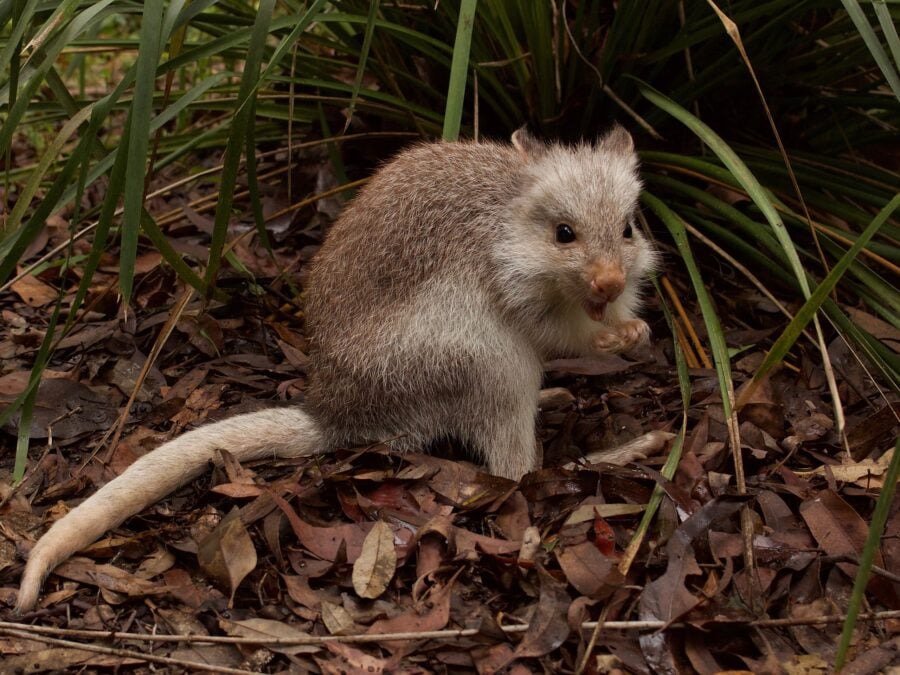
At mealtimes, rabbit sized Australian bettongs turn into nut cracking powerhouses that can splinter seeds tougher than popcorn kernels.
In new imaging analysis led by Flinders University and published in the Zoological Journal of the Linnean Society, researchers used 3D scans and geometric morphometrics of 161 skulls from all four living bettong species to uncover how two seed cracking species evolved very different jaw adaptations to bite through extraordinarily tough Santalum seeds, such as sandalwood and native peach (quandong). The work, led by PhD candidate Maddison C. Randall with senior author Professor Vera Weisbecker and colleagues across Australian museums, shows that extreme “hard bite” demands, rather than broad diet labels, dominate skull shape and could guide conservation and reintroduction plans for these threatened marsupials.
Bettongs are small, rabbit sized relatives of kangaroos that spend much of their time digging for soft, high nutrient foods such as underground fungi, roots and tubers. Yet two species, the burrowing bettong or boodie (Bettongia lesueur) and the brush tailed bettong or woylie (Bettongia penicillata), tackle a food item that pushes their anatomy to the limit. They routinely crack the thick, woody shells of Santalum seeds to reach the rich kernel inside, a feat that would overload the jaws of most animals their size.
Lab tests reveal just how extreme this challenge is. Quandong seed cases can be about 20 millimeters across and require at least 100 kilograms of direct force to break on testing equipment. For an animal weighing only around 2 kilograms with a skull barely 70 millimeters long, safely delivering that kind of bite force, and doing so repeatedly, demands either very efficient leverage, very robust bone, or both.
Field observations show that bettongs attack the problem with persistence and finesse. They clamp the seed between their large premolars, rotate it with their forelimbs, and bite again and again, as if propagating and monitoring tiny fractures in the shell until it finally gives way. This repetitive, high stress behavior is exactly the sort of performance extreme that, over evolutionary time, can reshape skulls.
Two Ways To Build A Nut Cracking Skull
The team used high resolution 3D scans of museum skulls, then mapped 147 anatomical landmarks on each cranium and analyzed shape using Procrustes based geometric morphometrics. Species identity explained more than a third of the variation in skull shape, far more than simple size effects. Crucially, the two Santalum eating species showed clear adaptations for hard biting, but they had not converged on the same solution.
“These seeds are extraordinarily tough, needing bite forces much higher than typical rabbit-sized animals can produce to crack them open.”
Randall and colleagues found that boodies, which live in arid zones and rely more heavily on mechanically resistant roots, seeds and browse, have short, robust faces with deeper cheekbones and enlarged ear regions. A shorter snout increases mechanical advantage, meaning more of the jaw muscle force is converted into bite force at the teeth. Finite element simulations from earlier work on the group show that this skull design delivers especially high bite efficiency.
Woylies, by contrast, have not shortened their faces. Instead, they have remodeled the business end of the bite. Their third upper premolar is shorter front to back but deeper, forming a more chisel like edge, and it sits farther back in the mouth where the jaw can transmit forces more safely. That change focuses the bite on a reinforced part of the jaw, allowing them to crack the same formidable seeds with a very different geometry.
“The boodie has a shorter face than the other species. This gives it more leverage, allowing harder biting. But the woylie doesn’t have a shorter face. It instead has a reinforced part of the skull where biting the seeds takes place.”
For skull evolution, this is a textbook example of “many to one mapping” at a fine taxonomic scale. Both species must solve the same biomechanical problem, but one improves the lever system as a whole, while the other fortifies and repositions the tooth that does the work. The remaining two bettong species, which do not crack Santalum seeds because their ranges do not overlap with these plants, lack these hard bite specializations and have longer faces and more blade like premolars.
The differences may also reflect competing demands. Woylies depend heavily on underground fungi, and bettongs likely locate truffles using smell. A longer snout can provide more internal surface area for olfactory tissue, potentially constraining how much the face can be shortened without sacrificing foraging performance. Boodies, which rely less on truffles, may be freer to evolve a shorter, more power optimized facial skeleton.
Jaw Superpowers, Plastic Skulls And Conservation Choices
All four bettong species are now threatened and occupy only a fraction of their former Australian range. At the same time, they are crucial ecosystem engineers: their digging and foraging turn over soil and leaf litter, improving soil health, water infiltration and seed germination. Understanding exactly what their jaw structures can and cannot handle is therefore more than an anatomical curiosity. It feeds directly into decisions about where and how to reintroduce them.
The new analysis underscores that Santalum seed availability, and in the case of woylies the abundance of underground fungi, may be key factors when evaluating release sites. Matching jaw adaptations to local food mechanics could mean the difference between animals that thrive and animals that scrape by on less suitable diets. The authors also highlight that captive diets can reshape skulls within a single species, as northern bettongs raised on soft captive foods diverged in cranial form from their wild counterparts.
This phenotypic plasticity cuts both ways. On one hand, it hints at a welcome capacity to adjust to changing diets, as bone is deposited in response to new loading patterns. On the other, it complicates taxonomic and ecological interpretations of skulls, especially in small, endangered populations where captive and wild histories may be mixed. It also warns that conservation breeding programs must pay close attention not only to calories and nutrients, but to the mechanical properties of the foods they provide.
Despite their shrinking numbers, bettongs remain a vivid example of how evolution and development can find multiple pathways to the same performance peak. Whether by shortening the face to crank up leverage or by reinforcing a single tooth and the bone beneath it, these tiny marsupials have turned their jaws into tools capable of breaking one of the toughest plant defenses in their environment. For conservationists, the message is clear. Saving bettongs requires thinking about their superpowered bites, the seeds and fungi that demand them, and the habitats where all three can still come together.
Zoological Journal of the Linnean Society: 10.1093/zoolinnean/zlaf158
Discover more from Wild Science
Subscribe to get the latest posts sent to your email.