

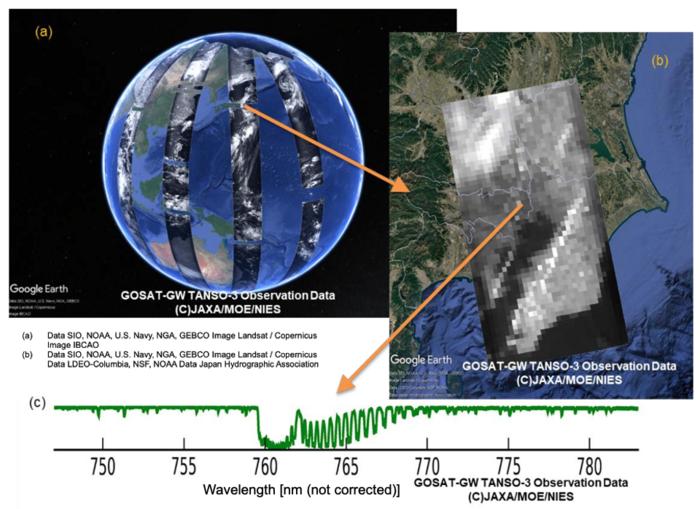
A powerful new eye in the sky has started watching Earth’s greenhouse gases. Japan’s Global Observing SATellite for Greenhouse gases and Water cycle (GOSAT-GW), also known as “IBUKI GW,” has delivered its first observations, confirming that its key instrument is functioning as designed.
The Total Anthropogenic and Natural emissions mapping SpectrOmeter-3 (TANSO-3) successfully captured global and regional measurements of carbon dioxide, methane, and nitrogen dioxide between July 14 and July 20, 2025. Developed by the Ministry of the Environment of Japan (MOE), the National Institute for Environmental Studies (NIES), and the Japan Aerospace Exploration Agency (JAXA), the satellite will soon begin providing high-frequency, high-resolution data critical for climate policy and research.
A New Era of Climate Observation
Launched on June 29, 2025, from Japan, GOSAT-GW is the latest in the GOSAT satellite series. These missions have long been central to monitoring global emissions, supporting both climate science and policy evaluation. TANSO-3 is unique in its ability to observe gases across the globe at high frequency and wide coverage while also zooming in on urban and regional hotspots with sharp resolution.
How TANSO-3 Works
TANSO-3 operates in two main modes:
- Wide Mode: Covers the entire globe within three days, with a swath width over 900 km and resolution of 10 km.
- Focus Mode: Targets cities and smaller regions with a swath width over 90 km and resolution as fine as 1–3 km.
For every observation pixel, the instrument collects spectral data, capturing how sunlight is absorbed by gases as it passes through the atmosphere. These absorption patterns reveal concentrations of key greenhouse gases.
First Observations Over Tokyo and Beyond
Early Wide Mode images captured vast swaths of Japan, from Kinki to Hokkaido, while Focus Mode zeroed in on Tokyo. The first datasets confirmed expected absorption signatures for nitrogen dioxide, oxygen, carbon dioxide, and methane. These results validated that TANSO-3 is performing within design expectations and will be able to support global emissions monitoring once calibration is complete later this year.
“The first observation operation of TANSO-3 successfully acquired spectral absorption data for carbon dioxide, methane, and nitrogen dioxide as planned, confirming that the observation functions of TANSO-3 are operating properly.”
Why It Matters
Atmospheric monitoring satellites like GOSAT-GW are essential for independent verification of national emissions, a priority under global climate agreements such as the Paris Agreement. With the ability to capture both broad global coverage and detailed urban hotspots, TANSO-3 bridges a crucial observational gap. Data from this mission will feed into climate models, improve predictions, and provide policymakers with accurate measurements to guide emissions reduction strategies.
Next Steps
Over the next three months, engineers will continue functional verification, followed by accuracy testing and calibration. If all goes to plan, GOSAT-GW will begin full-scale data delivery toward the end of 2025. The mission joins a growing fleet of space-based climate monitors, including NASA Earth Science satellites, ESA’s Copernicus program, and the earlier GOSAT missions.
With climate change accelerating, the satellite’s role will extend far beyond research, becoming a key tool for transparency and accountability in the global response to greenhouse gas emissions.