
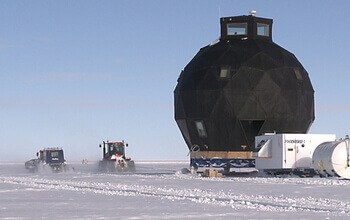
Successful world-class science sometimes requires moving metaphorical mountains. But the National Science Foundation (NSF) recently provided some of the machine muscle to literally move a 47-ton Danish research station across the Greenland ice sheet to the site of a new international deep ice drilling project, in what may be an unprecedented logistical feat.
A tracked vehicle used to support NSF’s Greenland Inland Traverse, or GrIT, was one of five tractors that towed the ski-equipped building 465 kilometers (288 miles) to the new site in East Greenland.
Over an eight-day period–from May 18 to 26–the East GReenland Ice core Project (EGRIP) dome and 11 sleds, with a total weight of 150 tons, were moved from the site of the North Greenland Eemian Ice Drilling project, an international effort in northwest Greenland, to the EGRIP site.
The EGRIP station is now located on the largest ice stream in Greenland to enable learning more about the flow of the ice stream and refine estimates of future sea-level rise.
NSF’s GrIT is a 1,400-mile round trip crossing from Thule Air Base in northwest Greenland to supply NSF’s Summit Station, which is situated at the peak of the Greenland ice sheet. It is a nearly two-month-long operation to transport thousands of pounds of equipment, fuel and supplies.
The ability to relocate the EGRIP station gives it a decided advantage in the harsh conditions atop the Northern Hemisphere’s largest ice sheet, where each year permanent structures are quickly buried under snowfall. The EGRIP buildings, mounted on skis, can be more easily extracted from the snow cover.
Denmark’s A.P. Moller Foundation and University of Copenhagen, Germany’s Alfred Wegener Institute, Norway’s Bjerkness Center and NSF all provided support to the project.
ScienceBlog.com has no paywalls, no sponsored content, and no agenda beyond getting the science right. Every story here is written to inform, not to impress an advertiser or push a point of view.
Good science journalism takes time — reading the papers, checking the claims, finding researchers who can put findings in context. We do that work because we think it matters.
If you find this site useful, consider supporting it with a donation. Even a few dollars a month helps keep the coverage independent and free for everyone.