

A water-rich visitor from the depths of space has emerged from a region of our galaxy never before seen up close, carrying what may be the oldest ice in the known universe.
The mysterious object, dubbed 3I/ATLAS, could be more than seven billion years old—predating our entire solar system by over three billion years, according to University of Oxford researchers.
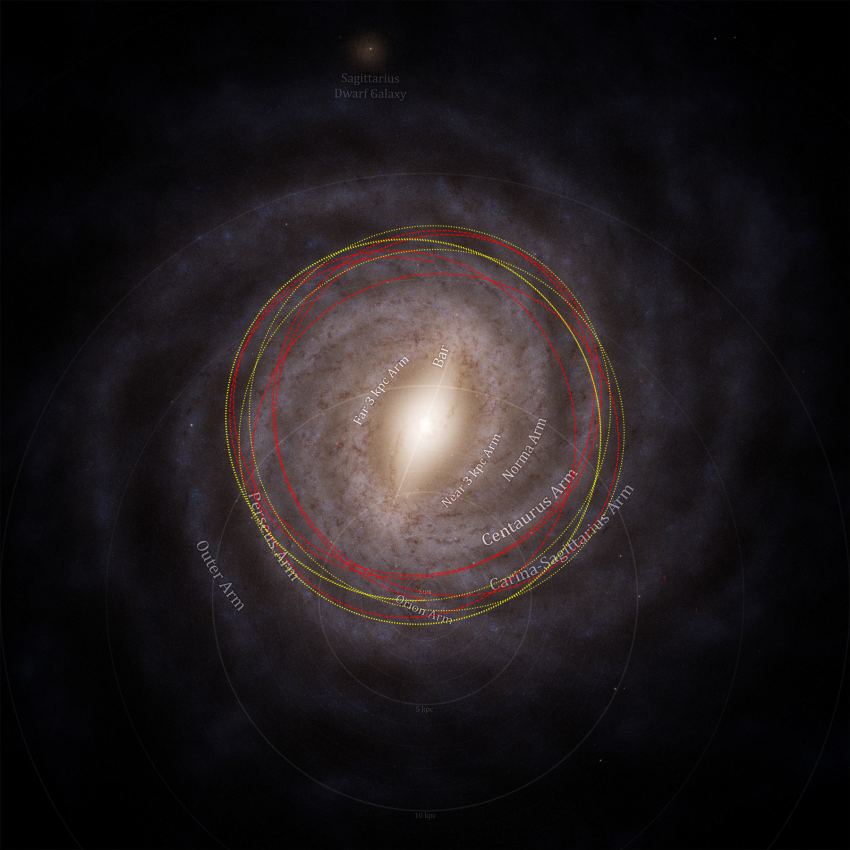
This marks only the third interstellar object ever detected entering our cosmic neighborhood, but unlike its predecessors, 3I/ATLAS appears to originate from the Milky Way’s ancient “thick disk”—a population of elderly stars orbiting far above and below the galactic plane where our Sun resides.
A Cosmic Time Capsule
Matthew Hopkins, the Oxford astronomer leading the research, had just defended his doctoral thesis when the discovery upended his planned vacation. “Rather than the quiet Wednesday I had planned, I woke up to messages like ‘3I!!!!!!!!!!’,” Hopkins recalls. The timing proved fortuitous—his newly completed model could immediately test predictions against real observations.
The ATLAS survey telescope in Chile first spotted the comet on July 1, 2025, when it was roughly 670 million kilometers from the Sun. Early analysis suggests 3I/ATLAS follows a steep trajectory through the galaxy, consistent with objects from the thick disk—a stellar population formed during the Milky Way’s tumultuous early history.
“All non-interstellar comets such as Halley’s comet formed with our solar system, so are up to 4.5 billion years old,” Hopkins explains. But interstellar visitors carry the potential for far greater antiquity, and statistical analysis suggests 3I/ATLAS represents the oldest comet humanity has encountered.
Galactic Archaeology in Action
The comet’s origin story reads like galactic archaeology. Hopkins’ team used correlations between stellar ages and velocities to estimate 3I/ATLAS’s likely birthplace and era. Objects from the thick disk typically formed when the galaxy was younger and more chaotic, around seven to fourteen billion years ago.
Key evidence supporting this ancient origin includes:
- Orbital trajectory: Steep path consistent with thick disk dynamics
- Velocity patterns: Vertical motion characteristic of ancient stellar populations
- Water ice composition: Expected from old, metal-poor star formation regions
- Size estimates: Possibly larger than previous interstellar visitors
Professor Chris Lintott, co-author and presenter of BBC’s The Sky at Night, emphasizes the significance: “This is an object from a part of the galaxy we’ve never seen up close before. We think there’s a two-thirds chance this comet is older than the solar system, and that it’s been drifting through interstellar space ever since.”
Testing Ancient Ice
As 3I/ATLAS approaches the Sun, solar heating will trigger cometary activity—the outgassing of vapor and dust that creates the characteristic glowing coma and tail. This process offers researchers a unique opportunity to analyze primordial materials that may predate Earth itself.
Co-author Dr. Michele Bannister of the University of Canterbury notes the anticipation: “The gases that may be seen in the future as 3I is heated by the Sun will test our model. Some of the biggest telescopes in the world are already observing this new interstellar object.”
The comet’s water-rich composition, predicted by Hopkins’ model, could provide insights into conditions during the galaxy’s youth. If confirmed, this ancient ice represents a direct sample from an era when the Milky Way was still forming its current structure.
Implications for Future Discoveries
The discovery carries broader significance for astronomy’s future. The team’s Ōtautahi–Oxford Model represents the first real-time application of predictive modeling to an interstellar comet, successfully anticipating properties before detailed observations.
Dr. Rosemary Dorsey of the University of Helsinki connects this to upcoming surveys: “The discovery of 3I suggests that prospects for Rubin may now be more optimistic.” The new Vera C. Rubin Observatory, beginning operations soon, could detect between five and fifty similar objects over the next decade.
For amateur astronomers, 3I/ATLAS should become visible through reasonably-sized telescopes in late 2025 and early 2026—offering a rare chance to observe material that may have witnessed the galaxy’s earliest epochs.
If 3I/ATLAS proves as ancient as predicted, it transforms from mere scientific curiosity into a messenger from the cosmos’s youth, carrying ice older than our world and stories from stellar nurseries that ceased operations billions of years before Earth formed.