

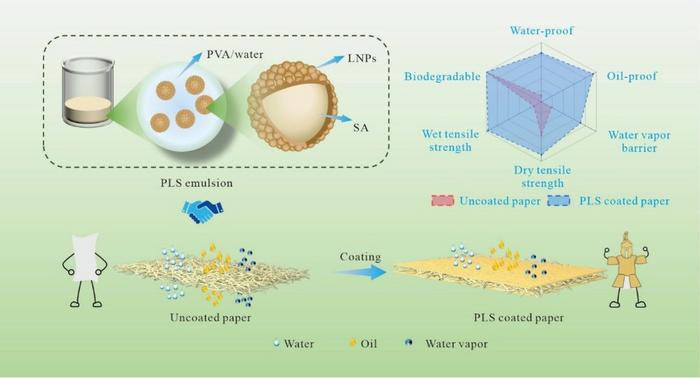
Water beads up on the paper surface, hovering like drops of mercury on glass. Oil slides off without leaving a trace. Yet plunge the same sheet into hot water during recycling and the coating simply vanishes, leaving clean fibres behind ready for their next life.
For decades, we’ve faced an impossible trade-off with paper packaging. Make it resistant to moisture and grease, and you typically ruin its recyclability. Coat it with polyethylene films or fluorinated chemicals, and you’ve essentially created a plastic-paper hybrid that contaminates recycling streams. But researchers at Northeast Forestry University in Harbin, China, reckon they’ve found a way out of this bind using an ingredient that sounds rather unpromising at first: lignin, the gnarly polymer that makes wood woody.
The breakthrough centres on what’s called a Pickering emulsion. Instead of using synthetic surfactants to stabilize oil droplets suspended in water, solid particles do the work. In this case, lignin nanoparticles prepared through solvent exchange position themselves at the oil-water interface, holding everything together. The emulsion contains polyvinyl alcohol in the water phase and stearic acid (a naturally derived fatty acid) as the oil phase.
When this mixture gets applied to paper, something interesting happens. The emulsion forms a continuous, compact layer that seals surface pores and creates what the team describes as a synergistic barrier. Water contact angles exceed 110 degrees. The Cobb 60 value stays below 18 grams per square metre. Oil resistance hits ratings above 9 out of 12 on the Kit scale. Those numbers put this coating in the same performance range as commercially used plastic-coated papers.
But here’s where it gets clever. Every component in the coating system serves a dual purpose: protection during use, clean removal during recycling. The polyvinyl alcohol builds a dense hydrogen-bonded network that reinforces the paper mechanically whilst contributing oil resistance. Stearic acid handles the water repellency. The lignin nanoparticles stabilize the whole structure without needing synthetic surfactants, which often muck up recycling.
During hot-water repulping, each component behaves differently but predictably. The polyvinyl alcohol dissolves. Stearic acid melts and disperses. Lignin nanoparticles release from the fibres. What you’re left with is clean cellulose that can be recycled without degrading quality. Most barrier coatings either contaminate recycling streams or require elaborate removal processes; the Chinese team’s approach builds recyclability into the material’s molecular architecture from the start.
The performance extends beyond laboratory tests, too. Packaging experiments with bayberries, grapes and cherry tomatoes showed the coating effectively reduces moisture loss by lowering water vapour transmission, which extends freshness compared with uncoated paper. When buried in soil, the coated paper degraded completely within roughly 120 days whilst polyethylene films showed no observable breakdown under identical conditions.
Yet this work arrives at a curious moment. Whilst researchers demonstrate increasingly sophisticated paper coatings, another line of inquiry examines how we might better use the very waste that generated the paper in the first place. A separate review published in the same journal explores converting waste lignocellulosic biomass (the plant material left after crops are harvested) into soil amendments that could address agriculture’s dual crisis of degraded soils and accumulating agricultural waste.
That review, authored by researchers at Nanjing Forestry University and King Saud University, notes that whilst the agronomic benefits of biomass-derived soil amendments are well established, the conversion technologies remain plagued by high energy requirements, low product stability and poor economic viability. Meta-analyses show these amendments can increase soil organic carbon stocks by 12 to 38 percent and boost crop yields by 9 to 11 percent on average. The challenge has shifted from proving these amendments work to developing cost-effective production methods.
The contrast is rather instructive. One team has solved a materials challenge by thinking carefully about end-of-life behaviour. The other highlights how even beneficial technologies struggle when production pathways consume more resources than they save. Both papers, published within days of each other, illustrate that sustainable materials science requires solving two problems simultaneously: making things work during their intended use and ensuring they behave well afterwards.
For the lignin-coated paper, commercial viability depends on factors the laboratory work cannot fully address. Lignin nanoparticle production needs simplification. Gas barrier properties require improvement for certain applications. Scale-up must prove economically competitive with established coating technologies. But the fundamental approach (designing materials where recyclability and performance emerge from the same molecular architecture) suggests a path forward for paper packaging in applications currently dominated by plastics.
As regulatory pressure and consumer demand continue driving the transition toward sustainable packaging, these multifunctional, recyclable coatings may enable paper to compete in markets where moisture and grease resistance have long been considered insurmountable barriers. The coating that vanishes in hot water might be exactly what’s needed to make paper packaging visible as a serious alternative to plastics.
Study link: https://www.sciencedirect.com/science/article/pii/S2369969826000022