

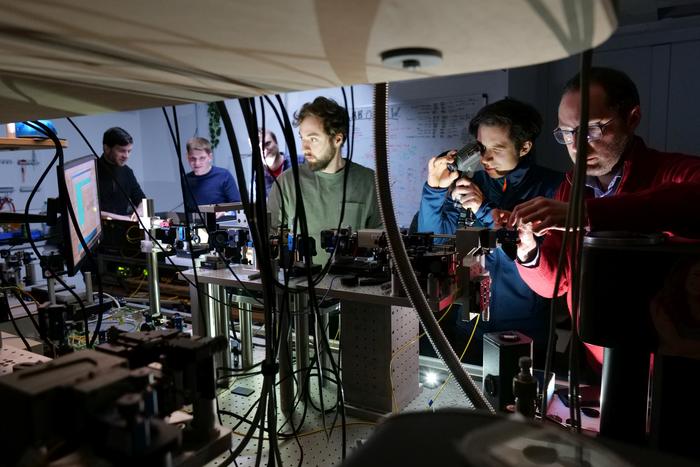
In a Stuttgart lab, physicists have “beamed” quantum information from one particle of light to another born in a completely different crystal, a key capability for building a future quantum internet that can resist even the most sophisticated hacks. The teleportation worked at telecommunication wavelengths that can travel through standard fiber networks, and it relied on semiconductor devices that can, in principle, be mass produced.
In an experimental study published on November 17, 2025 in Nature Communications, researchers from the University of Stuttgart, Saarland University, and the Leibniz Institute for Solid State and Materials Research in Dresden demonstrate telecom-wavelength quantum teleportation using photons from two remote semiconductor quantum dots. By combining entangled light, a specialized measurement called a Bell-state measurement, and polarization-preserving frequency conversion, they teleport the polarization state of one photon onto another with an average fidelity of 0.721, clearly above the classical limit of two thirds.
The work tackles one of the hardest hardware problems on the road to a quantum internet, the quantum repeater. Just as today’s optical repeaters refresh weak signals every few dozen kilometers in fiber, quantum repeaters will have to catch fragile quantum information before it is lost and recreate it further down the line, all without copying it in a way that destroys its quantum properties. That requires indistinguishable photons from distant sources, entanglement that survives long fibers, and devices that operate at the same telecom wavelengths used in global data networks.
Making Photons From Separate Sources Look Identical
Instead of working with idealized atoms in a vacuum, the team uses semiconductor quantum dots, nanometer sized “islands” in a crystal that behave like artificial atoms. Each dot has discrete energy levels, so when it is excited by a laser pulse it can emit single photons or entangled photon pairs with well defined properties. One quantum dot in the experiment acts as a single photon source, while a second dot acts as a source of polarization entangled photon pairs.
The challenge is that different quantum dots do not naturally emit photons at exactly the same color or with identical timing. For teleportation to work, two photons that meet in the Bell-state measurement have to be effectively indistinguishable. The researchers solve this by sending the relevant photons from both dots through polarization preserving quantum frequency converters based on lithium niobate waveguides. These devices shift the photons from their original near infrared wavelength of about 780 nanometers to a common telecom wavelength around 1515 nanometers, while preserving their polarization and quantum correlations.
After conversion, the team measures the spectral lines of the two quantum dots and shows that they now overlap closely, with only a small residual offset. Two photon interference tests in a fiber beamsplitter reveal that, with tight temporal post selection on a 70 picosecond time window, the interference visibility reaches 79 percent, high enough to support successful teleportation. Without this temporal filtering, the visibility drops to about 30 percent, limited by the natural cascade dynamics of the quantum dots and spectral broadening.
“For the first time worldwide, we have succeeded in transferring quantum information among photons originating from two different quantum dots,” says Prof. Peter Michler, head of the IHFG and deputy spokesperson for the Quantenrepeater.Net research project.
With the sources synchronized and matched in color, the actual teleportation protocol can run. One photon from the entangled pair stays at the “receiver” and is later analyzed. Its partner is sent into the Bell-state measurement along with the single photon whose polarization state is to be teleported. When the detectors in this measurement register a specific pattern of clicks, they herald that the two incoming photons have been projected into a particular entangled Bell state. Conditional on this herald, the polarization state initially prepared on the single photon has been transferred to the distant partner of the pair.
From Ten Meter Fibers To City Scale Quantum Links
To benchmark performance, the team prepares the input photon in three conjugate polarization states and reconstructs the teleported output state through full quantum state tomography. For the tightest temporal window, the average teleportation fidelity reaches 0.721, about 1.6 standard deviations above the classical threshold of 2/3. As the time window is widened to collect more events, both the two photon interference visibility and the teleportation fidelity gradually fall, eventually settling around 0.63, where residual noise and decoherence dominate.
In the current setup, the two quantum dots are connected by roughly 10 meters of optical fiber inside the laboratory, enough to demonstrate that teleportation between photons from distinct sources works at telecom wavelengths with realistic solid state hardware. Earlier work from the same group has already shown that entanglement from quantum dots can survive a 36 kilometer journey through the city center of Stuttgart, suggesting that the light itself can handle much longer paths in deployed fiber if the sources and converters are optimized.
The researchers are clear about the engineering still ahead. The success probability of teleportation is just above 70 percent, and the protocol relies on temporal post selection to reach high fidelities. Fluctuations in the quantum dots introduce small differences between photons, and conversion related noise can add unwanted background counts. Improving semiconductor fabrication, reducing spectral broadening, and boosting two photon interference visibility are all identified as key levers for future experiments and for practical quantum repeater nodes.
“Achieving this experiment has been a long-standing ambition, these results reflect years of scientific dedication and progress,” says Dr. Simone Luca Portalupi, group leader at the IHFG and one of the study coordinators. “It’s exciting to see how experiments focused on fundamental research are taking their first steps toward practical applications.”
For now, the teleportation distance is modest and the setup fills an optics table, but the ingredients are moving toward technologies that can plug into existing telecom infrastructure. Epitaxial quantum dots can be integrated in semiconductor chips, telecom wavelength photons are already the workhorse of global communications, and polarization preserving quantum frequency converters can be engineered into compact modules. As the Quantenrepeater.Net consortium and its partners refine these components, the kind of all photonic teleportation demonstrated here may become a standard operation inside future quantum repeater stations that quietly protect our data from eavesdropping attacks.