

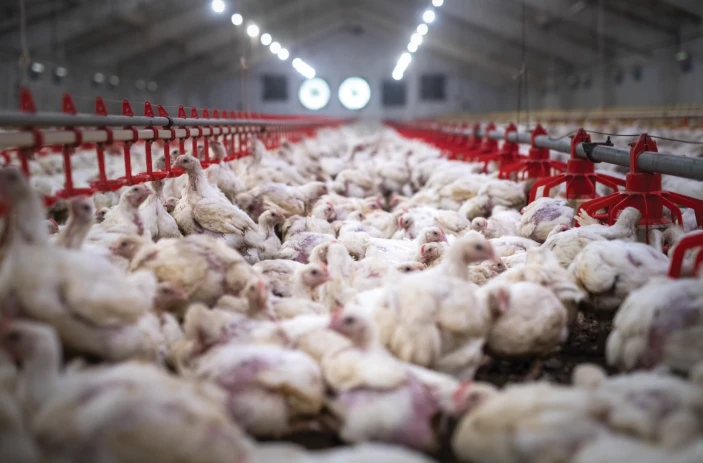
Preventing animal suffering may be one of the cheapest investments in the food system. A new study in Nature Food shows that adopting slower-growing chicken breeds under the European Chicken Commitment (ECC) could spare birds 15 to 100 hours of intense pain each, at a cost of just one dollar more per kilogram of meat.
Using carbon pricing as a benchmark, the researchers found that only US$0.00004 is needed to prevent an hour of pain, an amount smaller than a hundredth of a cent. The results challenge assumptions that higher-welfare chicken production is prohibitively expensive or environmentally unsustainable.
The Welfare Footprint Framework
The research, led by the Welfare Footprint Institute in collaboration with the Stockholm Environment Institute and the University of Colorado Boulder, applies a novel method called the Welfare Footprint Framework. Similar to a life-cycle analysis, it quantifies animal welfare in familiar terms: hours spent in pain or pleasure, across varying intensities. This makes animal welfare measurable alongside economic and environmental metrics, filling a gap in global food policy where farm animal well-being is typically absent from frameworks such as the United Nations Sustainable Development Goals.
“These are not abstract values. They allow us to put animal welfare on the same footing as other policy priorities,” said Dr. Kate Hartcher, Senior Researcher at the Welfare Footprint Institute and one of the study’s authors.
Intense Pain in Fast-Growing Breeds
Globally, more than 70 billion meat chickens are raised each year, making them the most numerous land vertebrates on Earth. Fast growth rates have been linked to widespread welfare problems including lameness, cardiovascular disease, heat stress, and chronic hunger. Parent birds, genetically selected for rapid weight gain but kept alive longer to produce chicks, must endure extreme feed restriction, resulting in thousands of hours of hunger-induced distress. As lead author Dr. Cynthia Schuck-Paim explains, “Few people are aware that the pain and distress behind chicken meat production begins even before a chick is born — with the life of their mother.”
Weighing Welfare Against Costs
One of the main objections to higher-welfare chicken systems is the added cost and carbon footprint. However, the study shows these burdens are remarkably small compared with the welfare benefits. Producing meat from slower-growing breeds may add up to 1 kilogram of CO₂ equivalent per kilogram of meat. At the European Union Emissions Trading System carbon price, that equates to about nine cents per kilogram. In contrast, the switch prevents at least 15 to 100 hours of disabling or excruciating pain per bird. Stated differently, each hour of intense pain avoided costs just US$0.00003–0.00005, far below other externalities routinely considered in sustainability debates.
- Slower-growing chickens prevent 15–100 hours of intense pain per bird.
- Cost: about US$1 more per kilogram of meat.
- Carbon trade-off: roughly 1 kilogram of CO₂ per kilogram of meat.
- Value of welfare: only US$0.00004 per hour of pain prevented.
Rethinking Food System Priorities
The authors argue that animal welfare should no longer be sidelined in sustainability assessments. While economic efficiency and environmental impact often dominate, the new framework shows how to integrate the lived experiences of animals directly into decision-making. For context, many public policies already weigh human health impacts through metrics like quality-adjusted life years. The Welfare Footprint Framework provides a parallel for nonhuman animals, using species-specific evidence to measure suffering and relief.
By quantifying animal welfare in common units, the framework opens the door for evidence-based reforms. It challenges the assumption that intensification and rapid growth are environmentally justified, given the scale of pain they impose relative to the small differences in carbon emissions. As the authors write in Nature Food, “For the carbon costs of the ECC switch to outweigh the animal-welfare gains, each hour of intense pain experienced by a chicken would need to be valued at only US$0.00003–0.00005.”
Looking Ahead
The findings may influence policy, corporate commitments, and consumer awareness. As pressure mounts to balance climate goals with ethical food production, this study suggests that preventing suffering in billions of chickens could be one of the cheapest welfare investments available. Much as carbon accounting has reshaped energy policy, welfare accounting could transform the way societies weigh the true costs of meat.
Journal: Nature Food. DOI: 10.1038/s43016-025-01213-z