

What if the very pollutants that make wastewater unusable could actually supercharge clean energy production? Scientists at RMIT University have turned this counterintuitive idea into reality, developing a system that harnesses heavy metals and other contaminants in wastewater to boost hydrogen fuel generation.
The approach flips conventional thinking on its head. Instead of expensive purification processes, the team’s electrodes actually capture platinum, chromium, nickel, and other metals from wastewater and put them to work as catalysts that speed up hydrogen production.
From Liability to Asset
“The advantage of our innovation over others to produce green hydrogen is that it harnesses wastewater’s inherent materials rather than requiring purified water or additional steps,” explained Associate Professor Nasir Mahmood, the study’s lead researcher.
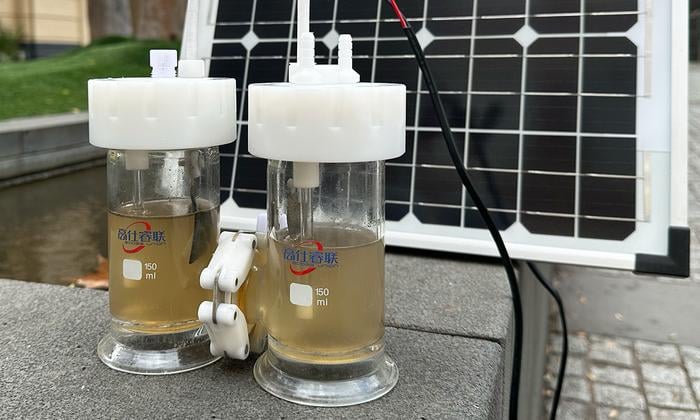
Their experimental setup resembles a sophisticated battery. Two electrodes—made with an absorbent carbon surface crafted from agricultural waste—sit in a container of partially treated wastewater. When renewable electricity flows through the system, it triggers a chemical reaction that splits water molecules into hydrogen and oxygen.
The magic happens at the molecular level. Metals naturally present in wastewater get attracted to the carbon electrode surface, where they form what researchers call “cocktail catalysts”—complex mixtures that prove remarkably efficient at conducting electricity and accelerating the water-splitting process.
Remarkable Performance Numbers
The results speak for themselves. During laboratory tests, the wastewater-based system demonstrated several key advantages over traditional methods:
- Superior high-current performance: At industrial-scale current densities (1000 mA/cm²), wastewater required significantly lower voltage than purified water
- Extended stability: The device operated continuously for 18 days with 95% efficiency maintained
- High energy conversion: Achieved approximately 89% Faradaic efficiency, meaning most electrical energy converted directly to hydrogen
- Outperformed precious metals: Surpassed platinum and iridium oxide catalysts, the current gold standard
What makes this particularly intriguing is the system’s initial behavior. At low current densities, purified water actually performed better. But as power increased to industrial levels, the wastewater system pulled ahead dramatically—exactly where commercial applications need peak performance.
The Chemistry Behind the Magic
The secret lies in synergistic effects between different contaminants. When nickel and iron work together, for instance, iron generates crucial oxygen radical intermediates while nickel catalyzes the final oxygen formation step. Meanwhile, chromium forms protective layers that enhance stability and prevent corrosion.
Fluoride compounds, typically considered pollutants, block unwanted side reactions due to fluorine’s extreme electronegativity. The researchers found these materials naturally deposit on electrode surfaces, creating what they describe as “high-entropy catalysts” with multiple active sites.
Perhaps most surprisingly, the contaminated water actually became more hydrophilic (water-loving) after treatment. A droplet of wastewater-based electrolyte disappeared within seconds on the treated electrode surface, compared to forming a 100-degree contact angle on conventional materials.
Global Water Crisis Solution
The timing couldn’t be more critical. With 380 billion cubic meters of municipal wastewater produced annually—80% discharged untreated—and hydrogen demand expected to reach 115 million tonnes by 2030, this technology addresses two massive challenges simultaneously.
Traditional electrolyzers require about 9 liters of purified water per kilogram of hydrogen produced. But freshwater scarcity affects regions supporting 20% of the global population. The wastewater alternative could prove especially valuable in water-stressed areas where conventional hydrogen production faces resource constraints.
Co-researcher Professor Nicky Eshtiaghi noted the broader implications: “Our innovation addresses both pollution reduction and water scarcity, benefiting the energy and water sectors. By using wastewater, the process helps reduce pollution and makes use of materials considered to be waste.”
The team tested their approach with two different wastewater sources to demonstrate versatility, and even powered the system with simulated solar energy to showcase renewable integration possibilities.
Next Steps Toward Commercialization
While promising, the research represents early-stage proof-of-concept work. Co-researcher Dr. Muhammad Haris emphasized that “further research was needed to refine the catalyst process, making it even more efficient and suitable for commercial use.”
The team is actively seeking industry partnerships to scale the technology. Their broader research platform includes innovations for removing microplastics from water using magnets and techniques for hydrogen production using seawater.
For regions where wastewater treatment costs strain municipal budgets, this approach offers a compelling value proposition: transform an environmental liability into a revenue-generating clean energy source. The researchers estimate that wastewater discharge volumes are roughly 3,000 times greater than what’s needed to meet global hydrogen production targets.
The study, published in ACS Electrochemistry, represents a significant step toward making green hydrogen production more accessible and sustainable—turning pollution into power, one molecule at a time.