

As I wrote last spring, we can efficiently test treatments for aging once we have an objective measure for the rate of aging. Without it, we’re left with the standard epidemiological model: treating thousands of people and waiting for a few of them to die. I have predicted that methylation-based aging clocks will turn a page in the history of epidemiology.
Six years ago, UCLA biostatistician Steve Horvath realized the potential value of an aging clock and set out to measure human age using methylation markers in DNA from across the body. He used statistical pattern-recognition software to look for relationships between a person’s age and the methylation state of his DNA. Methylation is the best-studied of the epigenetic markers that control which genes are turned on and off, and different sets of genes are active at different stages of life.

Age is an important predictor because the diseases that kill most of us all occur in a highly age-dependent way. In fact, the risks for cancer, heart disease, and Alzheimer’s disease all rise exponentially with age.
One statistical result from the original Horvath clock has a profound implication which aging researchers have been slow to take to heart: The Horvath clock was derived with statistical methods that looked only at chronological age. The algorithm was optimized to produce the best estimate of a person’s calendar age. Of course, age by the calendar is a good predictor of a person’s risk of death. In Americans over 40, the probability of death doubles every 8 years.
We should expect that since the Horvath clock is well-correlated to age and age is well-correlated to mortality, the Horvath clock should be correlated to mortality. (This isn’t guaranteed mathematically except when the two separate correlations are strong.) The interesting twist is this: The Horvath clock is more tightly correlated with mortality than age itself. The clock algorithm was derived from chronological age, so the math knows only about calendar years. But the clock algorithm predicts mortality better than age itself.
We can conclude that this extra accuracy of the methylation clock derives not from math but from biology. The message is that methylation is linked to the biological process of aging. Methylation changes don’t just happen over time; they are coupled to whatever it is that causes the risk of death to rise, linked, in other words, to aging itself.
With more recent developments in the clock, this conclusion gets stronger, and also stranger.
2017 The Zhang Clock
Yan Zhang of the German National Cancer Inst in Heidelberg has developed a methylation-based computation of mortality risk which is based on historic samples of blood from 406 people who died over a 15-year period and from 1,000 demographically-matched control.
They identify 58 sites that were tightly coupled to mortality. In 49 out of 58, less methylation was associated with a higher risk of death, and in the other 9, more methylation led to higher risk of death. (More methylation corresponds to less gene expression. The message is that increase in age-related mortality is due more to turning on genes that destroy us than to silencing genes that protect us.)
None (count ’em–zero!) of the 58 were incorporated in any of the previously published aging clocks (by Horvath and Hannum). What do we make of this? Age is associated with mortality more closely than any other biological indicator, and in fact mortality risk rises exponentially with age. And yet Zhang et al set out to look for methylation sites most closely associated with mortality risk, Horvath et al set out to look for methylation sites most closely associated with chronological age, and there was zero overlap between the sites they identified! In fact, less than half the sites they identified (23/58) had statistically significant correlations with age at all.
The recently established epigenetic clock (DNAm age) has received growing attention as an increasing number of studies have uncovered it to be a proxy of biological ageing and thus potentially providing a measure for assessing health and mortality. Intriguingly, we targeted mortality-related DNAm changes and did not find any overlap with previously established CpGs that are used to determine the DNAm age. [Zhang]
Part of the explanation may be that Zhang’s study was conducted in an older population (median age=62) at higher risk of death, and that the Horvath clock to which he compared it was designed to generally reflect age, from womb to tomb. Zhang says, “Methylation levels were measured on average 8.2 years before dying.”
Zhang’s mortality risk estimator is a count of how many of the 10 most telling methylation sites are in the “worst” quartile of his test population. (The “worst” quartile is the highest quartile for some and the lowest quartile for other sites.) A score of 5 corresponds to a 7-fold increase in mortality risk. This qualifies the Zhang score as one of the most powerful risk indicators that we have (don’t tell Aetna). For comparison, a BMI of 35 qualifies as “obese” and corresponds to a mortality risk ratio of only 1.36. Hemoglobin A1C, and HDL are common indicators of health status in older adults, and all of these have marginal associations with age-adjusted mortality. C-reactive protein and IL6 are blood markers of inflammation, and they were associated with risk ratios of 1.6 and 1.9, respectively [ref]. By this standard, the Zhang score is a big step forward.
Methylation is presumed to be under the body’s programmatic control. There are two reasons that methylation might be powerfully associated with mortality. First, some changes in methylation may be an indication of an acute response to some life-threatening stress; second, some changes in methylation may be part of an intrinsic death program associated with age. My guess is that there is some of each going on, but probably more of the former, since (as I said) only 23 of the 58 sites are significantly correlated with age.
Another curious fact: the methylation sites associated with smoking provided a better indicator mortality risk than was smoking itself. More about this below.
2018: The Levine Clock
Morgan Levine, working with Horvath at UCLA, developed a second-generation clock last year based on mortality and morbidity data as well as chronological age. The Levine clock was optimized with hindsight, factoring in age-related disease that occurred years after the blood was sampled.
Levine and her team worked in two stages. First, they developed a measure they call “phenotypic age” which includes age itself plus 9 modifiers that contribute to mortality risk.
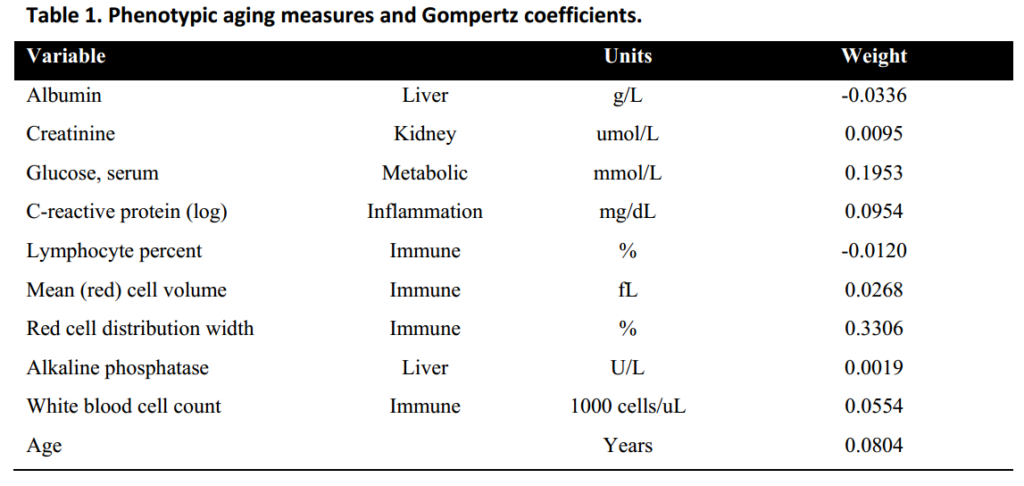
Albumin: dissolved proteins in the plasma, including hormones and other signal molecules.
Creatinine: this is a waste product cleared by the kidneys, thus a high value suggests kidney malfunction; but it can be confounded by exercise, which raises creatinine.
Glucose: blood sugar rises with Type 2 diabetes and loss of insulin sensitivity.
C-reactive protein: this is a measure of systemic inflammation.
Lymphocyte %: the most common types of white blood cells.
Mean red cell volume (MCV): the average size of red blood cells
Red cell distribution width (RDW): standard deviation of the above
Alkaline phosphatase (ALP): this is elevated in liver disease, including cancers and hepatitis.
White blood cell count: total white blood cells of all types
The list surprised me. This was not a popularity contest; it was developed from statistical association with mortality, with no prejudices up front. I was not surprised to see glucose and CRP in the list (though I would have thought they would substitute A1C for glucose, because A1C is more stable, while glucose varies from hour to hour). I would have thought to find HDL and IL-6 in the list, and I was particularly surprised to see the strongest weighting was Red cell distribution width, which I had not heard of. RDW is measured as the standard deviation in volume of individual red blood cells (erythrocytes). It turns out that small red blood cells are a symptom of diabetes, while high RDW scores are associated with cancer and heart disease. There’s a modest association between RDW and Alzheimer’s Dementia.
Also curious: total white blood cell count is positively associated with aging diseases, while lymphocytes, a subset of white blood cells, has a negative association. So, what are the white blood cells that are not lymphocytes? These comprise neutrophils, eosinophils, monocytes, and basophils. Large quantities of these are a warning of bad health to come. Neutrophils are the largest category among these, and they are part of the body’s innate defense against cancer and infections. Lymphocytes, on the other hand, comprise natural killer (NK) cells and T- and B-cells. NK cells are part of the innate immune system, while T-and B-cells are part of the adaptive immune system, but all of these are indicative of good health and long life.
All these components were put together by Levine et al to form their measure of phenotypic age. The team then went on to stage two, looking for methylation sites that correlate best with their newly-defined measure of phenotypic age. 513 sites were incorporated in their computation (see below). This can be confusing: PhenoAge is the measure derived from the above 9 blood tests + chronological age. DNAm PhenoAge is the methylation clock derived from the PhenoAge blood test.
The resulting PhenoAge methylation clock (DNAm PhenoAge) correlates only about 75% with chronological age (compared to 94% for the original Horvath clock). But DNAm PhenoAge predicts mortality and morbidity far better than either chronological age or the original Horvath clock. As you might expect, the methylation clock which was derived from the newly-invented PhenoAge measure does not predict mortality rates as well as PhenoAge itself, from which it was derived. This is expected because the DNAm PhenoAge clock is targeted directly to predict PhenoAge, and only indirectly to predict mortality. I am only making a point of this because the story is different and surprising in the case of the new GrimAge methylation clock–described next week.
Fifty sites vs Five Hundred
The first step in producing a clock is to produce a list of individual methylation sites in order of how tightly they correlate with age. If you construct a clock out of the first few, you get the best correlation and the most accurate measure of age. But the measure is fragile, and the accuracy may be illusory. When selecting a few items out of a list of hundreds of thousands, there will usually be accidents and outliers, statistical flukes. By including more sites assures that the overall age measure is not unduly affected by any one site, so if a few of the correlations turn out to be statistical errors, the overall average is still quite good. Horvath has generally chosen to be conservative and sacrifice some accuracy for robustness.
Next week, the new GrimAge clock…
Methylation measurements have provided the most accurate measure of age and prediction of age-related disease, head and shoulders above other measures. But can we do even better if we supplement methylation data with other things we know about a person–not just other blood tests, but life style factors. When I visited Horvath last summer, he introduced me to his post-doc Ake Lu, who was working on a composite clock, based on this thinking: methylation plus. That was the origin of the GrimAge clock.
Discussion
61 reader comments
Imported threads are marked Archive. New comments are welcome and moderated for spam.
I know it has been a while since this was posted. But I happened to notice that in Levine's calculations, the biggest influence is the chronological age of the person. In fact, for a 70 year old person, no reasonable combination of blood parameters can result in a "Biological Age" of 35 years. Assuming that new technology can actually rejuvenate a person to be much younger (I.e. Harold's & Akshay's elixir), Levine's method cannot possibly reflect that, because the chronological age component will not allow it.
Therefore, while Levine's method might be very good if no major advances take place, it would be useless for calculating the biological age of persons that managed to get substantially rejuvenated.
AFAIK there is a controversy on using age in the regression formulas as Levine's giving a mortality score (translated then to a "biological age") and different methods do not make use of it. Actually in Levine's Phenotypic Age formula RDW (Red cells Distribution Width) features the highest weight between the 9 blood biomarkers and higher than age (0.3306 vs 0.0804): https://doi.org/10.1371/journal.pmed.1002718 and doi: 10.18632/aging.101414
Fully stand with you in that I guess a good MD looks at the patient rather than the lab. But then you have a precision medicine and preventative approaches (take precision nutrition too) which would need encompassing composite biomarkers panels assessing biological aging and tracking health status validated longitudinally on morbidity and mortality. Before your patient starts to feel and look better you would need a guide to check if what you are doing is right and you would need to factor in time: as in disease appearance you have signs, symptoms and the clinical manifestation you might have in health a similar path which would need to be measured. I guess aging is a continuum as well as its delaying or reversal - meaning improving healthspan and possibly (I am confused on this!) lifespan.
Sorry .. this was in following to Paul Rivas's comment of February 11, 2020 at 8:42
..
Still reading a bit on RDW (Red cell Distribution Width) and its relatively high weight (not standardized though, as discussed) in the Levine's Phenotypic Age clock. I pop into this N=240477 subjects, generally healthier than other population, followed for 9 years. The study assessed prospectively the associations between RDW and common conditions.The results might explain the importance of RDW for the phenotypic age and the possible use in the clinic to assess individual wellness.
https://journals.plos.org/plosone/article?id=10.1371/journal.pone.0203504
Strangely my lab does not provide RDW but does provide MCV (Mean Cell Volume) which is related by definition (RDW=(Standard deviation of MCV / MCV) x 100), any clue?
Albedo
Do you have any theory as to why the RDW would be such a good prognosticator?
Not really but recollected reading that oxidative stress and inflammation might determine RDW (Red blood cell distribution width) value. Also, intuitively, as it is by definition a standard deviation in the MCV (mean corpuscular volume, also red blood) distribution, its not a big surprise you have an increasing with age as age increase heterogeneity of biological age predictors (but the prediction value decreases). Maybe also disentangling RDW and MCV age dependencies is not trivial as MCV also increases with age.
https://doi.org/10.1515/cclm.2011.831
https://doi.org/10.1016/j.ebiom.2017.03.046
Good points Albedo, but I’d be willing to bet that the answers to just two questions would be as reliable in terms of prognosis as anything else.
1. How old do you feel?
2. How fast do you walk?
Absolutely Paul, agree on that, can also add: a good MD can just (3) look at your face and tell a lot about your BA. But I guess also a lot depends on the granularity you want to have and the application, e.g. the 3 points alone might not suffice for a mechanistic analysis of drug impact and effectiveness in rejuvenation. We need more for that and more comprehensiveness and integration, right? And first you need to test on animal models if that BA captures aging well enough i guess.
Fully agree Paul, we need to be careful we don't try to achieve good biomarkers over real results. Otherwise we'll be like the patient given drugs that can clear amyloid beta but still leave you with Alzheimer's.
Ps RDW and MCV are probably both related measures of bone marrow cell senescence/hypertrophy.
The paper "Excessive Cell Growth Causes Cytoplasm Dilution And Contributes to Senescence" (Cell VOLUME 176, ISSUE 5, P1083-1097.E18, FEBRUARY 21, 2019) might offer some insights on why Red Cell Distribution Width has such a big weight in the Levine Clock and why it strongly predicts poor outcomes.
NIce article.
How about that lunch dateJosh?
#MAGA
Read it and Weep
Long Live Longevity
https://inference-review.com/article/long-live-longevity
Currently IPSC reprogramming is the only method to turn back the epigentic clock of a cell.
This study has found that in mice iPSC derived cells are safe to transplant.
(iPSC cells themselves cause teratomas when transplanted).
I think this is very good news for cell based regenerative therapy.
Theranostics. 2019; 9(1): 290–310.
Published online 2019 Jan 1. doi: 10.7150/thno.28671
PMCID: PMC6332789
PMID: 30662568
Direct in vivo application of induced pluripotent stem cells is feasible and can be safe
They don't even have to be iPSC derived cells according to the paper; so long as iPSCs are disseminated below a given concentration, no terratomas formed - and therapeutic benefit was had even at low concentrations.
https://www.ncbi.nlm.nih.gov/pmc/articles/PMC2798760/#!po=2.50000
Blood donation increases RDW -more donations lead to higher RDW
Hb, MCH and MCW all decrease with increased donations (male at least)
How does this factor with the blood based clocks?
Might donation (as suggested) have a role depending on your numbers...
The high weight of RDW in Levine's Phenotypic Age clock formula has impact on the biological age (BA) calculation.
Just for curiosity, I simulated a 5% increase of RDW on my data which alone generates an equivalent 5% increase of BA.
A 5% decrease in MCV alone decreases BA of 3%.
When combined the effects of increased RDW and decreased MCV compensate (BA increases of only 2.2%).
MCH and Hg are not included in the 9 Levine's clock biomarkers.
Idiot layman here: What are: RDW, MCV, MCH?
Would you mind sharing a few pointers for the rest of us (non-biochemists)? ;-)
Thanks in advance.
RDW (red cell distribution width) and MCV (mean corpuscular volume) are two geometrical factors: MCV is the average volume of red blood cells and RDW is the ratio between the standard deviation of the MCV distribution and MCV.
Thanks for that albedo - and MCH?
Okay I think I get it - RDW relates to the z-score MCV? I take it we are talking a 1.0 stdev?
MCH (mean corpuscular hemoglobin) is the average content of hemoglobin in red blood cells. Wrt your RDW comment and the 1-SD, I think you are right if I recollect correctly but I am not a biochemist or hematologist either ... ;-)
Seems like we need a clock for each of the 7 (or 9) kinds of ageing. Then we would know the effect(s) of each intervention.
Very good point. 'Aging is just a word we use to summarize a whole host of physical deteriorations.
I did a DNAage test about 6 months ago and the results said I was 5 years "older" then my chronological age. This is a very strange result and is >3 sigma out. I'm in my late 50's. I have a BMI of 22.9, an ideal hip to weight ratio, BP 106/65, RHR 47, just had a normal EKG and all my blood/urine work was normal. According to my bloodwork and the new study on firefighters-pushups-mortality, I have a very low risk of CHD. (easily do >40 pushups) . I am fit for my age and can outride many half my age on a bike. People say I I look younger than my age. My Aging.AI 3.0 estimated I was 6 years younger than my chronological age. I did have cancer (testicular) 30 years ago but caught it early and never did chemo or radiation. I'm not sure what the Horvath test is measuring but I hope it's not predictive of morbidity.
Be this as it may, it's probably best if you settle your affairs asap and prepare for departure of this mortal coil. Because DNAage says so! ;-)
Now seriously, Larry's report kind of makes my point (posted above) in that I expect Horwath's model to be flawed as it is most likely based on evaluating alpha factors via a multiple regression model. Which isn't a bad thing IF you can establish that each dependent value correlates with your independent value in a linear fashion.
Would you explain these statistical points further, please?
I thought I already did. You can find it a bit higher in this thread (under my name).
Just want to point to this paper for discussion:
https://www.escardio.org/The-ESC/Press-Office/Press-releases/What-s-age-got-to-do-with-it
That was a strange coincidence Stephen as I was just going to post that very study.
I recall doing exercise stress tests on multiple patients back in the late 80’s and a study came out showing that if the patient just gets through the entirety of the test that their odds of a cardiac event over the next ten years was close to zero. This was more predictive than the actual ST- T changes that we were looking for on the test. So fitness was more predictable than even evidence of cardiac ischemia on the Monitor.
So the evidence that fitness predicts longevity is hardly a surprise.
I’m not sure what to make of an increased MCV since this almost always indicates folate or B12 deficiency. Insulin levels are more important than spot checked glucose level. Alk phos is a very sensitive, but non specific lab result that can originate from liver or bone . Doesn’t usually mean much unless it’s sky high. low white blood cell counts do seem to correlated with lower mortality rates but I wouldn’t necessarily want a high lymphocyte count.
For now I’ll take fitness, normal body weight, and low inflammation until all of this gets sorted out.
From everything I've read fitness doesn't make you biologically younger, so it must be more to do with robustness - ability to resist stress from degrading your health in some way.
Youth is more to do with resilience; the ability to bounce back from damage (rather than resist it happening in the first place).
What I'm wondering is whether the various methylation tests are giving accurate enough additional information to make them worthwhile at this point. Let's consider rapamycin. It would be nice to have a fairly simple test to help guide me in my search for the ideal dose. I notice that over time the benefits seem to lessen. I feel a decrease in stamina and my weight starts to climb back up.
When I up the dose I very quickly notice more stamina, weight loss,and I just generally look and feel younger. I also notice that if I combine it with some other supplements that I can augment the effects.
Are these subjective findings not good enough? BTW it also lowers my insulin and WBC counts. Suppose one of the methylation tests tells me that I'm actually aging rapidly despite such subjective improvements. Will I believe it? Or conversely, maybe it will just tell me what I already know.
Yes, I expect that for the individual, blood markers and subjective feeling is probably still superior - the value of this test however is that it might identify some common aging biomarkers to simplify the process of assessing aging en masse. I've not seen any sign of it doing this so far, however, but maybe Grimage will change this.
@Mark
According to my own experience it does, but I'm not a scientist.
Here is a research paper that might prove my assumption:
https://www.nzherald.co.nz/lifestyle/news/article.cfm?c_id=6&objectid=12166478
That's a good point, Paul. Statisticians work with linear variables because it simplifies the math. But the fact that low WBC count is a bad sign doesn't mean "the higher the better". Maybe for the next generation of clock, Horvath can be convinced to introduce non-linearities.
The effect of aerobic exercise on mortality appears to be U-shaped.
https://www.ncbi.nlm.nih.gov/pubmed/25660917
Just a month ago, famous Danish marathon runner Henrik Joergenen died of a heart failure at the age of 57.
As part of his training schedule, he typically ran somewhere between 150-220 miles pr. week at his VO2Max
I agree Ole, I knew a few runners in my life who died of heart failure.
The problem with many runners is they become addicted, they just over do it.
If someone, like me, is over 60 resistance exercise is more beneficial then aerobic exercise.
My exercise regime consists of 80% strength training and 20% cardio.
I am not a scientist or doctor but this just seems like common sense to me. Your heart only has so many heartbeats it can deliver during its lifetime - entropy is real. Of course NOT exercising isn't an option as that produces unwanted physiological changes that can lead to premature death. But excessive use of the muscle in charge of pumping blood through one's body just doesn't seem like a good idea to me.
One theme all gerontological research seem to have in common is that of moderation. Drink a tiny bit of wine here and there, maybe good for you. Too much - bad for you and you'll kill your liver (among other things - alcohol turns into sugar which switches you into glucogenic mode). Fasten regularly - good for you. Fasten too much and you'll lose too much calcium in your bones and muscle mass (terrible post 50 and difficult to gain back).
Same with exercise. I actually work out pretty vigorously but I've always been like that and know my body enjoys it. Had to reduce it by about 20% though after I turned 50. Finding the sweet spot is the key and I'm pretty sure your body will tell you.
If you feel refreshed and fit after working out then you're in the zone. If you're exhausted and drained afterwards then that's a warning sign. Everyone is different but I'm sure we all know how far we can push ourselves. For example I recently had a difficult dental nerve infection that took us over a month to sort out. I had to deal with a lot of pain and unfortunately had to resort to ibuprofen here and there.
The gym absolutely sucked during that time and my metabolism actually slowed down. At best I was operating at 60% and that's not me - I've always been Mr. Energy. After the dental issue was sorted I actually took a few doses of quercetin as I was sure that I had accumulated quite a bit of inflammation and senescent cells were signaling all over the place ;-)
Anyway, I think Stephan nailed it: 80% strength training and 20% cardio (which can also be accomplished by super setting strength training and ground acrobatics - not everyone loves to run - I'm one of those). IMO that ratio is the sweet spot for us longevity aficionados.
If you are running long distances consistently, you would almost invariably doing most of the running at a steady pace. Steady pace = steady heart beat = reducing heart beat variability - a sure sign of aging.
I wrote about this.
https://broadspeculations.com/2013/08/18/wave-theory/
That link doesn't work.
I am not sure what you mean by "invariable pace". Most world class runners do run at many different paces. Lydiard training, which led to the LSD (low slow distance) movement, actually only used long slow distance as a build up to a tuning phase that included intervals and hill workouts.
Here's the link that appeared in the email that for me doesn't work in the browser.
https://www.researchgate.net/publication/26374608_Effects_of_aerobic_training_on_heart_rate
One question is whether too much aerobic exercise can be bad. There seems little doubt that some aerobic exercise is positive for health and longevity but the study cited seems to suggest there a sweet spot around 150 minutes a week and benefits might diminish after that.
Another question is whether the aerobic exercise is best done at steady consistent rate or at varying rates. Anyone logging 150-200 miles a week (more than a marathon a day) has to be running almost entirely at a steady consistent rate because throwing intervals and faster work into the mix wouldn't allow the volume to be maintained.
Lower HR variability is associated with higher mortality and also over-training. A question would be whether high volume runners are chronically over-trained. Another would be whether high volume steady state running actually is training for lower HR variability. I don't know if either of these questions have been studied but either one might explain the higher mortality in the higher volume aerobic exercisers.
This makes me feel better:
"Still, the only living person to get a GrimAge reading so far is Horvath himself. He had fared pretty poorly on his pan-tissue clock — “I want to say I was four or five years older than expected; I didn’t like that” — but according to GrimAge, he’s on track to die more or less when he expected"
.https://onezero.medium.com/a-new-test-predicts-when-youll-die-give-or-take-a-few-years-2d08147c8ea6
I am convinced that 20 years from now dating profiles, resumes, bios, etc. will have an additional field called epiAge. Which will increasingly replace chronological age as a yard stick for measuring a person's position on the grand entropic scale.
The social implications of course are staggering and books have already been written about this. The First Immortal by Halpering was not the first actually and I remember back in the 20th century reading a collection of very clever short stories on that topic. Unfortunately I don't recall the title but each story covered the ensuing social change from a different angle.
"Although the algorithms used to generate the clocks selectonly relatively few CpG sites, the methylation changes thatform the basis of the clock are many and widely distributed.Mammalian genomes appear to contain tens of thousands ofcandidate clock CpGs whose methylation status tracks chrono-logical age (Hannum et al., 2013; Wang et al., 2017). Humanclock sites that are syntenic in the mouse measured mouseage comparably to a random selection of sites (Stubbs et al.,2017), both with a mean absolute error of only about 11 weeks.This supports the idea that epigenetic clocks are not based ona small number of loci that are conserved between human andmouse; instead, potential clock CpGs appear to be abundantin both species. These numerous clock CpGs do not appear tolocalize exclusively to any particular genomic feature, and theyare not obviously excluded from regulatory regions."
DNA Methylation Clocks in Aging: Categories, Causes, and Consequences, September 2018Molecular cell 71(6):882-895
Macrophages are said to lose their ability to clear senescent cells and just hang around indefinitely in tissues, causing inflammation and allowing SC's to accumulate. This was the finding of the Zhukov lab a couple years ago.
This could explain the positive association of an increase in non-lymphocytes white blood cell count and mortality.
More generally, I wish it was easier to associate particular CpG sites and gene expression. Also, their role in wider molecular pathways. I recall Steve Horvath saying this was the problem that 'plagued' most epigenetic studies. Otherwise, although still useful, it is very hard to tell whether DNAm changes are a cause or an effect of ageing.
I wonder why this is so difficult. I would think that individual CpG sites mostly affect the down and up regulation of genes immediately downstream. I know that gene expression can sometimes be affected by other parts of the genome many base pairs away, but I was under the impression this was not the most common scenario.
In any case, many thanks Josh for bringing up the Zhang and Levine clocks as I was not aware of them. I am happy to say it is becoming hard to keep track of all the available ones. I am tempted to start building a table with each.
This is the greatest frustration with all these methylation studies: we know they are correlated with aging, but we don't know if they are casual because we don't know what genes are up or down regulated.
It might, if I was to play devil's advocate for a minute, merely be that all the really important methylation sites are maintained (more or less) by the epigenetic machinery, and what we are measuring are all the sites that don't matter, so are not maintained. So we might all live for 500 years in this scenario and be pheno-identical to a 25 year old, but still be identifiable through methylation as the age we really are.
I think the methylation changes are robust but stochastic processes.
Hypermethylation is probably linked to repressive histone modifications like H3K27 methyltransferases. Both G9a and PRC2 histone methyltransferase complexes contain DNA methyltransferase subunits. So its probably just a matter of time before these heterochromatine histone marks gets sealed permanently with DNA methylation. The sites that are usually are repressed with histone modifications are the sites that are rarely used by the cell.
Also DNA demethylation is a stochastic process driven by oxidation of 5 methylcytosine to 5 hydroxymethylcytosine. In the lack of proper de novo DNA methylation maintainance these sites slowly lose their methylation status
All this points into the direction of sinking signal to loss ratio in the expression profile of cells.
I would guess the efectors of aging are not genes but various non coding elements that gets transcribed wildly as we age. This burdens the cell metabolism and signal transduction. Also hypermethylation might decrease the cells response to rare, not occasional events, such as reaction to injury, damage, infection, etc. That would explain why hormesis works.
That's a nice analysis GaborB and I think you're probably right - a stochastic, reliable clock that gradually reduces the plasticity of cells and their ability to respond to different conditions. I wonder if the various non coding regions are all about isoforms - alternative splicing has been implicated in aging.
Yes I think there are many ways the sequences, that are usually repressed permenantly in young cels by DNA methylation, can harm you. Alternative splicing, repression by ncRNA, mobile genetic elements, etc.