

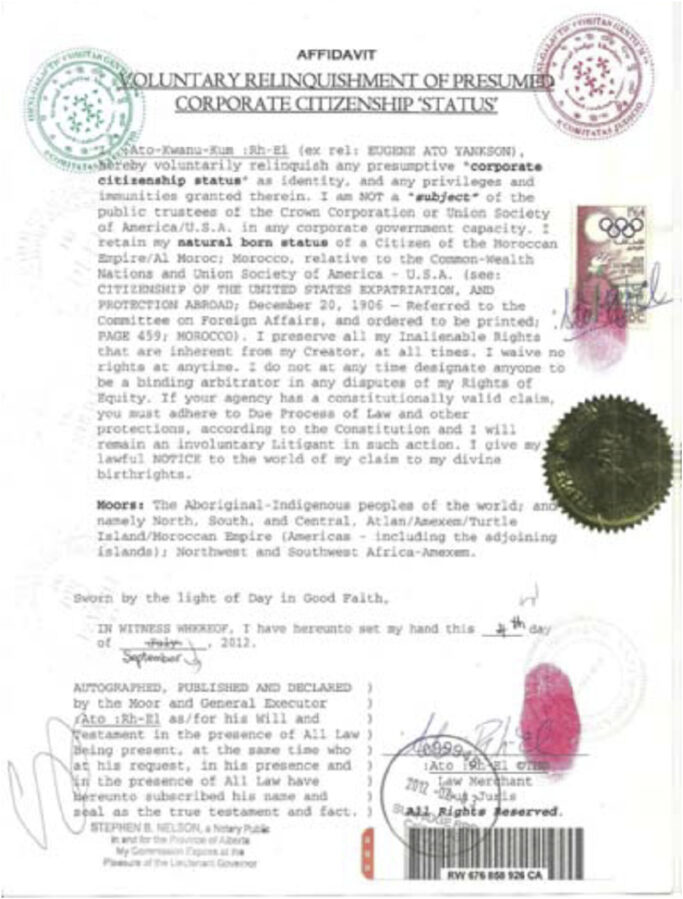
It looks like theatre, but it is no joke. A new study from the University of South Australia warns that pseudolaw, false legal theories wrapped in ceremonial rituals and archaic language, is now overwhelming courts and threatening democracy. Writing in the Alternative Law Journal, Associate Professor Joe McIntyre documents how pseudolaw, once fringe, is now a daily occurrence in Australian courtrooms. Its rise, amplified by generative AI, risks creating a feedback loop of misinformation that undermines justice and erodes trust in legal institutions.
What Is Pseudolaw?
Pseudolaw refers to arguments that mimic the form of legal reasoning while lacking substance. Adherents, often tied to the Sovereign Citizen movement, claim immunity from the law as “natural persons,” argue that courts lack authority if the wrong coat of arms is displayed, or accuse judges of treason. These claims have no legal validity, yet they proliferate because they look and sound authentic to outsiders alienated from the legal system.
Examples range from pandemic-era mask resisters citing the Magna Carta to motorists filing pseudo-legal challenges against traffic fines. Judges across Australia now report hundreds of such cases each month, each one consuming far more resources than typical litigation.
The Role Of Generative AI
McIntyre highlights a worrying new twist: litigants are increasingly using large language models to generate pseudolegal documents and even live courtroom submissions. These outputs often resemble genuine legal texts but are filled with hallucinations or meaningless jargon. Like pseudolaw itself, generative AI produces “the illusion of meaning” without substance, a similarity McIntyre calls deeply alarming.
“At its heart, pseudolaw mistakes the form of legal argument for its substance. It uses archaic language, ceremonial rituals and legal-sounding jargon to create the illusion of meaning.” — Joe McIntyre, Alternative Law Journal
Why People Believe
Theatricality is a defining feature of pseudolaw. Documents stamped with symbols and fingerprints, delivered with confidence and ritual, appear persuasive to non-experts. Scholars argue that pseudolaw flourishes in systems already heavy with archaic language, where alienated citizens cannot easily distinguish real law from mimicry. For some, pseudolaw offers empowerment through rituals that invert traditional power structures, much like magical thinking.
Implications For Courts
Judges describe pseudolaw as a major disruption to the administration of justice, forcing staff to process endless frivolous filings and clogging registries. The Australian case Rossiter v Adelaide City Council called pseudolaw “legal nonsense” and “an unnecessary waste of scarce public and judicial resources.” Similar warnings have been raised internationally, with sovereign citizen-style movements active in Canada, the United States, Germany, and the United Kingdom.
McIntyre stresses that mocking pseudolaw is counterproductive. Instead, responses must account for the genuine belief many litigants hold. Tailored approaches are needed for different adherents, from naïve newcomers to mercenary gurus. Above all, the problem reflects decades of declining investment in legal literacy and access to justice.
Key Findings
- Sample: Hundreds of pseudolaw cases documented in Australian courts, especially New South Wales, within six months.
- Source: Associate Professor Joe McIntyre, University of South Australia, analysis published in Alternative Law Journal.
- Phenomenon: Pseudolaw mimics legal form with no substance, including claims of “natural person” immunity and invalid state authority.
- AI Factor: Generative AI increasingly used to create pseudolegal submissions, amplifying misinformation.
- Impact: Judges report pseudolaw has changed “the whole face of the civil justice system,” wasting resources and delaying real cases.
- Consequence: Undermines trust in institutions, threatens judicial officers, and misleads vulnerable litigants.
Takeaway
Pseudolaw is not harmless courtroom comedy. It drains resources, spreads misinformation, and undermines democratic trust. As generative AI accelerates its spread, scholars and judges warn that only investment in legal literacy and systemic reforms can prevent it from becoming an existential threat to justice.
Journal: Alternative Law Journal
DOI: 10.1177/1037969X251362538