

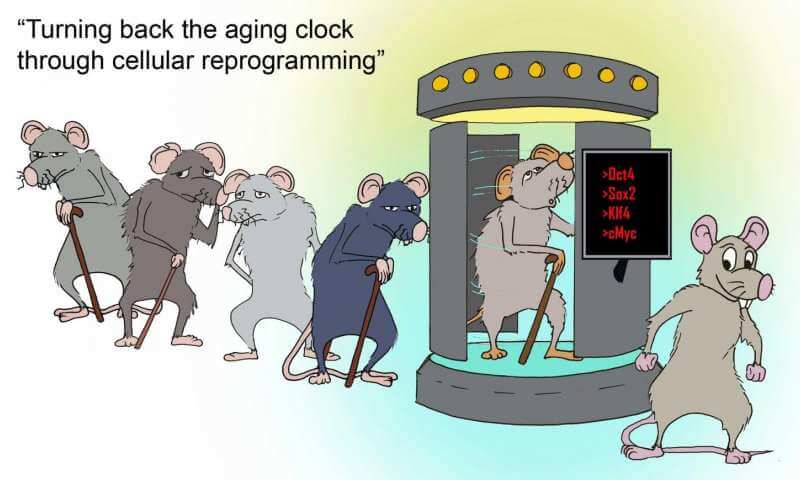
(without going all the way back to the womb, or causing cancer)
In a column last month, I posed the question whether the methylation clocks of Horvath are drivers of aging or responses to aging. If we intervene so as to set back the clock, are we signaling the body to be younger, or are we shutting down the repair mechanisms that the body has engaged in response to the damage of aging?
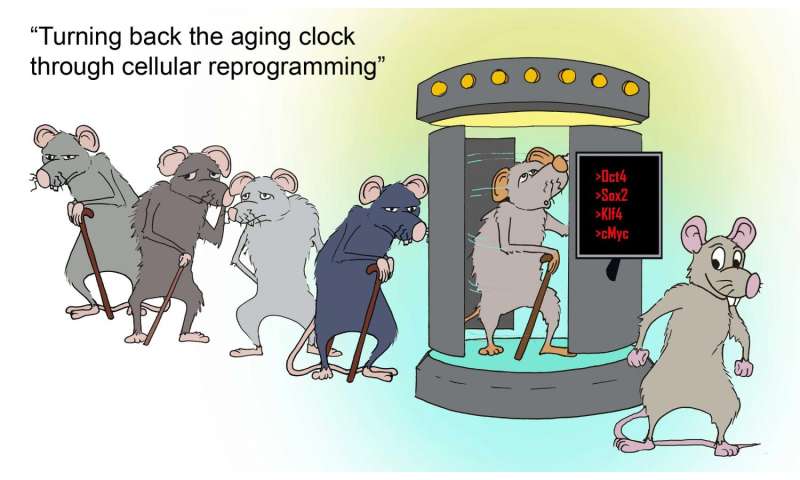
There’s a preprint from David Sinclair’s Harvard laboratory, posted on BioRxiv but not yet published, with very encouraging news for those of us who think that resetting the epigenetic (methylation) clock is a path to anti-aging. They suggest that 3 of the 4 Yamanaka factors, administered in short pulses, can set back the Horvath methylation clock without turning functioning tissues back into stem cells. The same study offers evidence to support the hypothesis that the epigenetic clock is a lethal driver of aging, rather than an adaptive response to damage.
Sinclair opens the paper with an un-footnoted statement that aging consists in accumulated damage, as if this is uncontested and incontrovertible. He refers to the straight-line methylation changes that happen predictably and consistently with age as “epigenetic drift”, as if these changes were random. He believes that they are ‘loss of information” when these changes show every sign of being predictable and directed.
In the standard evolutionary paradigm, the mouse is evolved to live as long as possible, all other things being equal. (To be explicit: I don’t believe this; I think the mouse is evolved for a lifespan optimized to its ecology, not longer or shorter.) If you believe this standard paradigm, then why doesn’t the old mouse reset its epigenetic clock without our having to do it for him? In Sinclair’s account, the mouse has lost information, and can’t do it. But the Yamanaka factors are all in the mouse genome, and if that is all the information the mouse needs, we have to ask why the mouse needs us to send the signals.
We wondered whether mammalian cells might retain a faithful copy of epigenetic information from earlier in life, analogous to Shannon’s “observer” system in Information Theory, essentially a back-up copy of the original signal to allow for its reconstitution at the receiving end if information is lost or noise is introduced during transmission17.
It’s cute that Sinclair invokes Claude Shannon’s foundational theory from the 1930s on transmission errors and signal correction. But is it relevant? The reason that Sinclair and many others assume the information (how to be a young mouse) is lost is that they believe that evolution has motivated the mouse to stay young and keep making babies if only it could. If the information isn’t lost, doesn’t that defeat the very premise of Sinclair’s “lost information” theory of aging?
The point is that Sinclair is a superb experimentalist. He is also realistic enough to accept the overwhelming evidence that aging is an epigenetic program, and that the best way to influence it is to reset our epigenetics. But he is still mired in the old theory that denies it is possible for an aging program to evolve, so his efforts to frame his work in the context of “lost information” and “random drift” are strained to say the least.
Now that I’ve got that off my chest, let’s get on to the substance of this new finding, and the carefully-designed experiments that support these findings. He and co-authors demonstrate that mice treated with OSK (the first 3 out of the 4 Yamanaka factors OSKM) have restored capacity to regenerate damaged nerve cells, a capacity which is normally lost early in life. They go on to show that OSK isn’t directly responsible for regenerative capacity. And they demonstrate that resetting the methylation pattern on the mouse DNA is necessary for the restoration.
Specifically, they engineer mice with a cellular switch that can turn on OSK in response to a applied antibiotics. They flip the switch in the eyes only, then crush the optic nerve to see if it grows back. Normally, a mouse is able to regenerate nerves only while it is in early stages of development.
Yes, the nerves grow back if the eyes are pre-treated with pulsed OSK. And the benefit is lost in the absence of methyl transferase enzymes. This last result was part of the experiment in order to demonstrate that the mechanism for restoration involves re-programming methylation patterns on the chromosomes.

Questions not addressed yet
I’m inclined to interpret this article as much for what it doesn’t report as for what it does.
In the main experiment, OSK was induced just in the eyes, so it was just the eyes that were rejuvenated. But they also report a “safety” test done, in which OSK was induced in the whole body at a low level for an entire year without toxic effects. Of course, it’s nice to know that the low-dose OSK was not toxic and that cancer risk did not increase. But did the mice benefit from the whole-body treatment? Did they show any signs of rejuvenation, or of enhanced stem cell function?
There is a Horvath methylation clock for mice. Did the mice get younger according to the Horvath clock? The authors report that damaging the retinal nerve made the nerve cells older according to the methylation clock, and that the application of OSK brought the cells back. But I don’t see anywhere in the paper a measurement of the eye’s methylation age before and after the OSK treatment, independent of injury. For that matter, there is no discussion of the methylation age of the mice treated with whole-body OSK for a year. These omissions are curious. Are they suspicious? Have they tried and failed to set back the methylation clock, and they don’t want to report it? Certainly it’s a question I would ask if I were reviewing this ms. Maybe we’ll know the answer when the paper is published.
Did mice live longer after treatment with OSK? Answering this one takes time, and perhaps the Sinclair lab has mice even now that are living longer, but it will be a few years before we know. Or perhaps the treatment has failed so far to extend lifespan, and Sinclair is reluctant to report a failure.
Discussion
102 reader comments
Imported threads are marked Archive. New comments are welcome and moderated for spam.
NR shown to slow retinal degeneration in mice:
https://www.biorxiv.org/content/biorxiv/early/2019/12/06/866798.full.pdf
Scientists from Institut Pasteur and CNRS demonstrated that progressive depletion of a protein drives proliferating cells into irreversible ageing. Moreover, such a depletion is a very early trigger, and therefore a determinant of cellular ageing, or senescence.
This factor, called CSB is involved in Cockayne syndrome, a disease affecting about one in every 200,000 people in European countries. The absence of CSB protein or its dysfunction causes early ageing, photosensitivity, progressive neurological disorders and intellectual deficit in patients with Cockayne syndrome. "We had previously shown that the absence or impairment of CSB is also responsible for dysfunction of mitochondria, the power plant of cells" says Dr. Miria Ricchetti, head of the team Stability of Nuclear and Mitochondrial DNA within the Stem Cells and Development Unit at the Institut Pasteur. "This new study reveals the very same alterations in replicative senescence, a process strictly linked to physiological ageing" say Dr. Ricchetti.
The importance of the present discovery is that it shows that a factor that was considered to be stable in normal cells is instead progressively depleted when they proliferate. When this happens, the cell is irreparably committed to the dead end of senescence.
The exhaustion of CSB is driven by epigenetic modifications (reversible and regulated modifications of gene expression, without altering the DNA) that block its expression at the DNA level. Moreover, a molecule previously identified by these researchers as being able to reverse the defects of Cockayne syndrome patient cells, is also able to attenuate the commitment of normal cells to senescence.
"These studies demonstrate an important link between the [pathological] accelerated ageing process and normal aging, and also expose the CSB protein as a key factor against cellular ageing" concludes Dr. Ricchetti.
Story Source:
Materials provided by Institut Pasteur. Note: Content may be edited for style and length.
Journal Reference:
Clément Crochemore, Cristina Fernández-Molina, Benjamin Montagne, Audrey Salles, Miria Ricchetti. CSB promoter downregulation via histone H3 hypoacetylation is an early determinant of replicative senescence. Nature Communications, 2019; 10 (1) DOI: 10.1038/s41467-019-13314-y
Late Life Metformin Shortens Lifespan
That means hormesis doesnt work in old age - can be lethal.
https://www.biorxiv.org/content/10.1101/863357v1
Highlights
Late life metformin treatment limits cell survival and shortens lifespan.
Metformin exacerbates aging-associated mitochondrial dysfunction causing fatal ATP exhaustion.
Old cells fail to upregulate glycolysis as a compensatory response to metformin.
The dietary restriction (DR) mimetic response to metformin is abrogated in old animals.
PKA and not AMPK pathway instigates the early life DR response to metformin.
Stabilization of cellular ATP levels alleviates late life metformin toxicity in vitro and in vivo.
That does makes sense. You also wouldn’t but an older person suffering from sarcopenia on a reduced calorie diet or intermittent fasting.
CR is likely beneficial because of freeing amino acids from the muscle for oxidative defenses (not just organelle recycling). In the case of an old, wasted person I think you'd actually want to use cysteine+glycine to control oxidative stress and inflammation, and cautiously use more anabolic aminos and resistance exercise to build muscle and an amino acid reserve.
There's only so much blood you can ring out of a stone.
An interesting study Akshay, and one that supports yours and Sinclair's position that ageing is caused by epigenetic changes, in what might otherwise be healthy cells. Something does spring to mind however. They stipulate the senescence effect of CSB downregulation is telomere independent, and given its location near a centromere on a long arm of chromosome 10, I may be inclined to believe it. But why then do immortalised cells not senesce via this mechanism? Or even conditionally immortalised cells using ROCK inhibitors? In these circumstances there must be an overriding epigenetic signal from the (long enough) telomere that inhibits p21. Could you overcome this with enough oxidative stress? Of course. But then that's not relevant to human ageing. So we have the problem of too many variables in a dynamic system to know what is causal.
Noticing that CSB downregulation is caused by acetylation removal, and your reference also to Metformin/hormesis not being beneficial at old ages, are you suggesting that sirtuins might be harmful if they accidentally deacetylate an active gene?
On the subject of what makes the epigenetic clock tick upstream, I think we haven't discussed here a very recent pre-print in which David Sinclair participated and that found a link between DNA double strand breaks and epigenetic alterations.
Steve Hill did a very good summary over at https://www.leafscience.org/dna-damage-leads-to-epigenetic-alterations/.
I wonder if both studies were connected in linking damage to epigenetic ageing, with one leading to the other.
Myself, I suppose I am still reluctant to view eAge a result of a metabolic process because this rate must be rather close in most species or even cells types, but the rates of ageing are very different even between species of the same class. That's why I always harp about telomeres and cell proliferation, because I view them as a more likely candidate to the rate of ageing.
But if DBS are one, or the main driver, of DNAm age it would fit the observations so far in non-proliferating tissues and as a result of different types of damage.
I'm in the process of reading Sinclair's book. Whilst it is interesting, and he and I agree on many things, he has yet to completely convince me of his 'information theory of aging'. It is obvious that gene expression changes are occuring with age, and that this is driving pathology. But he is fuzzy on how random DNA damage leads to epigenetic dysregulation, beyond using up NAD+ and distracting sirtuins. He also has not (as far as I've read) explained how what should be a random process of demethylation could lead to such a non random downregulation of various cellular defenses. He also assumes such epigenetic changes are upstream of things like telomere attrition, when it is clear the reverse is certainly true (as well). Finally, making a mouse with lots of DSB and seeing it ages faster doesn't to my mind prove the point he is trying to make. There are many models of aging. We need more before we can say this is the 'true' one.
Sinclair is primarily coming from a yeast aging point of view. Yeast are weird. They can extend telomeres - but at the cost of genomic instability. Or allow telomeres to erode and suffer from cellular senescence. Not the same situation in humans at all.
After 7 years of trying to understand the aging process I have come to the conclusion that it is the result of several intracellular and extracellular processes that are not evolutionary economical to repair. Just because we know that a few hundred cells out of 1e14 or 1e15 cells of the organism get the chance to completely rejuvenate - under very specific circumstances - it very likely does not mean that there exists a built in cellular process to rejuvenate a whole body.
As there are publications that extracellular signalling from surrounding aging tissue retards stem cell function, there might be some limited scope in finding a pharmaceutical solution to slow down aging and get 80 or 90 in healthy aging.
But eventually a solution must be found to create a large number of safe, healthy autologous young cells probably ex vivo - this is almost done - and get them to replace old crappy cells in the living tissue. The latter is a far shot at the moment I think.
I think the simplest explanation to DNA methylation changes is that it is damage which is evolutionary uneconomical to repair.
It may result from intracellular or extracellular stress but must likely it is just the result of competing DNA methylases and histone methylases of the large methyltransferase complexes like PRC2. When a PRC2 complex builds up near promoter it wants to methylate the histones but sometimes a DNMT molecule binds to the complex and the DNA is methylated instead, which is harder to reverse. So the only thing that drives these changes is the number of PRC bindings which may be roughly linear with time.
Thats why DNA methylation is such a good proxy for aging.
Sinclair can speed this process up by breaking the DNA which in turn dissociates and reassociates PRC2 and the likes to DNA - more opportunities to drive the clock.
Also intracellular or extracellular stress may make the DNMT more active and pushing the process in the direction of more DNA methylation.
Characterization of Skin Aging–Associated Secreted Proteins (SAASP)
Produced by Dermal Fibroblasts Isolated from Intrinsically Aged Human Skin
According to the publication above there is NO telomere shortening in primary dermal fibroblast cells from age 20-70
Thanks for your insights GaborB. I agree with many of them.
Regarding the telomere paper, I will read it with interest. Clearly though, fibroblasts will shorten their telomeres between the fetus and an adult. I can believe that they remain largely static in an adult, however. Nevertheless we cannot rule out their ageing being a consequence of telomere shortening in other cell types they are dependent on. On the other hand skin ageing has alot to with oxidative stress induced senescence, which then causes arrest of undamaged cells through SASP. This probably involved telomere damage but not necessarily shortening.
Regarding the paper, which I have now read, there is nothing too surprising there. They took fibroblasts from under womens' breasts, so it's not surprising they didn't need to turnover much during a normal lifetime (little to no sun exposure). But they did adapt to the wider systemic influences of the ageing body (I surmise) and change their own secretory phenotype to become more inflammatory.
It is just SO hard, and takes so much energy to battle entropy. Just look at my kids' bedrooms! I'd have to be on it constantly to keep them well ordered. You can see why ageing is the norm and not the exception in nature.
there is an even better article I recently found:
Senescent human melanocytes drive skin ageing via paracrine telomere dysfunction
its available on researchgate.
this is about the epidermis. the epidermis consists of a few (10%) melanocytes, the rest are keratinocytes. the melanocytes are long living, the keratinocytes are quickly turning over.
what they found was that telomere shortening was not characteristic of either cell populations. however the long lived melanocytes exhibited internal stress signalling (p16) and also exhibited "dysfnuctional telomeres" in an age dependent manner. the senescent melanocytes also secreted molecules that caused damage in the fast dividing keratinocytes. the researchers were able to rescue keratinocytes with senolytic treatment against the melanocytes.
this is a new paradigm for me. cell division makes the cell younger. because all the DNA scaffolding is reorganized and replenished and so do the cellular organnelles. structural damage cannot accumulate in fast dividing cells. however the opposite is true for the long living cells.
nevertheless it may happen that fast dividing cells also degrade in quality with time, they just dont sit idle for a long time so that the rot becomes visible.
Yes it is like bacteria, so long as they can divide they can overcome a build up of damage. Potentially animals that continue to grow may benefit from some of this mechanism. With dividing cells, their ageing is not so dissimilar - as telomeres shorten division slows and some of the same problems ensue, even without reaching replicative arrest.
I've read that paper before, very interesting that melanocytes are the culprit (at least in their skin model). Skin is an interesting case. Here the ageing is driven via UV on melanocytes. Suppressing oxidative stress should also work, which is probably why people have positive things to say about methylene blue and mitoQ skin creams.
Thoughts on berberine?
https://onlinelibrary.wiley.com/doi/full/10.1111/acel.13060
Surprising result. Berberine stripped the weight off me like nothing else I've tried. I wouldn't go near it again for that reason. Lab mice just seem like a mess metabolically.
Hi Mark - weight loss could be good. any idea what % yours was for fat and muscle. how did you dose? did you have any benefits with exercise parameters. maybe best to take intermittently. in above mentioned study was very benefical for mice - "The oral administration of BBR in mice resulted in significantly improved health span, fur density, and behavioral activity." Thanks
Has this type of problem reported by others?
I actually take berberine for a few years but did not see any substantial weight reduction.
I started off relatively lean and it made me substantially more so, even to the extent of neighbours not immediately recognising me because of the thinness of my face. I've no doubt it made me look older.
On the bright side, I didnt lose any strength (I didn't gain any either) at the gym during this period (a year or so of one capsule a day).
For me it was an effective weight loss supplement, which would be helpful for those who need to lose weight. I did also exercise fairly intensely (as I always do), but the berberine was the decisive factor in my weight loss.
from Robert Kane Pappas
Sinclair Interview Excerpts
YouTube
https://youtu.be/uA9z8K5snOk
Josh. I posted a 7 minute excerpt from my July Sinclair video interview on your post last month. In the 90 minute interview, I returned to the question of "Is aging programmed" at least 5 times, kind of pestering him with it. He responded at one point that we are speaking about word definitions. I think, importantly, you two actually agree on the process, the differences may not actually matter in terms of the remedy. I will post another excerpt where I ask him this.
A German review came out last week that cited your 2005 work:
"Dissecting Aging and Senescence-Current Concepts and Open Lessons"
https://www.mdpi.com/2073-4409/8/11/1446
Looking it over as work allows.
The reviewers' position on your 2005 paper that was incorporated into Figure 2 was:
“In our view, recent evidence that senescence is based on an unterminated developmental growth program and the finding that the concept of post-mitotic senescence requires the activation of expansion, or ‘growth’ factors as a second hit, favor the assumption that aging underlies a grating of genetic determination similarly to what is summarized above under the pseudo-programmed causative approach.”
epigenetic manipulations (rejuvanating the methylation pattern and so on) or elongating abnormaly the lenght of telomeres only show that researchers completely ignore the reasons why we age.
We age basically because our telomeres shorten from an ideal lenght pattern. year after years the total double helix DNA lenght (forget the chromosones here) wrapped around the histones shorten and must after each division rearrange itself with another shape and lenght. That fact impede the DNA to transmit by torsion fields correct (youthfull epigenetic) informations from cells to cells. When informations are incorrectly transmitted diseases and cancers occurs because amongst other stem cells divide the wrong way.
The telomere shortening and the consequent change in the hologram of magnetic field generated by the cells DNA cause a decayed state of cells functions (for the worse). The telomere shortening rate is one way for the cell assembly (the body) to measure the time elapsing. The speed of attrition is an indication of the speed of aging. Of course everybody speak of cells communication, vibrations, scalar waves, magnetic torsion field, you name it.
Pseudoscience?
First take a look at the unified field theory based on electric and magnetic fields which do not contradict these cells communications trough DNA.
.
But what do you think now if these cells communication fields could be indirectly observed in a labo experimentation? So far that is possible but only in case of METAMORPHOSIS.
TUFT university made in 2012 amongst other a strange observation they did not understand. A CCD camera was filming a FROG larvae. The larvae eventually transformed itself into a tadpole. The epigenetic pattern in the DNA of a larvae and the one of a tadpole are of course very different altough the cells remain the same initial material to turn one body into the other.So the genetic material had to wrap itself differently in order to express other genes.
They saw that the CCD camera altough the object fimed was still a larvae showed a kind of visual holiogram (visible for a CCD camera in the IR range but not to the researchers eyes) representing already the tasdpole boundaries (including mouth and eyes) This hologram superposed itself to the material larvae.
What did happen? The magnetic hologram (made of magnetic vortices emitted by the DNA) decayed locally by emitting bio-photon (it must be a very sensible camera however) in the IR range that the camera was able to make a picture of . So this magnetic hologram normally invisible gave these astonishing picture of the epigenetic generated tadpole at a time when this tadpole did not yet exist by cellular topological moves. This magnetic hologram was of course the 3D blue-print and the energy source in order for the cells to migrate and divide further in order to create the new life form.
That sounds like an interesting hypothesis, but then how to address it? You say this process is driven by telomere shortening, but this doesn’t seem like a clear enough driver, nor does it explain why short lived species like mice have longer telomeres than other long lived ones. While short telomeres are important, they certainly don’t seem to be what is DRIVING the pathology of aging. Besides, stem cells seem to be quite capable of producing telomerase when needed, and to begin proliferating and replacing senescent cells when provided the right signaling via plasma. Certainly the electrical field aspect needs to be investigated further. As Josh has mentioned on occasion, the role of electric fields has been a neglected area in the study of longevity and tissue growth and homeostasis.
What Ive heard is that mice have far faster telomere shortening. Such that they need those very long telomeres. Ive not verified but some commenters have said they too experience telomere shortening due to the fast rate of telomere shortening
https://www.ncbi.nlm.nih.gov/pubmed/31285335
Telomere shortening rate predicts species life span. Blasco, 2019.
Excellent paper from Blasco. Wish we had done this at Shay-Wright.
Thanks for posting.
A new study looks at reprogramming from a different angle by not using Oct4.
"Excluding Oct4 from Yamanaka Cocktail Unleashes the Developmental Potential of iPSCs"
https://www.sciencedirect.com/science/article/pii/S1934590919304230
Very promising research. I think they should also test the SKM cells as MLL-AF4 induced hematopoietec progenitors. Here traditional iPSC fail spectacularly compared to ESCs because leukemic transformation is very likely with iPSC but not with ESCs.
Hi Josh - Can you expand on your comment: "But he is still mired in the old theory that denies it is possible for an aging program to evolve, so his efforts to frame his work in the context of “lost information” and “random drift” are strained to say the least." How are you thinking about the aging program evolving to be reflected in changes to the epigenetic clock? It's something you obviously feel strongly about and I want to be sure I understand where you are going with this. GREAT BLOG!
I don't see why both paradigms need be mutually exclusive.
Josh,
Have you seen the work of Andrei Gudkov? He and his group are researching Line1 elements in DNA as the clock and driver of aging.
Line1 are retroviral elements in DNA which alter and lengthen the genome over time. They are looking at a sort of anti-retroviral in combination with a TLR5 agonist.
https://www.youtube.com/watch?v=C-yMNXEqfJ0&t=1527s
https://www.youtube.com/watch?v=JIyoABgkm-w
Very interesting research from Andrei Gudkov. His hypothesis that line 1 DNA retrovirus are the clock and the cause of aging as usual are derived from experiments with diseased radiated mice .Mice are unlike man as they experience a huge telomere shortening rate which means a fast rate of disorganization in the instructions given to the cells as per the hypothesis of the electro-magnetic DNA bio-field model.
This Andrei hypothesis should be challenged by observing if these same line 1 DNA retrovirus negative postulated effects are also found in species (like the LOBSTER, hyppocampus…. ) where the telomeres are not shortening when time passes and the tissues and organs remain astonishingly young as reported so far.
The electro-magnetic DNA expression model point to other reasons why these retrovirus like portions are active in the whole DNA. Like for the dogs species where Andrei mention they are useful for ( survival and ) evolution of species. Did he investigate by which mechanism the memory of the picture of a life-threatening environnement (electric shocks in a certain ground configuration) is transmitted genetically to the off-springs (and consequently was TRANSCRIBED ANALOGICALY in the genome of the parents mice upon occurence) as was proved recently?
With for Andrei mices, an environnement with life-threatening radiations, I am convinced this survival linked aspect of transcription should be exploding.
Hi Josh - I totally get it - thank you - and for what its worth - completely agree with you! I think you are dead on.... Here is some news from the front: GSA Annual Conference this past week, there was lot's of talk about the aging as a disease, there was lot's of great work presented, thoughts on a network systems, etc. The best part was that some of the young up & coming researchers remarked that they noted a ground shift in the discussion and unified approach to aging - as if it had happened overnight. This was my second GSA annual conference and even I noted a difference from last year. I think a lot as to be attributed to the Horvath Clock and Sinclair's book (although no one dared to mention his name) - so I wouldn't be surprised if we start to see further shift towards your theory of aging - which seems right to me. Keep up the great work!
Why were people reticent to mention Sinclair's book or Sinclair?
I don't know that they were reticent... there was just not mention... it seemed odd given the conversation among researchers and the relevance to the book.... this is the world of researchers though... they don't like to give credit to others... and are fighting for credit for ideas and discoveries themselves....
That makes sense but is unfortunate. I really wish academia wasn't so much like high school in feeling like a zero sum popularity contest
Josh, how do we know that OSK's effect on epigenetic markers is the causal mechanism here? I posed the same question to Sinclair and he said it very likely wasn't changes in telomere length (another effect of OSK) b/c optical nerves don't replicate and thus wouldn't be impacted by telomere re-lengthening, revealing it seems a misunderstanding of the effects of telomere attrition on genetic expression independent of any cell replication effects that result from extreme telomere attrition in non-nerve cells. Thoughts?
Of course telomere length isn't everything. Why would we expect it to be?
Fossel has argued for years now that it is basically everything b/c it's upstream of all other aging mechanisms. Sinclair argues in his book that sirtuin and other epigenetic dysregulation is most upstream, apparently a conflict with Fossel. Amano et al. 2019 with Sinclair as a coauthor also states that telomere dynamics are upstream of sirtuin dysregulation so I'm not clear on what Sinclair's "official" position is on this. If aging is programmed, then it would actually make sense that nature had crafted a kind of master switch for controlling aging and planned death.
Well do optic nerve cells get short telomeres? My guess is they don't because they last a lifetime (ideally) and only divide early in life. If their aging is driven by short telomeres then it must be the short telomeres of another cell type that supports them. In this particular experiment by Sinclair, OSK was targeted to the nerve cells, rather than more systemically, so it probably didn't operate via telomerase elongation.
Put another way, if you had a crushed optic nerve would a telomerase therapy (that is generally effective on aging) cure it? I would think no, not without supplying the required progenitor cells to rebuild the fibre.
I get your point and it definitely makes some sense but doesn't the same logic weigh equallly strongly against epigenetic changes resulting from the crushed nerve and, when reprogrammed, achieving the regeneration? Why would crushing the nerve result in epigenetic aging?
Epigenetic changes could be an attempted adaption to impairment by crushing. Reverting the cell to a progenitor via OKM restores plasticity and ability to heal, perhaps. All speculation on my part.
If you read Fossel's first book from the 1990s, he discusses how longer telomeres can do nothing to help when the cell type is completely gone.
I am a big fan of Fossel by the way, not arguing against telomeres being causal in aging.
Amano et al. and Fossel argue that telomeres are upstream of epigenetic rejuvenation, so wouldn't the same logic weigh in favor of evolution rejuvenating telomeres for this purpose? I don't have a dog in this fight but it seems that the weight of expert opinion lies more with telomeres being upstream. Sinclair suggests that it's perhaps a dialectic between telomeres and sirtuins but as far as I can tell he seems to think sirtuins are upstream of telomeres even though he's a coauthor on Amano et al. I have an interview with Sinclair coming out this week at LEAF with more info.
It’s all gene expression.
If you have the gene expression of a 20 year old in all your cells, then as far as I’m concerned you are 20 years old (biologically).
Telomere length appears to control gene expression within each cell type.
But there are other genes that control cell type.
Here is a recent interview with John Sinclair where he sheds light on the matter:
https://www.youtube.com/watch?v=cr1iRlSPSTA
Just watched the video. David Sinclair takes Resveratrol, NMN, and Metformin every day for anti-aging and overall health.
In another podcast he mentioned taking statin as well due to family inherited high cholesterol.
Sinclair has financial interests in NMN. IIRC there are only four trials recruiting for NMN... while if you go to clinicaltrials.gov, there are 44 trials listed for nicotinamide riboside.Tens of thousands of people have used NR for years now.
Chromadex is the company that makes nicotinamide riboside in the US. Their brand is "Tru Niagen"... they've been selling in the US, China, Japan, Hong Kong, Singapore, New Zealand etc. for years. And just today, the EU approved nicotinamide riboside, so it is available there on Amazon and soon through Watsons drug store chain.
BTW, "nicotinamide" is not NR. Neither is nicotinic acid.
"nicotinamide" is what was listed on the page I referenced. I emailed them a few days ago to find out exactly what it was, but haven't received any reply yet.
I enjoyed Dr Sinclair's book but the thing that really bothers me is he never explains why parabosis works. How do you explain the Conboy's results?
https://www.leafscience.org/brain-liver-and-muscle-rejuvenated-by-calibrating-aged-blood/