

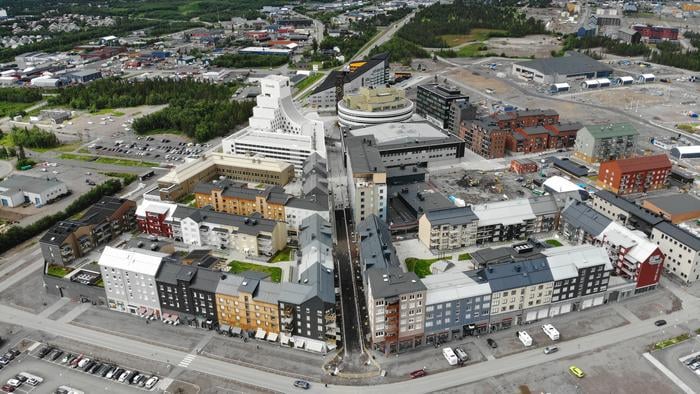
When Sweden’s northern mining town of Kiruna was relocated to make way for an expanding mine, planners promised a modern and vibrant Arctic city. Instead, a new study from the University of Gothenburg finds the rebuilt Kiruna has become noticeably colder, windier, and less comfortable to live in.
Relocated several kilometers east of its original site, the new Kiruna now sits in a low-lying depression where cold air gathers, especially during the long winter. Residents say the change is unmistakable. The grid-shaped streets, tall buildings, and shaded square have transformed the town’s microclimate, blocking sunlight and amplifying wind.
A Modern Plan That Ignored The Cold
Kiruna was once praised for its climate-sensitive design. The original town, planned in 1900 by Per Olof Hallman, was built on a south-facing slope with curving streets that followed the terrain to reduce wind tunnels and preserve solar warmth. But in the new Kiruna, these lessons appear forgotten.
“Decision-makers did not optimise the design for the urban climate when they planned the city. But it was known that the conditions would be worse than when city planner Per Olof Hallman drew up the city plan for Kiruna in 1900.”
That assessment comes from Jennie Sjöholm, a built heritage specialist at the University of Gothenburg, who has studied Kiruna’s transformation for 25 years. Her research in the journal Urban Design International shows that the new city’s microclimate is up to 10 degrees colder than the old one in winter, partly because it lies in a valley that traps frigid air.
The new layout replaced winding, climate-adapted streets with a rigid grid and tall blocks that prevent sunlight from reaching ground level for much of the year. The design also prioritized commercial development, with three shopping centers and a large central square built where wind speeds are highest.
When Beauty Meets The Arctic Wind
City officials wanted Kiruna’s new center to feel urban and appealing, with denser streets, public art, and modern architecture. But residents quickly noticed the unintended effects. In winter, wind blasts down the shopping street and sweeps across the open square.
“Although urban planners have added value in the form of a commercial centre with three shopping centres, a square and a new town hall, they have also created ‘a bloody wind tunnel,’ as one resident put it to me about the square facing the shopping street.”
The irony, Sjöholm argues, is that Kiruna’s self-image as a “winter city” has survived in name only. While the town markets its snow festivals and Arctic charm, its very streets now make being outdoors less pleasant. Historical architects such as Ralph Erskine once tailored buildings here to the climate, rounding corners to break the wind, stacking tall and low structures for warmth, and using snow as insulation. Those ideas have given way to aesthetics and convenience.
“Decision-makers have now prioritised other things than fully protecting the microclimate,” Sjöholm writes. Some new neighborhoods even have playgrounds and balconies on their north sides, an avoidable design flaw in the Arctic. The study suggests that small fixes, such as tree planting, wind barriers, and sheltered seating, could help, but the broader lesson may be about remembering what the old Kiruna already knew: in the far north, architecture and climate must work together or both will fail.
Kiruna’s experience may soon echo across the Arctic. Neighboring towns like Gällivare, Malmberget, and Luleå are also being reshaped by mining, green steel production, and the European Union’s push for carbon neutrality. As billions are invested in the region’s so-called green transition, planners face a choice: repeat Kiruna’s mistakes or rebuild northern cities that truly embrace the winter they cannot escape.