

A new quantum localization approach developed by researchers at Massachusetts General Hospital and other leading institutions represents a major advancement in medical image denoising, promising to enhance diagnostic accuracy while eliminating the need for complex parameter adjustments that plague traditional methods.
Medical imaging technologies like ultrasound, MRI, and CT scans often struggle with background noise that can blur anatomical details and complicate diagnoses. This noise manifests as random pixel fluctuations that obscure critical features, potentially leading to missed diagnoses or delayed treatment decisions.
From Particle Physics to Pixel Processing
The research team, led by Amirreza Hashemi at Massachusetts General Hospital and Harvard Medical School, developed a quantum-inspired algorithm that applies the mathematical principles of particle vibrations to image processing. Unlike previous attempts to incorporate quantum concepts into imaging, this approach directly applies the full mathematical framework of quantum mechanics rather than using metaphorical analogies.
“While quantum localization is a well-established phenomenon in physical materials, our key innovation was conceptualizing it for noisy images—translating the physics literally, not just metaphorically,” Hashemi explained. “This foundational analogy didn’t exist before. We’re the first to formalize it.”
The algorithm treats medical images as amorphous structures similar to those found in condensed matter physics. In this framework, clear image signals are considered “localized” like confined particle vibrations, while background noise behaves like “diffusive” vibrations that spread randomly across the image.
Solving Long-Standing Technical Challenges
Traditional denoising methods face significant limitations when dealing with complex noise patterns in medical images. Neural networks often struggle with intricate structures in noisy medical images and require extensive training datasets, while regularization-based approaches may fail to capture diverse noise patterns due to their non-linear nature.
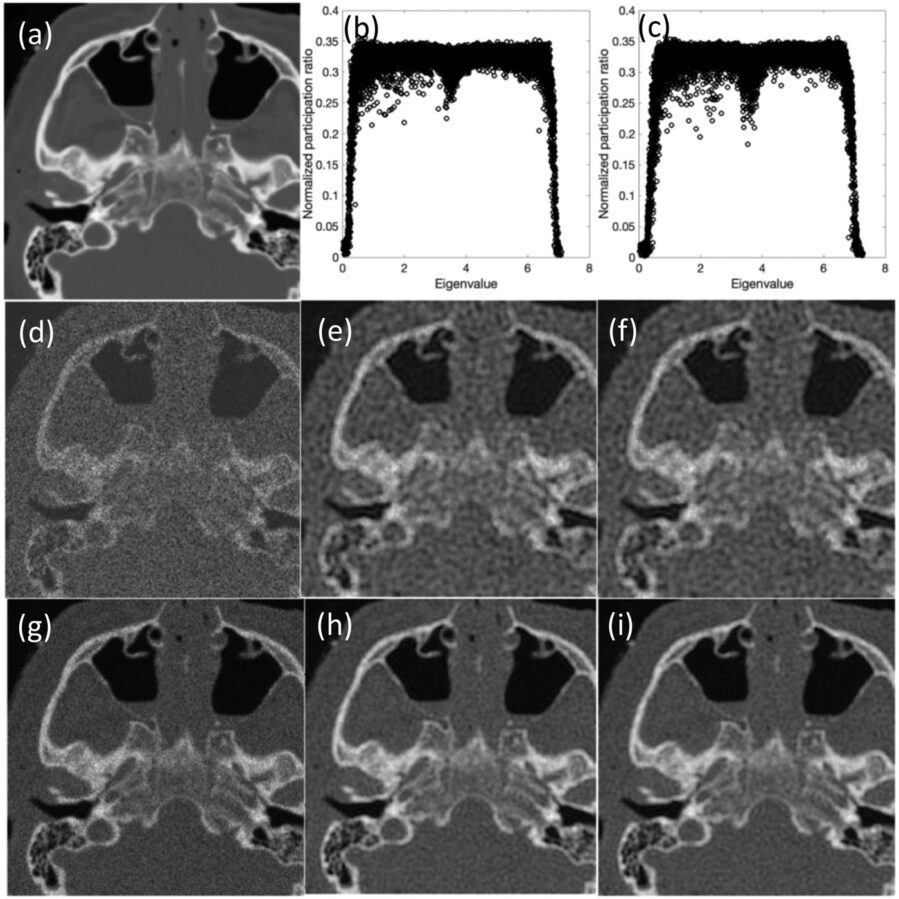
The quantum localization approach addresses these challenges by automatically separating signal from noise without requiring manual parameter tuning. The method uses a mathematical technique called the participation ratio to identify which parts of an image represent meaningful anatomical structures versus random noise.
Does this mean medical imaging could finally overcome its noise problem? The research suggests that by exploiting quantum characteristics, the algorithm can distinguish between localized imaging details and noisy components, enabling a filtering process grounded in physics rather than empirical thresholds.
Proven Performance Across Medical Applications
Testing on various image types demonstrated the algorithm’s effectiveness. For synthetic images with signal-to-noise ratios of 15, the quantum localization approach achieved superior peak signal-to-noise ratio values compared to traditional methods including total variation, wavelet, and deep learning approaches.
The method showed particularly strong results with computed tomography images, maintaining excellent performance metrics while reducing computational requirements by over 30%. Additionally, the algorithm compressed decomposed imaging modes by more than 70% while preserving image quality.
Key advantages of the quantum localization method include:
- Automatic noise filtering without manual parameter adjustments
- Superior performance compared to conventional denoising techniques
- Significant reduction in computational costs and processing time
- Preservation of fine anatomical details while removing background noise
Implications for Quantum Computing
Beyond medical imaging improvements, this research offers potential benefits for quantum computing development. The physics-driven framework aligns with computational primitives of quantum systems, potentially providing performance advantages as quantum computing scales.
The standalone nature of the algorithm, requiring minimal classical computing support, makes it particularly suitable for future quantum computing applications. This could prove valuable as quantum computing matures and finds broader applications in healthcare and medical research.
Future Clinical Impact
The research has immediate implications for medical imaging across multiple modalities. In nuclear medicine, the approach could improve image resolution in count-starved scenarios such as limited-angle tomography and organ-specific imaging. For routine clinical imaging, automated denoising without manual intervention could facilitate broader adoption across diverse healthcare environments, including resource-limited settings.
“Our method leverages physics-driven principles, like localization and diffusive dynamics, which inherently separate noise from signal without expensive optimization,” Hashemi noted. “The algorithm just works by design, avoiding brute-force computations.”
This quantum-inspired breakthrough demonstrates how fundamental physics principles can solve practical medical challenges, potentially revolutionizing how clinicians interpret medical images and make diagnostic decisions. As healthcare increasingly relies on precise imaging for early disease detection and treatment planning, such advances could significantly improve patient outcomes while reducing the complexity of image processing workflows.