

Scientists at NASA’s Jet Propulsion Laboratory and the California Institute of Technology have successfully demonstrated a new laser-based technique that could revolutionize the analysis of Mars samples when they eventually arrive on Earth. The research, published today in the Review of Scientific Instruments, shows how optical photothermal infrared spectroscopy (O-PTIR) can detect the chemical fingerprints of rocks with unprecedented precision, potentially helping scientists identify signs of ancient Martian life.
The breakthrough comes as NASA’s Perseverance rover has already collected 30 rock samples on Mars, including the intriguing “Sapphire Canyon” specimen taken from the leopardlike spotted “Cheyava Falls” rock in 2024. These samples, currently stored in tubes aboard the rover, are destined for Earth through the ambitious Mars Sample Return mission, though that program faces significant budget and timeline challenges.
A Lucky Discovery in Sedona
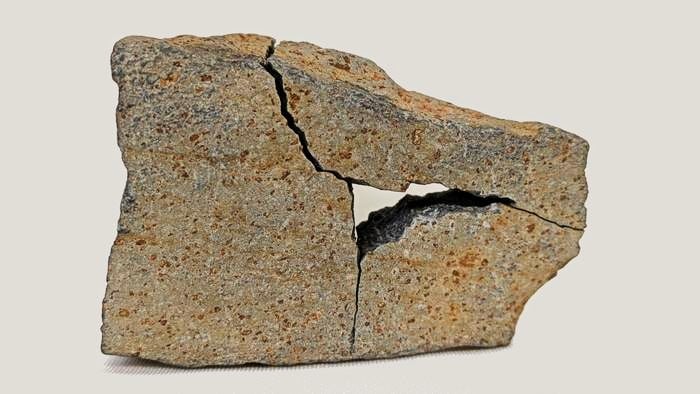
The story behind this scientific advancement begins with an unexpected find during a casual hike. Nicholas Heinz, the study’s lead author, was exploring the red rocks of Sedona, Arizona, when something caught his eye. “I was hiking in Arizona, in Sedona, when I saw this rock that just didn’t look like it belonged,” Heinz explained. “I put it in my backpack and brought it back to look at.”
That chance discovery turned into a scientific goldmine. The basalt rock Heinz found contained dark inclusions remarkably similar in size and appearance to the white, leopardlike spots found in Mars’ Sapphire Canyon sample. This terrestrial specimen became the perfect test subject for evaluating whether O-PTIR could be applied to future Martian samples.
Understanding the O-PTIR Technique
O-PTIR represents a significant advancement in rock analysis technology. The technique uses two precisely coordinated lasers to study materials at the molecular level. The first laser heats up the rock surface, causing tiny thermal vibrations proportional to the laser’s wavelength. Meanwhile, a second laser measures the extent of these microscopic changes, together creating what researchers describe as the material’s unique chemical fingerprint.
What makes O-PTIR particularly valuable for Mars sample analysis is its enhanced spatial resolution and rapid data collection capabilities. Each spectrum can be collected in minutes, allowing scientists to quickly identify areas of potential interest for more detailed study, particularly regions that might contain organic compounds indicative of past life.
The Mars Connection
The timing of this research couldn’t be more relevant. In July 2024, NASA’s Perseverance rover collected what scientists consider one of the most intriguing rock samples in the mission’s history. The Sapphire Canyon sample, extracted from the Cheyava Falls rock formation, features distinctive white spots with black borders set within red mudstone, a pattern that on Earth is sometimes associated with chemical reactions that can support microbial life.
The Cheyava Falls rock has captivated scientists because it contains several compelling features that could indicate past biological activity. The rock shows clear evidence of ancient water flow, contains organic compounds detected by Perseverance’s instruments, and displays the leopardlike spotting pattern that forms on Earth when certain chemical reactions occur. These reactions can release iron and phosphate, potentially providing energy sources for microbes.
Key Research Findings
The JPL team’s testing of O-PTIR on the Sedona basalt sample yielded several important discoveries:
- The technique successfully differentiated between the rock’s primary material and its dark inclusions
- O-PTIR demonstrated superior spatial resolution compared to traditional infrared spectroscopy methods
- The rapid analysis capability allows for efficient screening of samples to identify priority areas for detailed study
- The technique works effectively on thick rock sections without requiring extensive sample preparation
These capabilities are crucial for Mars sample analysis, where every grain of material will be precious and irreplaceable. Traditional analysis methods often require destructive sample preparation or have limited spatial resolution, making them less suitable for studying the small, intricate features that could hold clues about ancient Martian life.
Proven Track Record at JPL
The O-PTIR capabilities at JPL have already proven their worth in other NASA missions. In 2024, the technique helped confirm the biological cleanliness of the Europa Clipper spacecraft before its launch to study Jupiter’s moon Europa. This application demonstrates the versatility of O-PTIR technology beyond Mars sample analysis.
“I hope this capability will be considered for any future material returned from Mars, an asteroid, or any other planetary surface,” said Heinz. The team is now working with NASA’s Mars science team to test the technique on algal microfossils typically used as Mars analogs for rover missions.
Implications for Mars Sample Return
This research arrives at a critical time for NASA’s Mars Sample Return program, which has faced significant challenges including budget overruns and timeline delays. The program, originally estimated to cost up to $11 billion with sample return not expected until at least 2040, was paused in 2023 for redesign.
NASA Administrator Bill Nelson recently announced that the agency will pursue two potential approaches for the mission, with costs estimated between $7.1 billion and $7.7 billion. However, the program faces political uncertainty, with the current administration’s budget proposal calling for its termination. Despite these challenges, the development of advanced analysis techniques like O-PTIR ensures that when Mars samples do arrive on Earth, scientists will be prepared with the most sophisticated tools available.
The research represents a crucial step in preparing for what could be one of humanity’s most important scientific endeavors. By testing and refining analysis techniques on Earth using similar rock samples, scientists are building the expertise and methodologies needed to unlock the secrets that Martian rocks may hold about the possibility of ancient life beyond Earth.
“I hope this capability will be considered for any future material returned from Mars, an asteroid, or any other planetary surface,” said Nicholas Heinz, lead researcher at NASA’s Jet Propulsion Laboratory.
As the scientific community continues to advocate for the Mars Sample Return mission’s continuation, techniques like O-PTIR offer hope that when those precious samples finally reach Earth, scientists will be ready to extract every possible clue about Mars’ ancient past and its potential for having harbored life.