

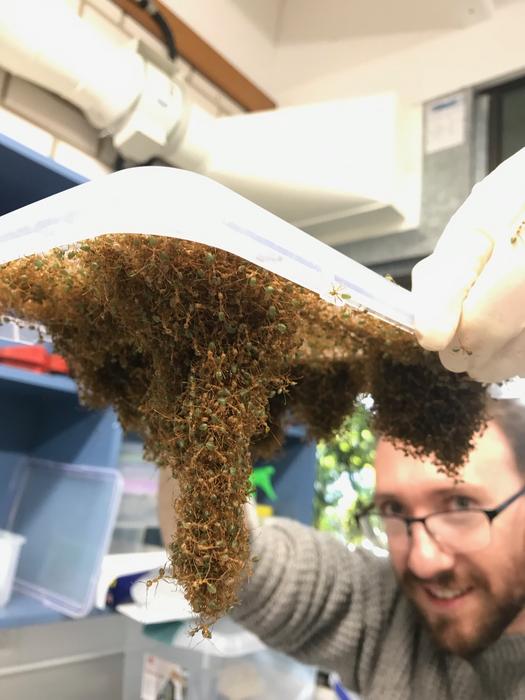
Weaver ants have solved a problem that has plagued human teams for over a century: as groups get bigger, individuals typically contribute less effort. New research published in Current Biology reveals that these remarkable insects actually become stronger when working together, with each individual ant nearly doubling their pulling force as team size increases. This discovery could transform how we design cooperative robot systems.
The Ringelmann Problem Finally Solved
In 1913, French engineer Max Ringelmann discovered a troubling pattern in human teamwork: while total force increased when more people joined a rope-pulling task, each person’s individual contribution actually decreased. This phenomenon, known as the Ringelmann effect, has been observed across countless human team scenarios from corporate brainstorming sessions to group projects.
Lead author Madelyne Stewardson from Macquarie University explains the significance: “Each individual ant almost doubled their pulling force as team size increased – they actually get better at working together as the group gets bigger.” This makes weaver ants the first documented species to achieve what researchers call “superefficient” teamwork.
The Force Ratchet Mechanism
How do these tiny tree-dwelling ants (Oecophylla smaragdina) accomplish what human teams cannot? The international research team discovered that weaver ants employ a clever division of labor within their chains. Some ants actively pull while others act as passive anchors, creating what researchers term a “force ratchet.”
“Ants at the back of chains stretch out their bodies to resist and store the pulling force, while ants at the front keep actively pulling,” explains co-lead author Dr. Daniele Carlesso from the University of Konstanz.
Dr. David Labonte from Imperial College London notes that longer chains of ants have more grip on the ground than single ants, allowing them to better resist the counter-force of leaves pulling back. This superior ground contact prevents the slippage that limits individual ant performance.
Revolutionary Nest-Building Behavior
Weaver ants are renowned for their sophisticated construction projects. Found across tropical Africa, Asia, and Australia, these ants form living chains of up to a dozen individuals to manipulate leaves far larger than themselves. They grasp each other’s waists with their mandibles, creating flexible biological tools that can roll and position leaves with remarkable precision.
The researchers conducted their experiments by enticing weaver ant colonies to form pulling chains attached to an artificial leaf connected to a force meter. This setup allowed them to measure real-time force contributions as ants joined and left the pulling teams.
Key Research Findings:
- Individual pulling force nearly doubled as team size increased from 1 to 15 ants
- Single ants averaged 60 times their body weight in pulling force
- Teams of 15 ants achieved over 100 times body weight per individual
- Optimal performance occurred with single elongated chains rather than multiple shorter ones
Implications for Robot Design
The discovery has immediate applications for swarm robotics, where teams of small, autonomous robots work together to accomplish complex tasks. Currently, robot teams only achieve linear scaling – doubling the number of robots doubles the output, but doesn’t exceed it.
Dr. Chris Reid from Macquarie’s School of Natural Sciences believes this research could revolutionize autonomous systems: “Programming robots to adopt ant-inspired cooperative strategies could allow teams of autonomous robots to work together more efficiently.”
This biomimetic approach could enhance applications ranging from disaster response to space exploration, where robot swarms need to adapt quickly to changing conditions without centralized control.
Beyond Traditional Teamwork Models
Why do weaver ants succeed where humans fail? The answer lies in their extraordinary attachment capabilities. Reid notes that when compared to other species, weaver ants’ grip strength “is off the charts – it’s an order of magnitude stronger than other ant species.”
Their six legs provide exceptional traction, and their ability to coordinate without complex communication systems eliminates the motivation and coordination problems that plague human teams. Each ant’s contribution is purely mechanical, driven by physical forces rather than psychological factors.
The study challenges long-held assumptions about the universality of the Ringelmann effect. While this phenomenon affects human teams, certain animal collectives – particularly social insects – have evolved mechanisms to overcome these limitations and achieve true collaborative enhancement.
Future Research Directions
The research team plans to test their force ratchet theory further by manipulating experimental conditions such as surface slipperiness and load weight. Understanding exactly how weaver ants coordinate their passive and active roles could provide additional insights for engineering applications.
This groundbreaking study not only advances our understanding of animal cooperation but also opens new possibilities for creating more effective artificial systems. As swarm robotics applications expand into areas like environmental monitoring, search and rescue, and manufacturing, the lessons learned from weaver ants could prove invaluable for designing truly cooperative machine teams.
The research demonstrates that sometimes in nature, more really is better – and understanding how could help us build better machines and more effective human teams.