

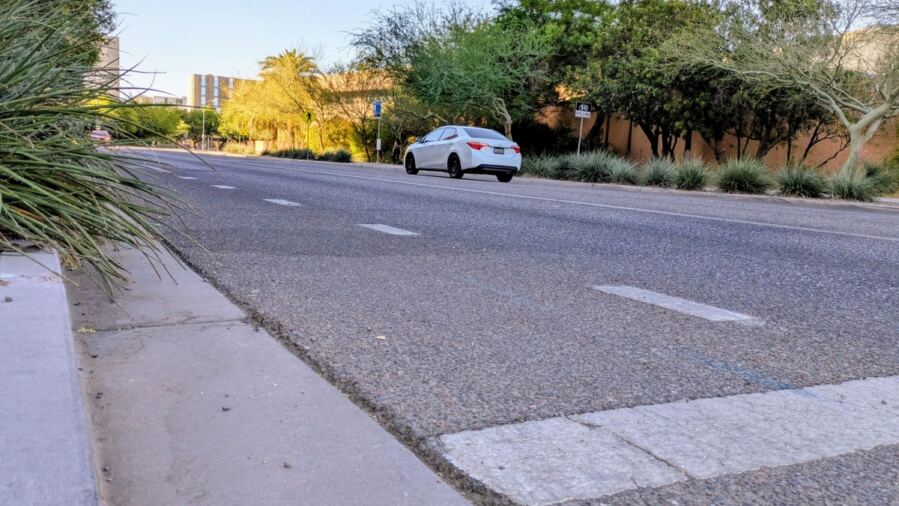
On a hot afternoon in Phoenix, the air above the asphalt shimmers. You can smell it: that acrid, petroleum-thick scent that clings to the back of your throat. Most people assume it burns off harmlessly, carried away by the same breeze that makes the heat bearable. Elham Fini spent years assuming the same thing, more or less. Then she started actually measuring what was in it. What she found was rather more troubling than anyone expected, and it’s getting worse as the climate does.
Fini, a senior scientist affiliated with Arizona State University’s Julie Ann Wrigley Global Futures Laboratory, spent the early part of her career studying why asphalt breaks down so quickly. That work kept pulling her back to the same culprit: volatile organic compounds, or VOCs, the carbon-based vapors continuously escaping from bitumen, the sticky petroleum product that holds road surfaces together.
The compounds are always there, seeping out at a low baseline even in mild weather. But heat accelerates them dramatically; laboratory measurements suggest asphalt emissions roughly double when surface temperatures climb from 40°C to 60°C, a range well within ordinary summer conditions in cities like Phoenix or Houston. And here is where the story starts to get complicated: those vapors do not simply dissipate. They react. Under urban skies full of sunlight and industrial chemistry, asphalt VOCs are converted into secondary organic aerosols, fine particles small enough to penetrate deep into the lungs and, in some cases, the bloodstream. The health implications of that transformation were, until recently, almost entirely uncharacterized.
Two new studies, both involving Fini’s research group, are starting to fill that gap. And what they reveal about the chemistry of road surfaces, especially in a warming, more humid world, suggests that asphalt deserves a place in conversations about urban air quality that it has never really had.
The first study, published in the Journal of Hazardous Materials, ran controlled chamber experiments on a mixture of 13 VOCs representative of actual asphalt emissions. Researchers exposed the mixture to hydroxyl radicals, which dominate atmospheric chemistry during the day, and to nitrate radicals, which take over at night. Both produced ultrafine particles smaller than 100 nanometres; these are the size range linked most strongly to adverse health outcomes, because conventional air quality monitoring tends to miss them entirely. The nighttime chemistry was particularly aggressive. Under dry conditions, nitrate radical oxidation generated particle yields several times higher than the daytime process, driven largely by catechol and related phenolic compounds in the asphalt binder. Put more plainly: the road outside your house is probably generating its worst aerosol pollution after dark, when you might have thought it had gone quiet.
When Rain Makes It Worse
The second study, in Science of the Total Environment, asks what happens when humidity enters the picture. The answer, it turns out, is a kind of feedback loop that nobody had fully mapped before. When relative humidity rises, the surface of asphalt binder becomes chemically enriched in polar, oxygenated compounds, drawn toward the material’s surface through interactions with water molecules. Those compounds are precisely the ones most reactive with atmospheric oxidants, which means humid conditions push more of the most dangerous VOC precursors into the air. Across the range studied, polar VOC emissions increased by up to 46% as humidity climbed from near-dry to roughly 50% relative humidity. Given that global humidity is projected to rise alongside temperatures, that is not a reassuring trend.
There is, additionally, a mechanical consequence. The same surface enrichment that boosts VOC emissions also weakens the binder, making asphalt more susceptible to cracking and degradation. The researchers analysed data from more than 5,000 road segment observations across US infrastructure spanning over three decades and found a statistically significant interaction between humidity range and sunshine exposure in accelerating deterioration. More degraded asphalt, the logic follows, emits more. “Heat is worsening the situation,” Fini said. “It’s exacerbating the emissions from asphalt.”
The broader numbers are worth sitting with for a moment. Estimates suggest that aged pavements around Paris contribute something like 20% of non-methane VOC emissions from road transport in the city, or roughly 3% of total non-methane VOC output. US modeling work indicates that asphalt-related organic emissions could raise summertime secondary aerosol concentrations by 0.1 to 0.2 micrograms per cubic metre on average, with some days reaching perhaps 0.5 micrograms per cubic metre. These are not trivial additions to urban pollution budgets, yet asphalt emissions are still largely absent from official inventories, the models that regulators use to assess air quality and set standards. “To make something truly sustainable,” Fini has said, “you cannot ignore the human side of it.”
What Could Replace the Petroleum
There is a piece of this story that reads almost like an improbable solution. Fini has been collaborating with Peter Lammers, chief scientist at the Arizona Center for Algae Technology and Innovation, to grow a specific strain of algae using wastewater from a Phoenix treatment plant, wastewater that carries more nitrogen and phosphorus than can legally be discharged into waterways. The algae is then baked at high temperatures in a low-oxygen environment into a biochar-like binder that can be mixed into conventional asphalt. A study in Clean Technologies and Environmental Policy found that while algae-infused asphalt does not dramatically cut total VOC output, it selectively captures the most toxic compounds, reducing the overall toxicity of emissions by roughly a hundredfold. “It’s a great setup,” Lammers said, “because we use water that’s far too high in nitrogen and phosphorus to be released anywhere. And instead, we reuse it to grow more algae.”
The caveat, and it is a significant one, is scale. Phoenix is planning to pave a test section of road with the algae material, which will provide the kind of real-world emissions data that laboratory chambers cannot. Fini is also exploring binders derived from wood waste generated by forest-thinning operations. Both options face the fundamental challenge that asphalt is a global commodity, produced and laid at a volume that makes material substitution extremely slow even when the chemistry is sorted out.
Meanwhile, the more immediate lever may be reformulation of conventional binders: specifically, reducing the concentration of phenolic and low-volatility oxygenated compounds that the new research identifies as disproportionate contributors to particle formation. The chamber study from the Journal of Hazardous Materials makes a specific argument that removing or reducing these polar precursors from asphalt formulations could substantially cut secondary pollution, without necessarily changing how the road performs structurally. Whether that argument reaches pavement engineers and procurement officers is a different kind of problem entirely, one that moves at the pace of standards bodies and procurement cycles rather than atmospheric chemistry.
Fini frames it in terms of what 4 million miles of American road surface could, in principle, be made to do. “We have 4 million miles of roads in America,” she said. “We should make those 4 million miles do more for us than just get from A to B.” As electric vehicles gradually eliminate tailpipe emissions from the pollution equation, the chemistry of the road surface itself may become, proportionally, more important. The ground beneath our feet has been hiding in plain sight.
Source: https://doi.org/10.1016/j.jhazmat.2026.141713 | https://doi.org/10.1016/j.scitotenv.2026.181729
Frequently Asked Questions
Is road asphalt actually a significant source of air pollution compared to car exhausts?
Increasingly, yes, and the gap is narrowing faster than most people realise. Studies suggest that aged pavements in cities like Paris contribute roughly a fifth of non-methane VOC emissions from road transport, and US modeling puts asphalt-related aerosols at a meaningful fraction of summertime particulate pollution. As electric vehicles reduce tailpipe emissions, the relative contribution of the road surface itself is likely to grow.
Why is nighttime asphalt pollution potentially more dangerous than daytime?
The chemistry changes after dark. During the day, hydroxyl radicals break down asphalt VOCs broadly and somewhat inefficiently. At night, nitrate radicals take over and react with extreme selectivity toward phenolic compounds in the bitumen binder, generating secondary aerosol yields several times higher under dry conditions. Because most people are home and windows may be open, nighttime particle formation from road surfaces is an underappreciated exposure route.
Does higher humidity make asphalt pollution worse or better?
Worse for emissions, partially better for nighttime particle formation. Humidity draws more polar, oxygenated VOCs to the asphalt surface, increasing emissions of the most reactive compounds by up to 46% in the range studied. Paradoxically, high humidity also suppresses the most aggressive nighttime particle-formation chemistry, delaying the nucleation process. The net effect in a hot, humid city like Houston is likely different from a hot, dry one like Phoenix.
Could changing what asphalt is made of actually fix the problem?
The chemistry suggests it could help substantially. The new research identifies specific phenolic and low-volatility oxygenated compounds in bitumen binders as the main drivers of hazardous particle formation. Reformulating binders to reduce these compounds, or replacing some fraction of conventional bitumen with materials like algae-derived biochar, appears capable of cutting the toxicity of emissions dramatically without necessarily compromising road performance. The harder challenge is getting those changes adopted at the scale of global infrastructure.
What health effects are linked to long-term exposure to asphalt emissions?
The picture is still being assembled, but it is not reassuring. Short-term exposure to asphalt fumes can cause dizziness and breathing difficulties. Longer-term, VOCs and fine particles from road surfaces have been associated with elevated cancer risk, cardiovascular disease, and, in recent modeling work, neurological damage including dementia risk, particularly among women and older people. Construction workers who work unprotected around hot asphalt face the highest exposures, though communities near heavily trafficked roads breathe a lower-concentration version of the same chemical mixture daily.