

Scientists at Columbia University have created robots that can physically grow, heal, and improve themselves by absorbing parts from their environment or from other robots—a process they call “robot metabolism.”
The research demonstrates machines that start as simple stick-like modules and self-assemble into increasingly complex three-dimensional structures, each transformation making them more capable than before.
Published in Science Advances, the study introduces Truss Links—magnetic robotic modules that can expand, contract, and connect at various angles to form sophisticated structures. The work represents a fundamental shift toward robots that operate as open systems, capable of adapting their physical form rather than remaining fixed in their original configuration.
From Simple Sticks to Walking Robots
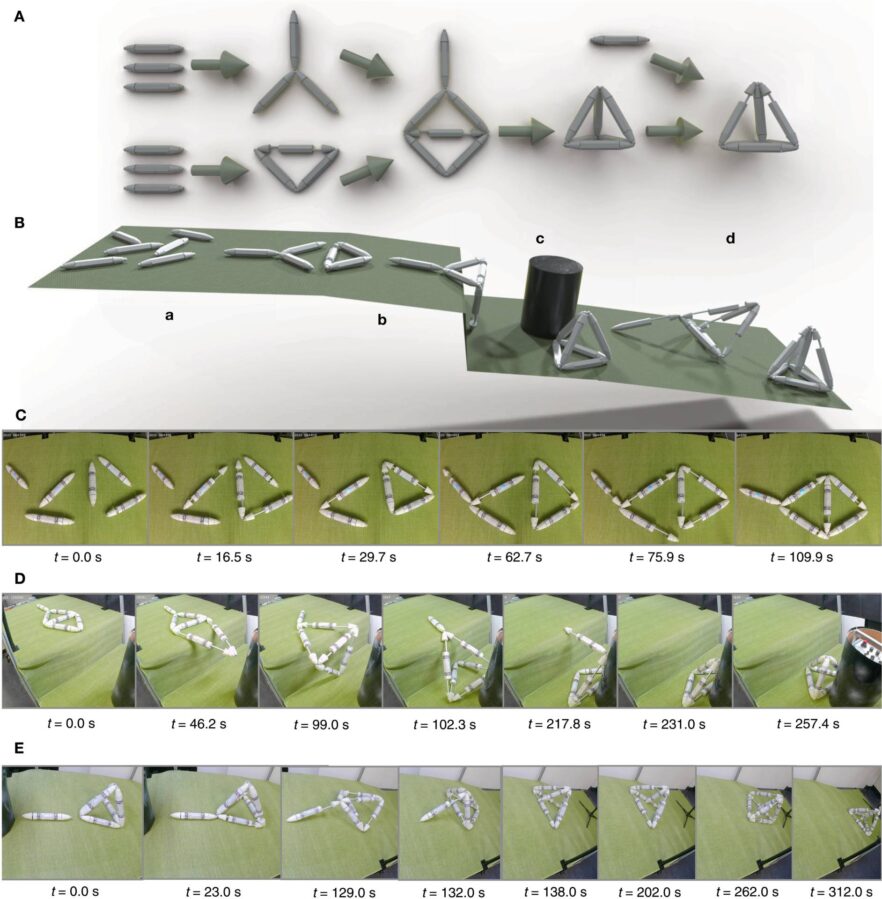
The research team demonstrated how individual Truss Links self-assembled into two-dimensional shapes that then morphed into three-dimensional robots. In one striking example, a tetrahedral robot integrated an additional link to use as a walking stick, increasing its downhill speed by more than 66.5%.
Each Truss Link measures 28 centimeters when contracted and can extend to 43 centimeters—a 53% expansion ratio. The modules feature magnetic connectors that automatically align and attach, allowing multiple units to connect from various angles without precise positioning.
“True autonomy means robots must not only think for themselves but also physically sustain themselves,” explained Philippe Martin Wyder, lead author and researcher at Columbia Engineering. “Just as biological life absorbs and integrates resources, these robots grow, adapt, and repair using materials from their environment or from other robots.”
Robot Development Stages Mirror Biology
The researchers created a multi-stage development process where robots progressively became more capable. Individual links could only crawl forward and backward in one dimension. When three links assembled into a triangle, the resulting robot gained two-dimensional navigation abilities, allowing it to circumvent obstacles impossible for single modules.
Further assembly created a “diamond-with-tail” configuration capable of overcoming 25-millimeter-tall ledges and folding itself into a tetrahedron. The tetrahedral form could move in three dimensions by toppling over obstacles, while the final “ratchet tetrahedron” configuration achieved the highest speeds but with reduced stability.
Key Capabilities Demonstrated:
- Self-assembly from individual modules into complex 3D structures
- Self-repair by reforming broken connections after impact damage
- Replacement of “dead” modules through programmed component shedding
- Robot-assisted assembly where functioning units help others develop
- Progressive capability improvement with each structural transformation
Biological Inspiration Drives Innovation
The robot metabolism concept draws inspiration from how biological organisms use simple building blocks—amino acids—to create complex proteins and entire life forms. Similarly, the Truss Link system uses standardized modules to generate diverse functional structures.
“Biological bodies, in contrast, are all about adaptation – lifeforms, can grow, heal, and adapt,” noted Hod Lipson, co-author and director of the Creative Machines lab. “In large part, this ability stems from the modular nature of biology that can use and reuse modules (amino acids) from other lifeforms. Ultimately, we’ll have to get robots to do the same.”
The research team conducted extensive simulations to quantify the probability of various configurations forming randomly. Over 2,000 simulation runs revealed that some structures, like the diamond-with-tail configuration, occurred in 44.3% of random attempts, while more complex forms required environmental assistance or operator guidance.
Self-Repair and Component Replacement
The study demonstrated remarkable self-healing capabilities. When robots fell from heights and broke connections, they could autonomously reform their original shapes. Triangle, three-pointed star, and diamond-with-tail configurations all successfully recovered from impact damage that disconnected their components.
Perhaps most impressively, the robots could replace “dead” components through programmed cell death similar to biological apoptosis. When a component’s battery dropped below critical levels, it would automatically detach and separate from the structure, allowing a functioning replacement to be integrated.
The researchers also showed robot-to-robot cooperation, where an established tetrahedral robot helped flat 2D arrangements transform into 3D tetrahedrons by acting like a crane to lift and position components.
Future Implications and Applications
The technology promises applications in disaster recovery and space exploration, where robots must adapt to unforeseen circumstances without human maintenance. The ability to self-repair and reconfigure could prove crucial for long-term autonomous operations in harsh environments.
“Robot Metabolism provides a digital interface to the physical world and allows AI to not only advance cognitively, but physically—creating an entirely new dimension of autonomy,” Wyder explained. “Initially, systems capable of Robot Metabolism will be used in specialized applications such as disaster recovery or space exploration.”
However, Lipson cautioned about the broader implications: “The image of self-reproducing robots conjures some bad sci-fi scenarios. But the reality is that as we hand off more and more of our lives to robots… Who is going to take care of these robots? We can’t rely on humans to maintain these machines. Robots must ultimately learn to take care of themselves.”
The research team envisions future robot ecologies where machines independently maintain themselves, growing and adapting to new tasks and environments—a crucial step toward truly autonomous robotic systems that can evolve beyond their initial programming and design limitations.
