

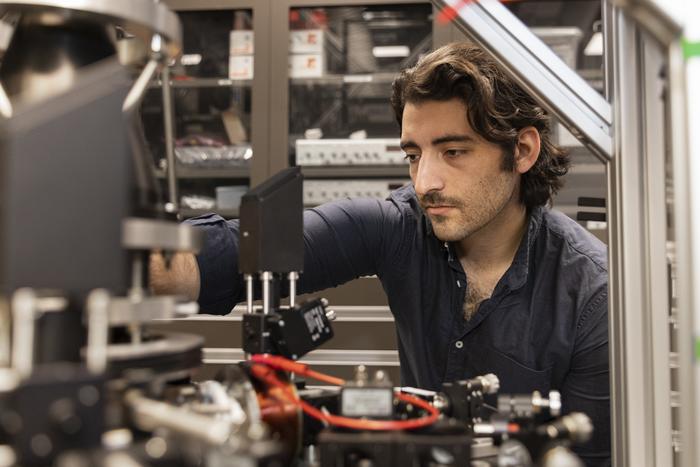
Quantum computing just became more practical. Scientists at the University of Sydney have demonstrated a universal gate set for Gottesman-Kitaev-Preskill (GKP) qubits, a milestone that could drastically reduce the number of physical qubits needed to build useful quantum machines. By encoding logical qubits in the oscillations of a single trapped ion, researchers overcame a long-standing barrier to efficient error correction. Published in Nature Physics, the study shows how optimal control of atomic vibrations can unlock hardware-efficient quantum logic, providing a clearer path to large-scale, fault-tolerant computation.
Why Fewer Qubits Matter
Quantum computers promise revolutionary applications in cryptography, chemistry, and materials science. Yet today’s prototypes face a crippling efficiency gap: it takes dozens or even hundreds of physical qubits to protect and operate a single logical qubit. This massive overhead makes scaling impractical. The GKP code, often called the “Rosetta stone” of quantum computing, offers a way to compress logical qubits into continuous quantum oscillations. Until now, its complexity had kept it out of reach experimentally.
Breakthrough in Sydney
The Sydney team used a single ytterbium ion held in a Paul trap at room temperature. By applying laser-driven forces, they manipulated the ion’s harmonic motion to encode GKP qubits and entangle them. Crucially, their method preserved the fragile structure of the encoded states, avoiding distortions that typically undermine performance. This allowed them to demonstrate three key capabilities: high-fidelity single-qubit gates, a two-qubit entangling gate, and the direct preparation of a GKP Bell state.
“Our experiments have shown the first realisation of a universal logical gate set for GKP qubits,” said Dr Tingrei Tan, University of Sydney. “This provides a foundation to work towards large-scale quantum-information processing in a highly hardware-efficient fashion.”
How the Gate Works
A logic gate is the building block of any computer, determining how bits or qubits interact. In classical machines, gates are transistors switching between on and off states. In quantum machines, they exploit entanglement and superposition. By demonstrating a universal set of logical gates, the Sydney researchers proved that GKP qubits can be used not just for storage but also for computation.
First author Vassili Matsos, a PhD student, explained that the team stored two logical qubits in a single trapped ion and then entangled them. To maintain stability, they used control software from Q-CTRL, a Sydney spin-off, to design optimized quantum gates that minimized distortions.
Key Findings
- Sample and setup: Single 171Yb+ ion in a Paul trap at room temperature
- Duration: Experiments included gate operations lasting 196–993 microseconds
- Result: Universal gate set for GKP qubits, plus direct GKP Bell state preparation
- Efficiency: Reduced physical-to-logical qubit ratio by encoding in ion oscillations
- Fidelity: Single-qubit and entangling gates achieved high logical fidelities, limited mainly by motional dephasing
- Location: Quantum Control Laboratory, University of Sydney Nano Institute
- Safety: Conducted at room temperature, compatible with existing hardware platforms
Implications for Quantum Technology
The findings could accelerate the move from laboratory demonstrations to practical quantum systems. GKP codes are adaptable to multiple platforms, including superconducting circuits and photonic systems, meaning the techniques pioneered in Sydney may have wide impact. Hardware improvements, such as faster light-atom coupling and better cooling protocols, could further boost performance. The ability to prepare entangled GKP states directly from vacuum is especially promising for reducing resource overhead in future devices.
Takeaway
By showing that universal gates can be performed on GKP qubits encoded in a single trapped ion, University of Sydney researchers have brought error-corrected, scalable quantum computing closer to reality. Their work demonstrates that efficient, hardware-light architectures may soon rival conventional qubit-heavy approaches.
Journal: Nature Physics
DOI: 10.1038/s41567-025-03002-8