

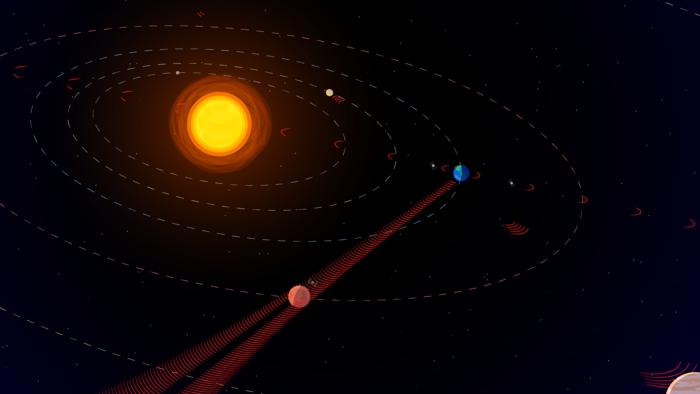
If aliens beam signals like humans do, we know where to listen. A new study led by Penn State and NASA’s Jet Propulsion Laboratory shows that Earth’s deep space transmissions concentrate along planetary alignments, meaning extraterrestrial civilizations might reveal themselves in similar ways. By analyzing two decades of NASA Deep Space Network logs, researchers found our strongest interplanetary signals are most detectable when Earth lines up with Mars or other planets. The work, published in Astrophysical Journal Letters, suggests SETI searches should focus on exoplanetary alignments and nearby stars lying within Earth’s orbital plane.
Guided by Our Own Signals
The team examined how our strongest signals spill into space. Most transmissions target probes orbiting Mars, telescopes at Sun–Earth Lagrange points, and missions like the James Webb Space Telescope. Because radio beams are not perfectly narrow, much of that power leaks into interstellar space. If another civilization watched from the right vantage point, they could detect us far more easily during planetary alignments than at random times.
“Humans are predominantly communicating with the spacecraft and probes we have sent to study other planets like Mars,” said Pinchen Fan of Penn State. “But a planet like Mars does not block the entire transmission, so a distant spacecraft or planet positioned along the path of these interplanetary communications could potentially detect the spillover.”
By comparing NASA’s transmission logs with planetary positions, the researchers calculated that an alien observer watching Earth–Mars alignments would have a 77 percent chance of intercepting one of our signals. For alignments with other planets, the probability falls to about 12 percent, but this is still thousands of times greater than chance.
A Roadmap for SETI
The study points SETI researchers toward specific strategies:
- Target exoplanetary systems where planets transit their host stars, as these alignments mimic the Earth–Mars geometry.
- Focus on stars within about 23 light-years that lie close to Earth’s orbital plane, since most of our transmissions hug this band.
- Time searches to coincide with exoplanet conjunctions or alignments, when signal spillover is most likely detectable.
The approach leverages the logic that if we broadcast this way, so might others. As Penn State astronomer Jason Wright noted, humanity’s spacefaring activity is still young, but as we expand deeper into the solar system, our radio presence will only grow stronger and more structured.
Key Findings
- Sample: 20 years of NASA Deep Space Network logs (2005–2024)
- Primary signals: Directed toward Mars spacecraft, Sun–Earth Lagrange telescopes, and outbound probes
- Detection probability: 77% chance during Earth–Mars alignment, 12% for other planetary alignments
- Range: Typical signals detectable up to 23 light-years with Earth-level telescopes
- Orientation: 79% of transmissions occur within 5 degrees of Earth’s orbital plane
Expanding the Search
Future telescopes such as NASA’s Nancy Grace Roman Space Telescope will discover thousands more exoplanets, greatly expanding the number of candidate systems where Earth-style transmission spillover might be detected. The researchers argue that identifying systems with edge-on orientations should be a SETI priority.
Meanwhile, the same geometry applies to laser communications, which are becoming more common in human spaceflight. Though beams are narrower, even small amounts of leakage could betray a civilization’s presence if we know when and where to look.
Takeaway
Human deep space transmissions cluster during planetary alignments, making them easier to detect from afar. By assuming extraterrestrial civilizations use similar communication networks, SETI researchers can dramatically improve their odds by targeting exoplanetary alignments and stars within Earth’s orbital plane.
Journal: The Astrophysical Journal Letters
DOI: 10.3847/2041-8213/adf6b0