

Two curves. One shaped like the letter L, the other like the letter J. They look almost identical at first glance, but for anyone trying to understand how exercise protects the heart, the difference between them is rather significant. The L-curve describes what aerobic exercise does to cardiovascular risk: dramatic early gains for people who go from nothing to something, then a long, shallow tail of diminishing returns as activity increases. The J-curve describes what happens with weight training. Risk drops sharply at first, then, beyond roughly an hour a week, starts creeping back up. Maybe. The evidence is thinner there, and researchers are careful to say so.
This, in rough outline, is one of the central findings from a comprehensive review by Fangchao Liu and colleagues at the National Center for Cardiovascular Diseases in Beijing, published this spring in Medicine Plus. The team set out to do something the field had been slow to do properly: compare aerobic exercise, muscle-strengthening exercise, and combinations of both, not just for their effects on heart disease outcomes overall, but on each of the major risk factors along the way.
The aerobic side of the picture is well-established, if still producing surprises. The dose-response relationship follows that L-shape, which has a rather hopeful implication: the people who gain most from exercise are those who are currently doing nothing at all. Going from 2,000 daily steps to 5,000 is, by some estimates, associated with a 45 percent reduction in cardiovascular mortality risk. Climbing to 10,000 steps delivers no additional benefit on top of that. The marginal return on your tenth kilometre of running is considerably smaller than on your first. What is perhaps less intuitive is that even extremely brief bouts of activity seem to count. One study cited in the review found that just five to ten minutes of moderate-to-vigorous aerobic activity per day was associated with a 41 percent reduction in major adverse cardiovascular events, compared to people who were sedentary. The biology, it turns out, doesn’t demand hour-long sessions.
When You Exercise May Matter As Much As How Much
Timing has emerged as an unexpectedly interesting variable. An analysis of accelerometer data from nearly 30,000 UK Biobank participants found that people who exercised in the evening showed a 36 percent lower risk of cardiovascular death compared to their inactive counterparts, versus 17 percent for morning exercisers and 16 percent for afternoon exercisers. Whether that reflects something real about circadian biology or simply a quirk of who exercises in the evening (younger, perhaps, or less sedentary overall) is not yet settled. Still, the finding is striking enough that Liu’s team highlighted it specifically. There’s also encouraging news for the so-called “weekend warrior” pattern, where people cram a week’s worth of activity into one or two days. A separate study found this approach delivers roughly the same cardiovascular protection as evenly distributed activity, which is, practically speaking, quite useful to know.
The muscle-strengthening findings are where things get more complicated, and more contested. The J-shape of the dose-response curve suggests an optimal zone somewhere between 40 and 60 minutes of resistance training per week, with a putative safe upper limit around 130 to 140 minutes. Go beyond that, and the data hint that cardiovascular risk may begin to climb back toward levels seen in inactive people. The review is candid about how preliminary this is. Most of the evidence relies on self-reported questionnaires, which are notoriously unreliable for capturing resistance exercise (how hard did you actually lift? for how long? how often?). Accelerometers, which have transformed aerobic exercise research, still struggle to distinguish a squat from a slow walk. The J-curve, in other words, might be an artefact of measurement problems rather than real biology.
What’s less contested is that even small amounts of resistance training provide meaningful benefit. A large cohort study found that one to 59 minutes of weight training per week, the lowest dosage category examined, was associated with a 40 to 70 percent lower risk of total cardiovascular events compared to doing none, independent of how much aerobic exercise people were also doing. That independence matters. The two types of exercise appear to be protecting the heart through at least partly different mechanisms.
The Case for Doing Both
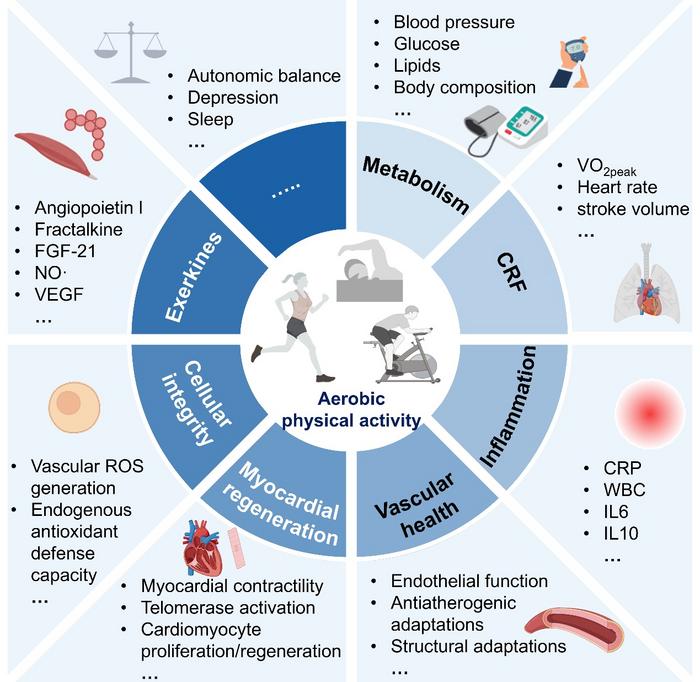
This brings the review to its most practically significant finding. When researchers compared inactive people to those doing only aerobic exercise, only resistance training, or both, the combined group came out substantially ahead. Aerobic-only participants showed a 29 percent lower risk of cardiovascular mortality. Resistance-only, 18 percent. People doing both: 46 percent. The synergy isn’t just additive; the two modalities appear to amplify each other’s effects. Aerobic exercise increases stroke volume and improves how efficiently vessels dilate; resistance training strengthens the muscle architecture of the heart itself and improves the microcirculation in peripheral muscle tissue. At the molecular level, both types of exercise trigger cascades of signalling molecules that reduce chronic inflammation, improve mitochondrial function, and help regulate blood pressure through different pathways. Running and lifting, in this sense, are not interchangeable. They are complementary tools.
For blood pressure specifically, the review synthesises data from a remarkable meta-analysis of 270 randomised controlled trials. Aerobic exercise alone reduced resting systolic blood pressure by around 4.5 mmHg. Resistance training alone achieved similar reductions. But combined activity brought the systolic figure down by roughly 6 mmHg. For people with hypertension, those numbers translate to meaningful reductions in stroke risk. The review notes, with some understatement, that aerobic exercise’s antihypertensive effect is sometimes comparable to pharmacological therapy, and occasionally superior. Which is a fairly remarkable thing to say about going for a walk.
The picture for high-risk populations is more nuanced. People with existing cardiovascular risk factors, including diabetes, hypertension, and obesity, tend to see more pronounced benefits from physical activity than healthy populations. The biology is working harder to compensate for existing dysfunction, and exercise provides more leverage. But the flip side is that these same people face greater risk from exercise-related adverse events if they push too hard too fast. The review is explicit that personalised prescription matters here, and that blanket guidance is unlikely to serve high-risk individuals well.
Where the field is heading is fairly clear. Wearable technology is generating objective data on activity patterns at a scale that self-report questionnaires could never match, and machine learning is beginning to extract meaningful signal from the noise. The ambition is personalised exercise regimens that adjust in real time based on individual physiology and health trajectory. Whether that vision survives contact with real human lives is another question. For now, the two curves offer a starting point. Get moving. Then pick up something heavy.
Frequently Asked Questions
Is it true that too much weightlifting can be bad for your heart?
Possibly, though the evidence is preliminary and comes with important caveats. Research suggests a J-shaped relationship between resistance training and cardiovascular risk, with an apparent sweet spot around 40 to 60 minutes per week and a possible upper safety limit near 130 minutes. Beyond that threshold, some data hint that risk may begin to rise. But most of this evidence relies on self-reported questionnaires, which are unreliable for capturing resistance exercise intensity and volume, so the J-curve may partly reflect measurement error rather than true biological risk.
Why does combining cardio and weights protect the heart more than either one alone?
The two types of exercise protect the heart through genuinely different mechanisms, and those mechanisms appear to complement rather than simply add to each other. Aerobic exercise improves how efficiently the heart pumps blood and how well blood vessels dilate; resistance training strengthens the heart muscle’s structural architecture and improves blood flow in peripheral muscles. At the molecular level, both trigger different signalling pathways that reduce inflammation, regulate blood pressure, and improve mitochondrial function. Doing both, in effect, covers more biological ground.
Does it actually matter what time of day you exercise?
Emerging data suggest it might, though researchers are cautious about drawing firm conclusions. An analysis of nearly 30,000 UK participants found that evening exercisers showed substantially greater reductions in cardiovascular mortality risk than morning or afternoon exercisers. Whether this reflects circadian biology, differences in exercise intensity, or characteristics of who tends to exercise in the evening is not yet clear. The finding is intriguing enough to warrant further study, but it shouldn’t override the more fundamental point: any exercise, at any time, is better than none.
What if I can only exercise on weekends?
The evidence suggests that concentrating your weekly activity into one or two days delivers cardiovascular protection comparable to spreading it evenly across the week. This so-called “weekend warrior” pattern has been specifically examined in large cohort studies and found to significantly reduce cardiovascular risk relative to being inactive. So if weekday constraints make regular exercise impossible, banking your minutes at the weekend still counts.