

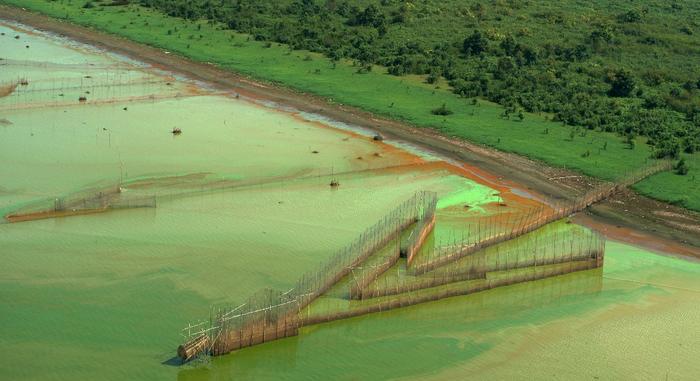
When the Mekong swells each monsoon, the Tonle Sap River is supposed to turn around and push life into Cambodia’s great lake. That seasonal reverse flow is fading fast, and new modeling fingers a stark culprit: sand mining. In a paper published today in Nature Sustainability, researchers show that aggressive extraction of construction sand from the Mekong in Cambodia and Vietnam has carved the riverbed lower, weakening the hydraulic push that once inflated Tonle Sap Lake each year.
Tonle Sap is no ordinary lake. Recognized as a UNESCO Biosphere Reserve, it shelters endangered amphibians, reptiles, mammals, and birds, with an acknowledged diversity of 885 species. It also feeds and employs millions, acting like a giant flood capacitor that stores wet season water for the dry months and tempers downstream floods across the Mekong Delta, home to 23 million people. On paper, that system looks resilient. In the field, it looks brittle.
Researchers report that between 1998 and 2018, riverbed lowering along the Mekong mainstem reduced the volume of reverse flow into Tonle Sap by 40 to 50 percent. Their forward scenarios are even bleaker. If current extraction continues, the reverse flow could be down by 69 percent by 2038 compared to 1998. That would shrink peak lake levels by meters, reduce flooded area by roughly 40 percent, and, critically, slash dry season outflow to the delta by close to 59 percent. Think of brown water receding too soon, floodplain forests left high and dry, and fish nurseries without their pulse.
“Our work demonstrates that, while climate change and damming are minor contributory factors, by far the dominant driver has been riverbed incision caused by largely rampant sand mining on the Mekong.”
That assessment, from co-author Steve Darby of the University of Southampton, runs counter to the common narrative that upstream dams or climate change alone explain the lake’s decline. The study does not absolve those pressures; it quantifies them as secondary contributors that compound a geomorphic crisis. Lower the riverbed enough, the team argues, and you reduce water levels at the delta apex, weakening the gradient that flips the Tonle Sap River each year. The hydraulics become unfavorable, and the clockwork reversal shortens and weakens.
The knock-on effects propagate hundreds of kilometers. During the monsoon, more water bypasses the lake and surges into the Mekong Delta, raising flood risk. In the dry season, less water bleeds back from the lake, inviting saltwater intrusion deep into rice country and threatening aquaculture. Those shifts hit people first and ecosystems soon after. Field interviews cited by the team describe aquaculture mortality near 80 percent in some communities, declining wild catch, and mounting household debt. One fisher summed up the mood with a plea for a different future for their children.
A Global Building Boom With Local Costs
Why is the sand leaving so fast? Construction demand. Cities in the region and beyond are swallowing concrete at unprecedented rates, and the Mekong’s bed has become a quarry. Cambodia extracted an estimated 59 million tonnes of river sand in 2020. Vietnamese operations in the delta have averaged tens of millions of cubic meters per year. Those volumes dwarf the Mekong’s natural sand supply, creating a sediment deficit that chisels the channel deeper and destabilizes banks. Anyone who has watched a riverbank slump into chocolate water after a dredger passes knows the feeling in their gut.
“Rapid urban growth has fuelled a global surge in a demand for construction sands, increasing river sand mining rates.”
Lead author Quan Le and colleagues couple those extraction rates with the sediment trapped behind hundreds of hydropower projects in the basin. Fewer grains arrive, more grains are removed, and the budget goes negative. In this light, Tonle Sap’s fading flood pulse is not a mystery. It is a balance sheet.
What It Would Take To Pull Back
The researchers sketch mitigation ideas that are as challenging as they are necessary. At the top of the list is curbing riverine sand mining, backed by transparent, risk based governance that accounts for cross border impacts. They also point to sediment management at dams, including flushing strategies that release fines during high flows. That would not replace the coarse sands most effective at resisting incision, but it could help slow the slide. None of this is quick or cheap. All of it is cheaper than collapse.
The science here is sobering, but it is not fatalistic. Hydraulics respond to policy. So do dredgers. The Mekong remains the second most biodiverse aquatic ecosystem after the Amazon, and Tonle Sap is its heart. If the reverse flow weakens into a memory, the region will inherit deeper floods, saltier farms, emptier nets, and hollowed communities. If it stabilizes, the flood forests can breathe again, and the capacitor can hum through another season. The choice, the study implies, is in the sand.