

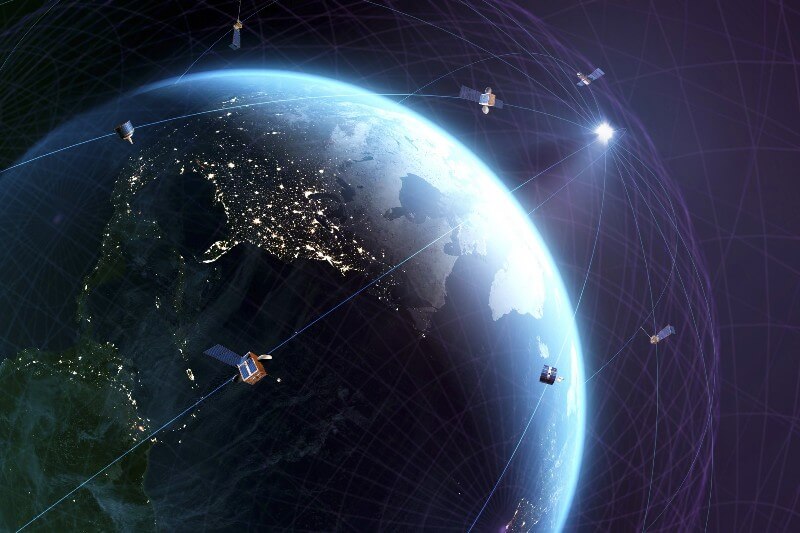
The shining promise of space-based astronomy faces a threat: tens of thousands of commercial satellites launched not for science, but for internet connectivity. A comprehensive new forecast reveals that even telescopes orbiting hundreds of kilometers above Earth cannot escape the light pollution from satellite megaconstellations.
NASA researchers simulated how proposed telecommunications satellites will affect four different space observatories, including the Hubble Space Telescope and three planned missions. Their projections paint a stark picture: if current industry proposals become reality, one-third of Hubble’s images will show satellite trails by the 2030s, while some newer telescopes will find contamination in more than 96% of their observations.
Beyond Ground-Based Concerns
The scientific community has expressed alarm about satellite constellations disrupting ground-based astronomy for several years now. Reflected sunlight from spacecraft appears bright enough to see with the naked eye and can overwhelm professional telescopes. But space telescopes were assumed to operate above the fray, immune to interference that affects observers looking up through Earth’s atmosphere.
That assumption proved wrong. Analysis of Hubble observations between 2018 and 2021 showed 4.3% of images already contain artificial satellite trails, despite the relatively modest satellite population during that period. The current count of approximately 15,000 active satellites represents just 3% of planned deployments.
Industry filings with the U.S. Federal Communications Commission and International Telecommunication Union propose launching half a million satellites by the end of the 2030s. Most will occupy orbits between 340 and 8,000 kilometers altitude, placing them squarely in the observational range of space telescopes. The researchers examined proposed constellations including Starlink generations 1 and 2, OneWeb phases 1 and 2, Kuiper, and numerous Chinese systems like Guangwang and Cinnamon-937.
“If all FCC filings result in launches, Earth would be orbited by half a million artificial satellites by the end of the 2030s.”
Varied Impacts Across Missions
The forecast examined four different orbital scenarios. Hubble, operating at 540 kilometers altitude, will see the lightest contamination, averaging just over two satellite trails per exposure once planned constellations reach full deployment. That still means more than a third of its images will be affected.
SPHEREx, a NASA infrared space telescope planned for launch at 650 kilometers altitude, faces heavier interference. Its wide field of view spanning 39.5 square degrees increases the probability of catching satellites mid-transit. The simulations predict 5.6 trails per typical exposure, with contamination appearing in more than 96% of observations.
The Chinese Space Station Telescope, also called Xuntian, will encounter the worst interference of any mission studied. Orbiting at just 450 kilometers alongside the Tiangong station, it sits lower than most satellite constellations. The forecast projects 92 trails per exposure on average, with virtually every observation showing at least one streak.
ARRAKIHS, a proposed European Space Agency mission to study galaxy halos, would face 69 trails per exposure from an 800-kilometer orbit. Its long exposure times of 600 seconds and observing strategy that points closer to Earth’s limb increase vulnerability to satellite light.
These projections assume completion of all currently proposed constellations, totaling approximately 560,000 satellites. Running simulations with one million satellites, the researchers found trail counts would roughly double.
“Our results demonstrate that light contamination is a growing threat for space telescope operations.”
The brightness of satellite trails varies considerably depending on whether satellites receive direct sunlight or only reflected light from Earth and the Moon. Sun-illuminated trails show surface brightness around magnitude 18-19 per square arcsecond, easily detectable in most astronomical exposures. Even trails lit only by Earthshine reach magnitude 22-23, still above detection limits.
The research team verified their brightness predictions against an actual Starlink satellite trail captured by Hubble on November 2, 2020. The observed trail matched model predictions closely, appearing at magnitude 18.0 per square arcsecond with a width of 7.9 arcseconds.
Industry efforts to darken satellites through special coatings and sun-shielding visors have produced only modest improvements, reducing visible magnitude from around 4.6 to 5.9 or 6.0. That helps naked-eye observers but leaves satellites extraordinarily bright for sensitive astronomical cameras. Recently deployed Direct to Cell satellites actually appear brighter than earlier models, despite lower orbits.
The researchers propose several mitigation strategies. Maintaining detailed, frequently updated orbital information for all satellites would allow astronomers to predict when trails will cross their fields of view. Restricting large constellations to altitudes below space telescope orbits would help, since satellites spend more time in Earth’s shadow at lower altitudes. International coordination on satellite brightness standards and orbital solutions precise to centimeters rather than kilometers would enable better avoidance strategies.
The study emphasizes that current satellite numbers represent only the beginning of a rapid expansion. Next-generation super-heavy launch vehicles from multiple countries will dramatically reduce the cost of deploying satellites to orbit. Without coordinated limits, the near-Earth space environment faces industrialization that prioritizes telecommunications over scientific access to the cosmos above our atmosphere.