

Every scratch on a phone screen or scuff on a pair of safety goggles isn’t just cosmetic damage. Those tiny cracks trap bacteria, cloud the surface, and weaken structural integrity. For years, materials scientists have faced a stubborn trade-off: make a coating hard enough to protect a device, and it’s too rigid to repair itself. Make it soft enough to heal, and it lacks the durability for everyday use. The result has been surfaces that inevitably degrade, harbor microbes, and need replacement.
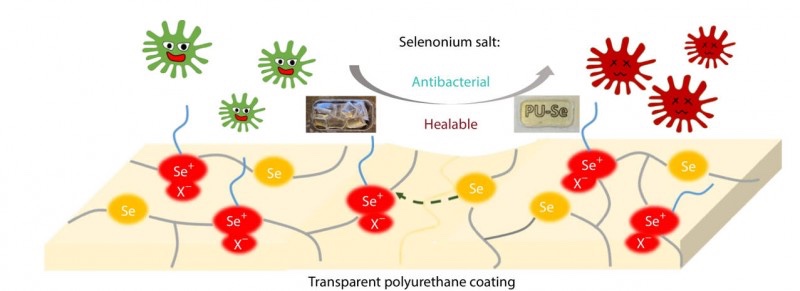
A research collaboration spanning Jiangsu University of Technology, Soochow University, and Ghent University has now solved this puzzle. Writing in the Chinese Journal of Polymer Science, the team describes a transparent polyurethane coating that repairs damage and kills bacteria without losing optical clarity. The advance comes from weaving dynamic selenonium salts into the polymer network, creating a material that behaves like glass at room temperature but can temporarily loosen its internal connections to seal wounds when heated.
Most protective coatings rely on permanent chemical bonds that snap irreversibly when scratched. This new material uses dynamic chemistry, where bonds can break and reform. When researchers applied heat at 140 degrees Celsius, the polymer chains shuffled and reconnected, filling in gouges within about an hour. Under slight pressure, healing time dropped to roughly 20 minutes. It’s a vitrimer-like behavior: the coating stays hard and stable during use but flows just enough to repair itself before locking back into solid form.
Contact-Killing Without Chemical Leaching
The selenonium salts do double duty. Beyond enabling self-repair, they act as contact killers for bacteria. Lab tests against E. coli and S. aureus showed dramatic reductions in bacterial growth as selenonium content increased. At high loading, bacterial colonies were nearly eliminated. Microscopy revealed ruptured membranes, indicating the surface physically breaks apart microbes rather than releasing antimicrobial chemicals that can wash away over time.
That distinction matters for long-term applications. Many antibacterial coatings lose effectiveness because their active ingredients leach out. To test durability, the scientists submerged samples in simulated seawater for two weeks. The material didn’t swell, didn’t cloud, and retained its antibacterial power. Light transmission stayed around 91 percent, nearly identical to high-quality glass. Pencil hardness reached 1H, with adhesion ratings of 4B to 5B, placing it within performance standards for electronics and marine equipment.
“The key lies in the dynamic selenonium chemistry, which allows the polymer network to reorganize during healing while keeping the surface hostile to microbes,” the authors explain.
Recyclability Changes the Lifecycle
What sets this coating apart from earlier self-healing materials is true reprocessability. Even after the researchers ground up the films and remolded them, the recycled material kept the same mechanical strength and chemical structure as the originals. This fits into a circular design model where damaged coatings are melted down and reused rather than discarded, potentially reducing the environmental footprint of high-tech plastics.
The team synthesized the coating through a one-pot process followed by thermal curing, carefully tuning selenonium content. Too little, and healing was weak. Too much, and other properties suffered. Finding that balance allowed the material to combine clarity, durability, antibacterial activity, and recyclability without the usual compromises.
Potential applications span phone screens, underwater lenses, hospital touchscreens, and ship hulls where biofouling from algae and barnacles creates constant maintenance costs. Anywhere scratches and microbial contamination threaten surface integrity, a coating that stays clear while repairing and defending itself could extend product lifespans significantly.
The coating currently needs heat to trigger the fastest healing, and the team is working to tune flexibility and scale up production. If they succeed, the days of living with shattered screens or germ-covered railings might finally be numbered. For now, the study proves we don’t have to choose between a surface that’s tough and one that’s smart enough to fix itself.
Chinese Journal of Polymer Science: 10.1007/s10118-025-3414-7