

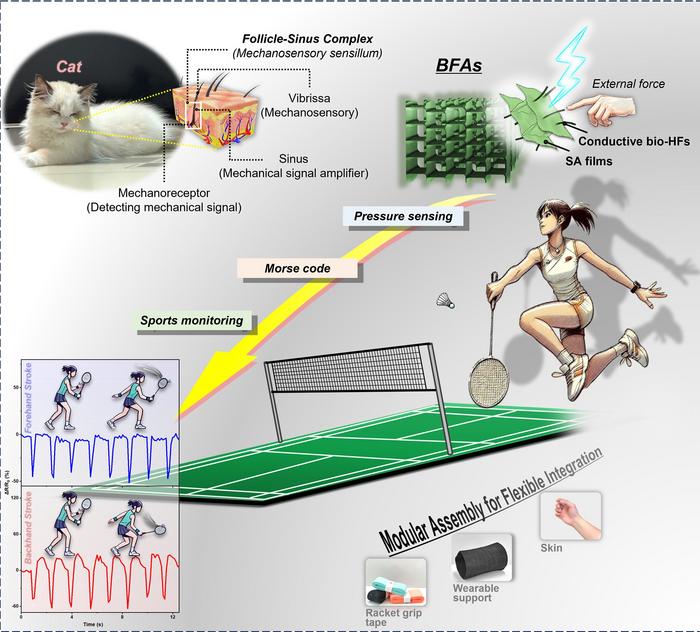
Cat whiskers can detect a breeze so gentle it barely moves dust. Now researchers have copied this biological marvel to create pressure sensors that could transform how athletes train and recover.
The new sensors, inspired by the follicle-sinus complexes at the base of cat whiskers, achieved remarkable sensitivity while being made from sustainable hemp fibers. Unlike traditional sensors that struggle with durability and precision, these biomimetic devices maintain their responsiveness through thousands of compression cycles.
Associate Professor Chunhong Zhu from Shinshu University led the research team that published their findings in Advanced Functional Materials. The scientists created what they call biomass fiber aerogels (BFAs) that mimic both the whisker shaft and the fluid-filled chambers beneath it.
How Cat Biology Inspired Better Technology
Cat whiskers aren’t just stiff hairs. They’re deeply embedded in specialized structures called follicle-sinus complexes, which contain fluid-filled cavities that amplify weak mechanical signals. When a whisker bends slightly, these cavities deform and convert the tiny movement into neural signals cats can perceive.
“Cats, known for their exceptional agility and sensory acuity, rely highly on their well-developed sensory systems for spatial awareness,” Zhu explained. The research team used hemp microfibers coated with polyaniline to mimic whiskers, while porous sodium alginate structures replicated the amplifying sinus cavities.
The manufacturing process avoids energy-intensive methods typically required for carbon-based sensors. Instead, the team used freeze-drying techniques to create ultralight aerogels with densities of just 0.0049 grams per cubic centimeter. The resulting sensors can detect pressure changes with a sensitivity of 6.01 kPa⁻¹ and respond within 255 milliseconds.
From Pulse Monitoring To Athletic Performance
During testing, the sensors successfully captured carotid pulse signals, recognized handwriting patterns, and transmitted Morse code. But the real innovation came in sports applications. When attached to badminton players or integrated into racket grips, the sensors tracked serving techniques, footwork patterns, and stroke dynamics in real time.
The sensors maintained their accuracy through over 1,200 compression cycles, retaining 77% of their initial responsiveness after 500 cycles. They proved resilient to environmental challenges, maintaining functionality even in acidic conditions and high humidity.
Ms. Dandan Xie, the PhD student who worked on fabrication, noted the sensors’ versatility in both skin-attached and equipment-integrated applications. The devices can be molded into custom shapes, opening possibilities for integration into various sports equipment and wearable devices.
This biomimetic approach addresses a key limitation of existing pressure sensors: the trade-off between sensitivity and durability. Traditional designs often sacrifice one for the other, but the cat whisker-inspired structure maintains both qualities through its hierarchical design.
The research offers a sustainable alternative to conventional sensor manufacturing while delivering superior performance. As sports technology increasingly focuses on precise biomechanical feedback, these whisker-inspired sensors could provide athletes and coaches with unprecedented insights into movement patterns and technique optimization.