

The walls of your house might soon store electricity. Scientists have turned ordinary cement into a living battery by embedding electricity-generating bacteria that can power devices and regenerate themselves over time.
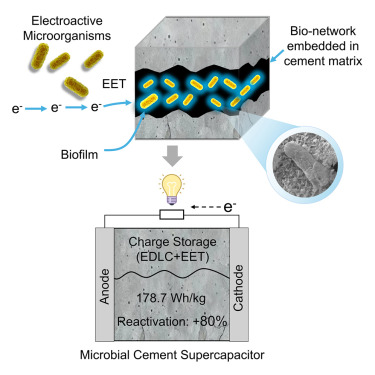
Researchers at Aarhus University embedded Shewanella oneidensis bacteria directly into cement, creating what they describe as the world’s first microbial cement supercapacitor. The bacteria naturally transfer electrons through specialized proteins, turning building materials into energy storage systems.
The performance numbers are striking: the bacterial cement achieved 178.7 Wh/kg energy density and 8.3 kW/kg power density. That’s significantly better than previous cement-based energy storage attempts and approaches some lithium-ion capacitor performance levels.
But the real surprise comes when the microbes start dying. The system doesn’t just stop working.
Death And Resurrection
Even after bacterial death, the cement retains much of its energy storage capability through residual biofilms and conductive networks left behind by the microorganisms. The researchers found that dead bacterial networks can passively maintain electron transport pathways embedded in the cement matrix.
More remarkably, they can bring the system back to life. The team designed integrated microfluidic channels that deliver nutrient solutions containing proteins, vitamins, and growth factors directly to dormant bacterial populations.
‘This isn’t just a lab experiment,’ says lead researcher Qi Luo. ‘We envision this technology being integrated into real buildings, in walls, foundations, or bridges.’
This reactivation process restored up to 80% of original energy capacity in their tests. Six cement blocks connected in series produced enough power to illuminate an LED light, demonstrating scalable energy generation.
The bacterial cement maintained functionality across extreme temperature ranges, from -15°C to 80°C, suggesting resilience for real-world construction applications. At optimal temperatures around 33°C, microbial electron transfer contributed 79% of the total charge storage.
Infrastructure That Lives
The concept opens possibilities for self-powered buildings and infrastructure. Shewanella bacteria are environmentally abundant and naturally occurring, making them sustainable biological resources for large-scale applications.
The researchers stress-tested their material through 10,000 charge-discharge cycles, with the system retaining 85% of initial capacity. Traditional batteries degrade irreversibly over time, but this biological approach offers something different: regeneration.
‘Imagine a regular room built with bacteria-infused cement: even at a modest energy density of 5 Wh/kg, the walls alone could store about 10 kWh,’ Luo explains.
That’s enough electricity to run a standard enterprise server for a full day, embedded directly in structural components that also bear mechanical loads.
The technology remains at proof-of-concept stage, but the implications stretch beyond energy storage. The researchers suggest that microbial networks could potentially serve multiple functions: adaptive conductivity, environmental sensing, and self-healing capabilities.
As renewable energy adoption accelerates, the need for distributed storage grows. Conventional batteries depend on scarce materials like lithium and cobalt. This biological approach uses abundant cement and naturally occurring bacteria, potentially offering a scalable alternative.
Turns out the future of energy storage might be quite literally built into our buildings. The researchers envision house facades doubling as batteries, bridges powering their own sensors, and infrastructure that doesn’t just shelter us but actively generates and stores the energy we need.