

Our brains carry a hidden compass. In a University of Pennsylvania study published in JNeurosci, researchers used fMRI and virtual reality navigation tasks with 15 participants to show that two brain regions, the retrosplenial complex and superior parietal lobule, track facing direction across environments and tasks.
The findings offer new evidence for what neuroscientists call a neural compass, a system that maintains a stable sense of orientation while moving through the world. While rodents are known to have specialized “head direction cells” that accomplish this, confirming a comparable mechanism in humans has long eluded scientists.
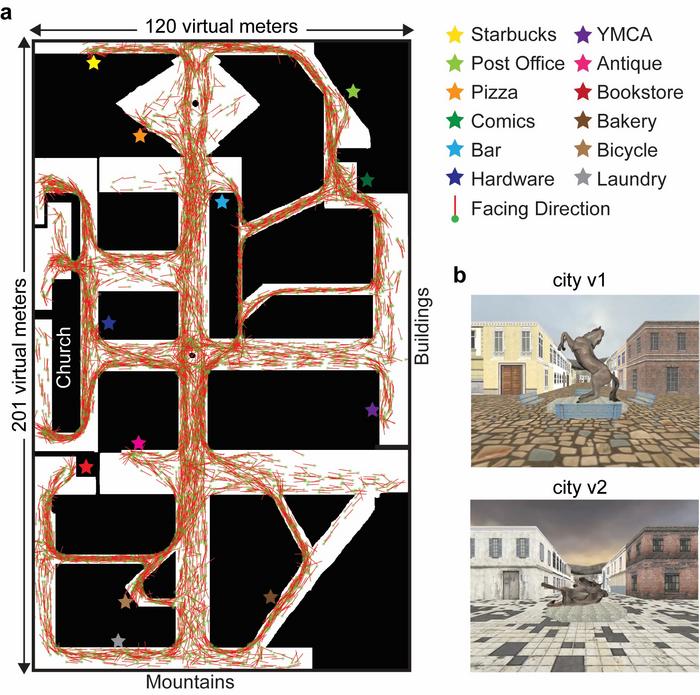
To address this gap, lead authors Zhengang Lu and Russell Epstein, together with colleagues Joshua B. Julian and Geoffrey K. Aguirre, designed a virtual taxi-driving experiment. Participants navigated digital cityscapes projected in virtual reality while their brain activity was monitored in a functional MRI scanner, a tool that tracks brain activity by measuring changes in blood flow. The task required them to pick up and deliver passengers to specific destinations, mimicking the dynamic demands of real-world navigation.
Analysis of the scans revealed that activity in two brain areas, the retrosplenial complex and the superior parietal lobule, was tuned to the direction participants were facing. Importantly, this directional signal persisted even when the visual details of the city changed, when participants moved to different parts of the city, and when they switched between task phases.
In other words, the neural compass appeared to be both stable and flexible, maintaining orientation across shifting contexts. Further analyses suggested that these regions compute direction relative to the city’s north–south axis, rather than relying solely on visual landmarks or immediate surroundings.
“Losing your sense of direction is something that can happen in neurodegenerative diseases, so continuing to explore the function of these two brain regions may help with early detection or monitoring progression of these diseases. We’re also interested in understanding how people navigate using both visual and internal cues—this would relate to the challenges faced by people with impaired vision,” said Epstein, professor of psychology at Penn.
The study helps resolve a long-standing challenge in human neuroscience. Previous imaging experiments often used simplified tasks, such as judging rotated objects on a screen, which may not have captured the full dynamics of natural navigation. By combining immersive virtual reality with advanced encoding models, the Penn team could track how the brain responds during active movement in a realistic environment.
Still, the research has limitations. The sample size was small, with just 15 participants, and the navigation occurred in a digital rather than physical world. While virtual environments provide experimental control, they may not capture every sensory input people rely on when moving through real cities. The authors note that future studies could integrate motion tracking or augmented reality to extend these findings into real-world settings.
The discovery of a neural compass in humans opens doors to multiple lines of inquiry. Understanding how these brain regions integrate
visual and vestibular cues may inform assistive technologies for people with blindness or spatial disorientation. It could also provide biomarkers for diseases like Alzheimer’s disease, where patients often become lost even in familiar environments.
The work underscores how the brain balances flexibility with consistency. Our environments change constantly, from day to night or summer to winter, yet we maintain a coherent sense of direction. Identifying the retrosplenial complex and superior parietal lobule as key nodes of this system gives researchers a firmer map of the brain’s navigation circuitry.
For now, the findings confirm what neuroscientists have long suspected but struggled to demonstrate: that humans, like other animals, carry an internal compass. It is not magnetic but neural, etched into the circuitry of our brains and tuned to the geometry of the world around us.
Journal of Neuroscience. DOI: 10.1523/JNEUROSCI.1765-24.2025