

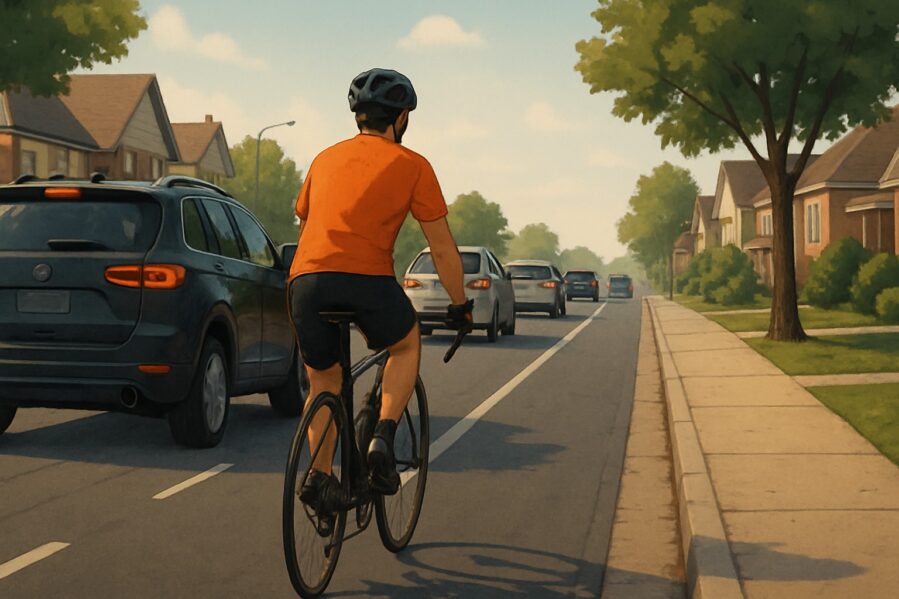
Imagine cruising through your neighborhood at 50 kilometers per hour, windows down, feeling the breeze. Now imagine a cyclist trying to navigate that same street, heart pounding as cars whip past just inches away. A new study from RMIT University suggests we can fix this mismatch without turning your commute into a crawl.
Researchers modeled every road in Greater Melbourne and found something surprising: dropping residential speed limits from 50kph to 30kph slashes cyclist stress by 30% while adding only about one minute to short local car trips. The findings arrive just as Victoria rolls out new legislation allowing councils to propose 30kph zones near schools and on local streets.
The Stress Test
The team rated roads using a Level of Traffic Stress framework, a system that classifies streets from LTS-1, where even your grandmother would feel comfortable pedaling, to LTS-4, the kind of multi-lane arterial that makes seasoned riders grip their handlebars a little tighter. They factored in speed limits, traffic volume, cycling infrastructure, and road hierarchy using OpenStreetMap data combined with government travel surveys and agent-based transport modeling.
Under current conditions, cyclists spend about 55% of their trips on low-stress roads (LTS-1 and LTS-2). Drop residential speeds to 30kph, and that figure jumps to 70% for all trips and 74% for trips under two kilometers. More than two-thirds of an average bike ride shifts to calmer streets.
“Slowing traffic makes bicycle riding less stressful, encouraging more people to choose bikes as a safe and viable mode of transport,” said study lead author Dr. Afshin Jafari.
The mode choice model confirmed what many cyclists already know: high-stress routes kill ridership. The analysis showed a strong negative correlation between cycling likelihood and exposure to LTS-3 and LTS-4 segments, those nerve-wracking stretches where painted lines feel more like suggestions than protection.
The Car Question
Speed limit reductions often face pushback over fears of gridlock and endless delays. The RMIT team anticipated this, running simulations on 717,740 car trips to measure the actual impact. The verdict? Average travel time across all car trips remained essentially unchanged. Even for trips where at least half the distance ran through newly slowed residential streets, the increase was about one minute, from roughly four minutes to five.
Why so minimal? Most car journeys use residential streets only at the beginning and end, spending the bulk of travel time on arterials and collectors where speed limits remain untouched. The 30kph zones function like neighborhood speed bumps, brief slowdowns that barely register on the overall clock.
“Most trips should use residential streets only at the start and finish, so 30kph rather than 50kph on those short sections makes little difference,” Jafari explained.
The simulations also revealed an unexpected bonus: daily traffic volumes on residential streets declined slightly under both the 40kph and 30kph scenarios. Motorists naturally gravitated toward main roads, leaving neighborhoods quieter and safer, especially for children walking or playing.
Jafari noted that outer suburban areas, often lacking even footpaths, stand to gain the most. Installing physical barriers on every local street would be ideal but demands considerable time and capital. Lowering default speed limits, by contrast, can be implemented quickly and cheaply while longer-term infrastructure projects proceed.
The study analyzed 69,176 trips from the Victorian Integrated Survey for Travel and Activity, routing each one through the network under baseline, 40kph, and 30kph scenarios. Researchers used impedance-based algorithms to account for intersections and detours, recognizing that cyclists might accept routes up to 15-20% longer to avoid high-stress roads.
International evidence supports the findings. Research from European cities shows 30kph zones reduce road crashes by 23%, fatalities by 37%, and injuries by 38%. Lower speeds also cut noise pollution by up to 40%, a win for urban livability.
The study did not explicitly model the resulting uptake of cycling, a logical next step. Combining the updated LTS network with the mode choice model inside the agent-based simulation would allow researchers to capture both the shift from short car trips to cycling and any additional changes in car travel times generated by that shift.
Still, the message is clear: slowing down on residential streets makes cycling safer without meaningfully disrupting car traffic. As cities grapple with congestion, pollution, and public health, 30kph zones offer a practical interim step toward building truly bike-friendly networks.
Journal of Cycling and Micromobility Research: 10.1016/j.jcmr.2025.100085