

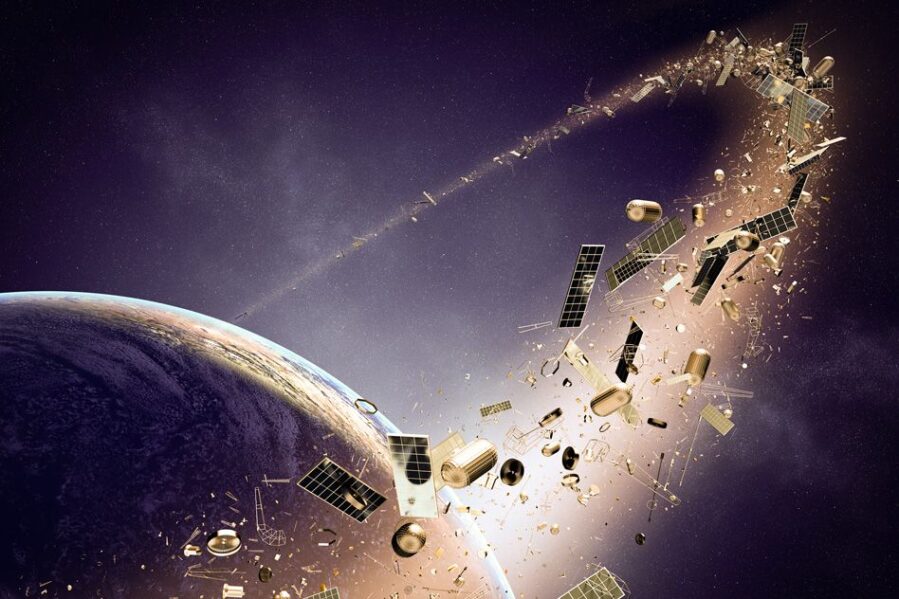
Picture a collision at 15,000 miles per hour between a dead Soviet satellite and a discarded rocket stage. The impact doesn’t make a sound in the vacuum, but it creates thousands of new projectiles, each one capable of punching through aluminum like tissue paper. Now multiply that scenario across 70 years of space launches, and you start to understand why astronauts on the International Space Station occasionally have to shelter inside their escape capsule, waiting to see if invisible shrapnel will tear through their walls.
The orbital debris problem isn’t new. What’s new is that researchers have finally figured out the economic puzzle that’s prevented anyone from doing anything about it.
Hao Chen, an assistant professor at Stevens Institute of Technology who studies space systems design, puts the danger in stark terms. Over 100 million objects smaller than one centimeter are circling Earth right now, plus countless larger pieces. Every single one is a threat.
“Even if a tiny, five-millimeter object hits a solar panel or a solar array of a satellite, it could break it. And we have over 100 million objects smaller than one centimeter in orbit.”
Space operators spend millions on collision avoidance, constantly maneuvering satellites to dodge debris, burning fuel they’d rather save for actual operations. But here’s the problem: nobody wants to pay to remove the junk because there’s no direct financial return. You clean up orbit, and your competitor’s satellite benefits just as much as yours does. Classic free-rider economics.
Three Flavors of Orbital Garbage Removal
Chen and his collaborators analyzed three cleanup methods in their study published October 5 in the Journal of Spacecraft and Rockets. Each requires a specialized remediation satellite, essentially a space tow truck, but the approaches vary wildly in cost and ambition.
The cheap option is uncontrolled reentry. Grab the debris, drag it down to about 350 kilometers altitude, let go. Atmospheric drag eventually pulls it down somewhere on Earth. You don’t know where, exactly, which seems like it might cause some diplomatic incidents, but it’s affordable.
Controlled reentry costs more. The cleanup vehicle hauls debris all the way down to 50 kilometers before release, ensuring a predictable descent path. That extra 300 kilometers requires substantially more fuel, and the vehicle has to climb back up for the next piece. But you avoid dropping a dead satellite on someone’s capital city.
Then there’s the ambitious scenario: orbital recycling. Transport debris to a space-based recycling center where aluminum from old satellites gets melted down and reformed. The transportation costs are high, but you’re avoiding the $1,500-per-kilogram expense of launching raw materials from Earth. You’re essentially mining the junkyard, which sounds like science fiction but makes cold economic sense.
Game Theory Meets the Cosmic Junkyard
Here’s where Chen’s work gets interesting. His team used game theory, specifically Nash Bargaining Theory developed by mathematician John Nash, to crack the incentive problem. How do you fairly split costs and benefits between debris remediators who do the actual work and space operators who run satellites that benefit from cleaner orbits?
Right now the structure is completely broken. Remediators would shoulder all the costs for missions, technology, and operations while gaining nothing directly. Meanwhile space operators would save millions on fuel and collision avoidance but wouldn’t have to contribute anything. They’d just enjoy the cleaner, safer orbital environment someone else paid for.
“The debris remediators pay for the missions, the technology, and the actual work. Without some kind of financial incentive, they don’t really gain anything from it; they bear all the costs while others reap the benefits.”
Chen’s proposed solution involves creating a fee system where space operators pay remediators based on the collision risk reduction they receive. The math shows genuine surplus value can be generated from debris removal, enough to make it profitable for cleanup companies while still saving operators money compared to their current dodge-and-weave approach. Both sides come out ahead, which is the whole point of Nash’s framework.
Of course, implementing this requires an oversight agency to set fees, collect payments, and enforce participation. Not exactly simple when you’re coordinating competing nations and private companies, each with their own orbital assets and political agendas. But Chen argues the alternative is worse: without intervention, debris keeps accumulating from current and future launches, making orbital space increasingly dangerous and expensive to use. Eventually you hit a cascade effect where collisions create debris that causes more collisions, exponentially multiplying the junk until certain orbits become unusable.
The research, funded by NASA’s Office of Technology, Policy, and Strategy, will be presented at NASA headquarters on December 10. Whether space operators will actually agree to pay for cleaning up a mess they helped create remains an open question. For now, satellites keep dodging, astronauts keep sheltering, and the junkyard above our heads keeps growing. Chen’s framework offers a path forward, assuming anyone wants to take it.