

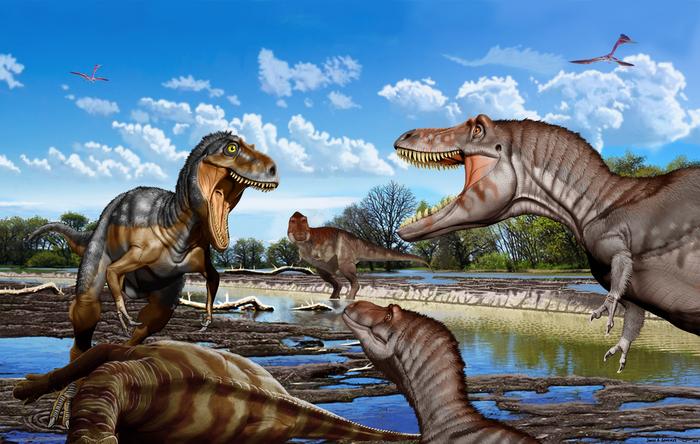
The throat bone did not lie. After decades of paleontologists insisting that Nanotyrannus was just a scrawny adolescent Tyrannosaurus rex, a microscopic examination of a single hyoid bone has proven them wrong. The 18-foot predator was fully grown when it died, a distinct species hunting alongside its gigantic cousins in the final days before the asteroid.
Christopher Griffin of Princeton University did not expect this result. Nobody did. The scientific consensus had calcified around the idea that Nanotyrannus lancensis was simply T. rex’s awkward teenage phase, a growth stage between hatchling and 40-foot monster. Griffin’s team set out to confirm this with bone histology, the standard technique of slicing fossilized tissue thin enough to examine under magnification.
But the Nanotyrannus holotype, a skull discovered in 1942 and housed at the Cleveland Museum of Natural History, presented a problem. Skulls are riddled with air pockets and structural quirks that make them useless for age determination. Paleontologists typically section leg bones or ribs, reading growth patterns like tree rings. This specimen had neither.
What it did have was an intact hyoid, the small horseshoe-shaped bone that anchors the tongue. No one had proven whether throat bones preserved reliable maturity signals in dinosaurs. Griffin assembled experts to test the approach across living birds, crocodiles, lizards, and additional dinosaur fossils. The growth signals turned out to be remarkably consistent.
Growth Records Contradict Size Expectations
The Natural History Museum of Los Angeles County maintains the only complete T. rex growth series in existence, spanning from juvenile through subadult stages. Zachary Morris, a postdoctoral fellow at the museum’s Dinosaur Institute, compared hyoid bones from these specimens with the controversial Nanotyrannus skull.
The teenage T. rex showed rapid growth in both limbs and throat bone. Thomas, a larger subadult specimen, displayed continued development despite weighing several tons. But the Nanotyrannus holotype, though dramatically smaller than either, showed clear hallmarks of skeletal maturity. The growth plates had closed. The bone density had stabilized.
“At the time, the prevailing consensus was that the Nanotyrannus holotype skull represented an immature Tyrannosaurus rex, and was not a separate species,” Griffin said. “Our expectations were simply following along with that consensus, but once we sampled the hyoid and saw features that strongly indicated maturity, we knew that we had to examine that idea more skeptically.”
Ashley Poust, curator of vertebrate paleontology at the University of Nebraska State Museum, had assumed the hyoid would confirm juvenile status. Instead, the bone showed something closer to adult architecture. “This small-bodied meat-eater’s hyoid bone showed growth patterns that suggest maturity or approaching maturity,” he said. “This lets us be confident in keeping the name Nanotyrannus, because this animal is clearly not on a growth path to becoming a Tyrannosaurus rex.”
The finding means Late Cretaceous North America supported at least two apex predators simultaneously. Adult Nanotyrannus competed directly with juvenile T. rex for mid-sized prey, while fully grown T. rex dominated a separate ecological tier. Picture a 7-ton adolescent T. rex encountering a mature Nanotyrannus weighing perhaps 2 tons, both eyeing the same hadrosaur carcass. Both had bone-crushing jaws. Both had binocular vision. The ecosystem was more dangerous, and more crowded, than previously imagined.
Hyoid Bones Open New Research Pathways
Poust noted the technique might prove valuable for fragmentary fossils lacking traditional limb bones. “It’s expanding, in a small way, the ability to learn about animals’ past lives,” he said. Museum collections worldwide contain isolated skulls that might yield maturity data if their hyoid bones survived fossilization.
The research, published December 4 in Science, follows another recent paper in Nature examining a different suspected Nanotyrannus fossil from Montana. The convergence of independent evidence from multiple specimens strengthens the taxonomic case considerably. The holotype specimen is particularly important because it formally defines the species. Any other Nanotyrannus fossils must be compared against this single skull.
“Since this specimen is mature, this definitively shows that Nanotyrannus is distinct from Tyrannosaurus,” Griffin said.
Caitlin Colleary, senior author and curator at the Cleveland Museum of Natural History, acknowledged the tradeoff between preservation and discovery. The team created 3D scans and molds before sectioning the hyoid. “In this instance, it was totally worth it because we gained so much more than we lost.”
The skull was originally classified as Gorgosaurus in 1942, then reidentified as Nanotyrannus lancensis in 1988 after decades of reexamination. Each generation of paleontologists brings new techniques. The hyoid bone, overlooked for 80 years, finally revealed what leg bones and vertebrae could not.
What remains unclear is how two large predators divided resources without driving each other extinct. Understanding these final ecosystems before the asteroid impact requires knowing not just what lived, but how different species coexisted in a world that would vanish in an afternoon 66 million years ago.