

Fossil Graveyard In Qatar Recasts The History Of The Arabian Gulf
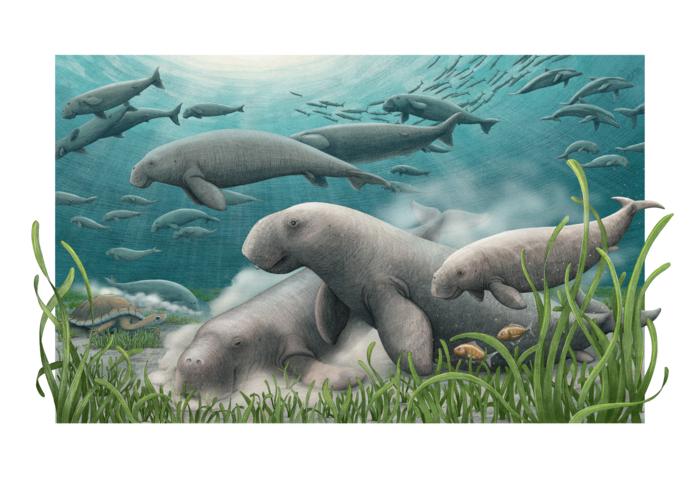
The sun-drenched, rocky desert of southwestern Qatar holds a powerful contradiction: a vast, 21-million-year-old cemetery of marine mammal bones. This fossil site, locally known as Al Maszhabiya, or the “dugong cemetery,” dates back to the Early Miocene epoch and has yielded a discovery that re-engineers the ecological history of the Arabian Gulf. Researchers have named the remains of a tiny, ancient sea cow found there Salwasiren qatarensis, a distant relative of the modern dugong.
In a major collaboration, scientists from the Smithsonian National Museum of Natural History and Qatar Museums have introduced a species that was a true miniature. Estimated to weigh only 250 pounds – about the size of an adult Giant Panda – Salwasiren was one of the smallest sea cows ever discovered. Their findings, published in the journal PeerJ, reveal that the Gulf’s critical seagrass meadows have been actively shaped, or “engineered,” by sea cows for over 20 million years, a vital environmental role that the modern dugong continues to occupy today.
The contemporary dugong, a sturdy aquatic herbivore, is essential to coastal health. These creatures, often simply called sea cows, use their sensitive, bristled snouts and dolphin-like tails to graze on seagrass. In doing so, they function as ecosystem engineers. Their feeding creates distinct trails and pits, a process called bioturbation, which mixes the seafloor sediment and releases trapped nutrients back into the water. The health of the entire ecosystem improves, benefiting numerous marine plants and animals. Crucially, the Arabian Gulf supports the world’s largest individual herd of these animals.
Yet, the modern dugong population is under severe stress. They face threats from accidental capture by fishermen, coastal pollution, and environmental pressure as rising temperatures and salinity levels push the seagrass meadows they depend on toward their physiological limits. This modern vulnerability lends urgency to the prehistoric record.
The story hidden in the rocks of Al Maszhabiya began simply in the 1970s, when geologists mistook the abundant, scattered bones for those of ancient reptiles. Paleontologists returned decades later, realizing the wealth of sea cow remains. Today, Al Maszhabiya is recognized as the world’s richest known assemblage of fossilized sea cow bones, documenting material across more than 170 individual locations in a small area.
The location and density of the bonebed provide a window into the Early Miocene. At that time, before the current desert formed, this site was part of a warm, shallow, incredibly fertile marine environment. It was a region of high biodiversity, shared by prehistoric dolphins, sea turtles, sharks, and barracuda-like fish. The seafloor itself was carpeted with vast, lush underwater pastures of seagrass, a rarely-fossilized resource whose presence is inferred by the herbivores that ate it.
In those long-ago waters, the diminutive Salwasiren would have navigated slowly. Unlike some modern dugongs, which can be eight times its weight, this ancient species was compact and possessed intriguing ancestral traits. Its fossils show it still retained small, vestigial hind limb bones, a feature that modern dugongs and manatees have since lost through evolution. It also had a straighter profile to its snout and smaller tusks than its living cousins.
The species name, Salwasiren qatarensis, pays homage to its home: “Salwasiren” references the nearby Bay of Salwa, a modern dugong habitat, while “qatarensis” honors the nation of Qatar. Nicholas Pyenson, a curator at the Smithsonian’s National Museum of Natural History who helped lead the study, emphasizes the profound continuity of the finding.
We discovered a distant relative of dugongs in rocks less than 10 miles away from a bay with seagrass meadows that make up their prime habitat today. This part of the world has been prime sea cow habitat for the past 21 million years – it’s just that the sea cow role has been occupied by different species over time.
The sheer, overwhelming concentration of bones at Al Maszhabiya provides the proof for Salwasiren‘s ecological function. Because the fossil bed features a single dominant species, the researchers concluded that the ancient animals were performing the identical habitat-shaping function as their living descendants. The density confirms that Salwasiren was a crucial, early example of an ecological engineer in the Arabian Gulf.
This finding powerfully demonstrates the concept of repeated evolution. The ecological requirements of the Arabian Gulf’s seagrass ecosystems have remained constant for 20 million years, demanding a large herbivore to maintain them. While the specific animal filling that niche has changed – a complete turnover of the evolutionary cast – the job of the sea cow has not.
For conservationists, this deep history is immensely valuable. By looking backward, scientists can glean insights that might help protect the current dugong population. Ferhan Sakal, an archaeologist with Qatar Museums and a paper coauthor, notes that the rocks provide vital lessons for navigating the rapid challenges of climate change.
If we can learn from past records how the seagrass communities survived climate stress or other major disturbances like sea-level changes and salinity shifts, we might set goals for a better future of the Arabian Gulf.
This historical context offers a powerful baseline for resilience. It proves that the region has maintained sea cow populations through deep geologic time, suggesting an inherent strength in the Gulf’s coastal structure that can be utilized in future management plans. The area is not merely a modern dugong habitat, but their ancient and enduring ecological home.
The significance of the site extends beyond paleontology. Sakal and his colleagues are already working to nominate Al Maszhabiya for protection as a UNESCO World Heritage site, cementing the critical connection between the nation’s past and present. Faisal Al Naimi, director of Archaeology at Qatar Museums, highlights that the dugong’s heritage, stretching deep into geologic time, is integral to the country’s identity.
To ensure the legacy is accessible, the researchers went beyond excavation. They created digital 3D models of Salwasiren qatarensis‘s skull, vertebrae, and other skeletal elements. These open-source models allow researchers, students, and the public to examine the anatomy and the excavation process online, ensuring the discovery is preserved for all to study, in the desert and on the screen.
A Blueprint For Climate Resilience
The story of Salwasiren provides a crucial blueprint for understanding marine ecosystem resilience. The ability of successive sea cow species to successfully anchor the same ecological niche across 20 million years, enduring massive climatic and geological disturbances, speaks to the profound, deep stability of the Gulf’s coastal foundation. Data spanning such immense timescales, drawn from extinct animals, offer far greater insight than short-term environmental monitoring.
The fossil bed was not exclusive to sea cows. It also included other ancient vertebrates, such as sharks and turtles, indicating that Salwasiren was not an isolated inhabitant but a foundational element of a rich and complex food web. The bonebed is so extensive that Pyenson suggests Al Maszhabiya may yet reveal more species of dugong relatives, possibly demonstrating a community of several sea cow types coexisting in the Early Miocene.
In protecting the Al Maszhabiya area, as the researchers plan, they safeguard more than just bones; they protect a 20-million-year-old success story. It stands as an enduring record of the persistent partnership between the sea cow and the seagrass, a quiet, powerful cycle that has driven life in the Arabian Gulf across geologic ages. By preserving this narrative, scientists hope to ensure the modern dugong population survives and that the Gulf remains a prime sea cow habitat for millennia to come.