

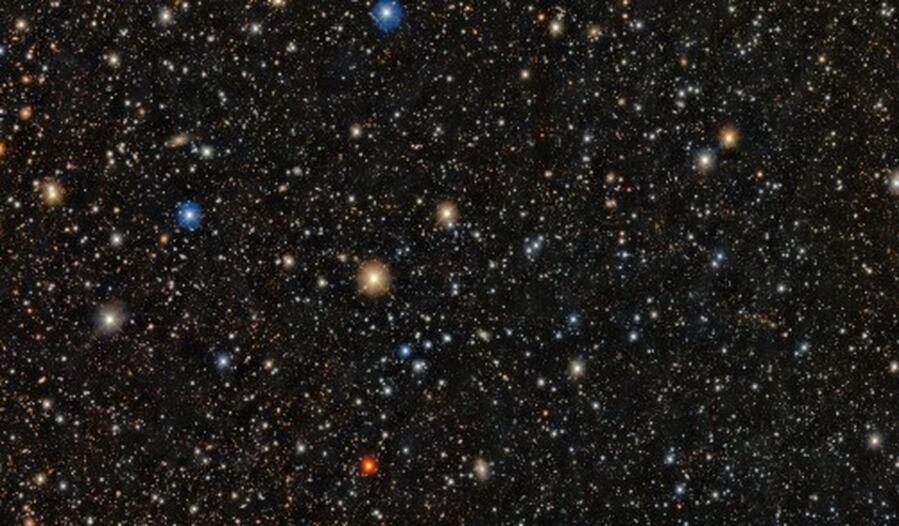
A narrow-band filter on a camera the size of a refrigerator, bolted to a four-metre telescope in the Chilean Andes, sorts starlight by its calcium content. It does this across thousands of stars at once, building a chemical map of ancient galaxies from the ground up. Most of what it finds is ordinary. But in February 2024, among a few hundred candidate stars near the tiny dwarf galaxy Pictor II, the filter flagged something that sat far outside the distribution, a red giant whose spectrum barely whispered of calcium at all. It was called PicII-503. Anirudh Chiti, a Brinson Prize Fellow at Stanford University, had the follow-up observations fast-tracked.
What his team found, confirmed across two telescopes and many hours of spectrograph time, is the most chemically primitive star ever measured outside our own galaxy.
PicII-503 contains less iron than any star previously observed beyond the Milky Way, less than one forty-three-thousandth of the solar iron abundance, and its calcium is even scarcer still, around one hundred and sixty-thousandth of the sun’s. Alongside this near-total absence of heavy elements, the star carries an extraordinary overabundance of carbon: roughly three thousand times more carbon relative to calcium than the sun shows. That particular combination, vanishingly low iron and an extreme surplus of carbon, is a signature long observed in the rarest stars in the Milky Way’s outer halo, and its origin has been one of the outstanding mysteries in stellar astrophysics. PicII-503 may have settled it.
The first stars in the universe formed from essentially nothing. Hydrogen and helium, leftover from the Big Bang, collapsed under gravity into the first generation of massive, brilliant, and short-lived objects. When they died, they did so violently, seeding the interstellar medium with the first traces of heavier elements. Second-generation stars, born from that enriched gas, carry those traces like fossils. The lowest-metallicity stars known are, in this sense, direct records of individual supernovae from the universe’s very first epoch. Chemistry as archaeology. The trouble has been that nobody knew where these ancient halo stars actually came from.
The prevailing suspicion was relic dwarf galaxies: small, ancient systems that formed early, were enriched by only one or a handful of supernovae, and were eventually absorbed into the Milky Way over billions of years. But demonstrating that conclusively required finding an unambiguous second-generation star still sitting inside one of those relic systems, rather than already absorbed into the halo. PicII-503 is that demonstration. Pictor II is a satellite galaxy of the Large Magellanic Cloud, itself a satellite of the Milky Way, and it is one of the smallest galaxies known, containing perhaps a few thousand stars and older than ten billion years. It is, in the technical jargon, an ultra-faint dwarf, and it has barely moved from where it formed.
The discovery required an instrument called the Dark Energy Camera, mounted on the Víctor M. Blanco telescope at Cerro Tololo Inter-American Observatory. More specifically it required the MAGIC Survey, a 54-night programme using a specialised narrow-band filter tuned to the calcium H and K absorption lines, which are extraordinarily sensitive to metal content. That sensitivity allowed the team to estimate, from imaging data alone, which stars in Pictor II’s vicinity were candidates for spectroscopic follow-up. “Without data from MAGIC,” Chiti says, “it would have been impossible to isolate this star among the hundreds of other stars in the vicinity of the Pictor II ultra-faint dwarf galaxy.”
The spectroscopic confirmation came in stages. First the MagE spectrograph on the six-and-a-half-metre Magellan telescope confirmed the star’s velocity was consistent with Pictor II membership. Then thirteen separate forty-five-minute exposures on the Very Large Telescope’s X-Shooter spectrograph, obtained across ten days in March 2025 under Director’s Discretionary Time, gave the team the signal-to-noise they needed to push the iron abundance to its formal upper limit. The calcium feature, typically the strongest metal line in any stellar spectrum, was barely detectable. The carbon feature, by contrast, was unmistakable.
That pairing is the key. Stars known as carbon-enhanced metal-poor stars, or CEMP stars, are scattered through the Milky Way halo in comparatively small numbers, and their extreme carbon enrichment has attracted two main competing explanations. One invokes mass transfer from a binary companion on the asymptotic giant branch; such stars typically carry an enhancement in barium and other heavy elements produced by slow neutron capture. PicII-503 shows no detectable barium at all, which effectively rules that pathway out. The other explanation, and the one this discovery supports, involves what theorists call faint or low-energy supernovae from first-generation stars: explosions in which heavy elements like iron form close to the stellar core and collapse back into the remnant, while lighter elements including carbon are carried outward and ejected. Small galaxies are the key to this scenario, because a more energetic explosion, a hypernova, would simply blast its chemical products right out of a system as weakly gravitating as Pictor II. The fact that PicII-503 has iron at all, however little, means something did stay put, which places an upper limit on the energy of the explosion that created it.
Fitting the star’s measured abundances against yield models from first-star supernovae, the team constrained the progenitor to a star lighter than 45 solar masses and an explosion energy below roughly twice the canonical supernova energy. A best-fit scenario, assuming a standard calcium-to-iron ratio for core-collapse supernovae, preferred a modest twelve-solar-mass star with an explosion energy around three-tenths of the canonical value. Faint, in other words. Exactly the kind of event that could occur in the smallest dark matter minihalos and leave its chemical signature behind.
There is a further twist. PicII-503 lies not at the centre of Pictor II but well beyond it, at more than five times the galaxy’s half-light radius. The handful of previous observations that hint at metallicity gradients in ultra-faint dwarfs, with the most metal-poor stars preferentially in the outskirts, are consistent with this, but the statistics have been limited. This star adds meaningful weight to the pattern. The implication, perhaps, is that the initial enrichment events in these primordial systems were not uniformly distributed, that the first supernovae tended to enrich the periphery first, or that the earliest second-generation stars formed there preferentially.
“What excites me the most,” Chiti says, “is that we have observed an outcome of the very initial element production in a primordial galaxy, which is a fundamental observation.” The James Webb Space Telescope can observe galaxies at the epoch of reionization and beyond, but it cannot resolve individual stars in systems as faint as Pictor II at those distances, and the chemical signatures it does detect in early galaxies lean toward different enrichment processes, including nitrogen enhancements in more massive systems that point to different stellar physics entirely. The local universe’s surviving relic dwarfs, in this sense, are accessible time machines. What Webb sees at redshift ten and what Chiti’s spectrograph sees in the halo of a galaxy forty-six thousand light-years away are complementary records of different corners of the same early universe.
The MAGIC Survey is still running, due to complete its southern-hemisphere coverage around 2026. Thirty-metre-class telescopes are on the horizon. If PicII-503 was found in the outskirts of one faint galaxy with existing instruments, there is reasonable hope that many more second-generation stars are waiting in the edges of nearby relic systems, each one carrying a slightly different chemical imprint of the specific supernova that seeded it. The universe’s first stars have been gone for more than thirteen billion years. Their children, it turns out, are still out there.
Frequently Asked Questions
What makes PicII-503 so unusual compared to other ancient stars? PicII-503 has the lowest measured iron and calcium abundances of any star known outside the Milky Way, and it carries an extreme overabundance of carbon around three thousand times higher than expected relative to calcium. That combination places it clearly in the category of second-generation stars, meaning it formed directly from gas enriched by a single first-generation supernova. Most other ultra-faint dwarf galaxy stars have iron abundances roughly ten times higher, so this star sits in essentially uncharted chemical territory.
Why does the small size of Pictor II matter for understanding how PicII-503 formed? The mass of a galaxy determines which supernovae can retain their chemical products. A high-energy explosion, called a hypernova, would simply blast its yields out of a tiny system like Pictor II. The fact that PicII-503 exists with its particular mix of elements means the supernova that enriched it must have been relatively low-energy, a so-called faint supernova. This finding supports a specific model for how the most carbon-rich ancient stars form, one that predicts they should be found preferentially in the smallest, least massive early galaxies.
What is the MAGIC Survey and why was it needed to find this star? MAGIC stands for Mapping the Ancient Galaxy in CaHK. It uses a narrow-band filter sensitive to calcium absorption features, which allows astronomers to estimate the metal content of thousands of stars from imaging data alone, without requiring time-consuming individual spectroscopy for every candidate. Without that capability, identifying PicII-503 as a priority target from among hundreds of stars near Pictor II would have been essentially impossible.
How does this discovery help explain the mysterious carbon-rich stars in the Milky Way halo? Carbon-enhanced metal-poor stars, known as CEMP stars, are scattered through the outer Milky Way in small numbers, and their origin has been debated for decades. PicII-503, which shows the same extreme carbon signature while still sitting inside the relic dwarf galaxy that formed it, provides direct evidence that CEMP stars in the halo were born in ancient dwarf systems like Pictor II that later merged with the Milky Way. It ties together two otherwise separate lines of evidence.
Could JWST see stars like PicII-503 in the early universe? Not directly. The James Webb Space Telescope can observe very early galaxies at enormous distances, but it cannot resolve individual stars in systems as faint as Pictor II at those redshifts. It also tends to detect chemical signatures from more massive early galaxies, which show different enrichment patterns. Stars like PicII-503, preserved in local relic galaxies, give access to the chemistry of the very smallest early systems in a way that even JWST cannot reach.
DOI / Source: https://doi.org/10.1038/s41550-026-02802-z