

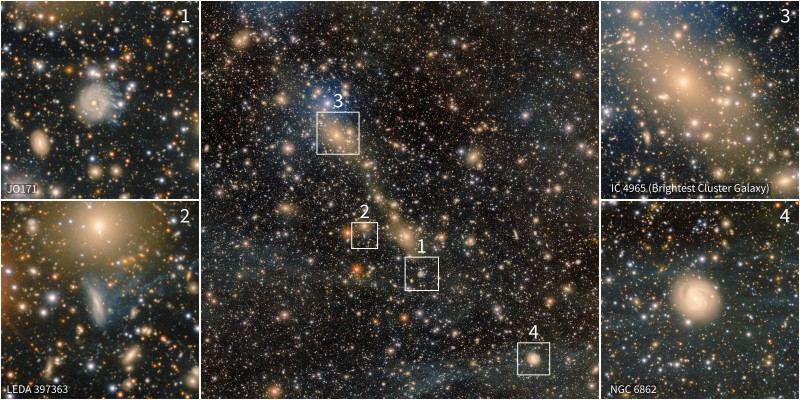
It took twenty-eight hours under the pristine Chilean sky for the Dark Energy Camera to expose a secret hidden in plain sight.
Deep in the constellation Triangulum Australe, more than 700 million light-years away, two galaxy groups are colliding. Their violent dance has cast a gauzy river of orphaned stars across space, a phenomenon astronomers call intracluster light. By photographing that faint glow in unprecedented detail, researchers have reconstructed part of Abell 3667’s history and offered a tantalizing preview of what the Vera C. Rubin Observatory will soon deliver. Intracluster light, Abell 3667 and DECam stand at the heart of this cosmic detective story.
Why Should We Care?
Galaxy clusters are among the Universe’s largest structures, and their growth helps scientists test models of dark matter and cosmic evolution. Intracluster light acts like forensic dusting powder, revealing where galaxies have clashed and how stars were ripped free. If we can read those traces across thousands of clusters, might we finally learn how dark matter sculpts the cosmos?
Key Findings
- Deepest portrait to date The image reaches surface brightness near 30 mag arcsec−2, the threshold where night sky glow usually overwhelms faint objects.
- Four-hundred-kiloparsec star bridge A rectangular ribbon of light connects the two brightest cluster galaxies, marking their first close pass.
- Color clues A flat g-r color across the bridge indicates the stars were stripped rapidly during a recent merger rather than slowly over time.
- Foreground cleaned Advanced sky-subtraction separated Milky Way dust filaments from authentic cluster light, ensuring a reliable signal.
- Rubin Observatory preview DECam’s single-field depth matches what Rubin will achieve across the southern sky by year eight of its survey.
From Pixels to Physics
Capturing intracluster light is like photographing smoke lit by a dying campfire. DECam’s 570-megapixel detector gathered starlight so faint it is less than one percent of the night sky’s brightness. Scientists then applied a custom pipeline that restores the raw background, fits sky patterns, removes stellar halos and finally stacks the clean frames. The result is a map of stripped stars stretching roughly 400,000 light-years between the cluster’s two dominant galaxies.
What the Bridge Reveals
The bridge’s uniform color suggests a burst of tidal stripping during a head-on encounter. Shells wrapped around one galaxy and plumes extending from both point to the same event. These features match simulations in which two midsized clusters graze past each other, their mutual gravity yanking stars into intergalactic space.
The Road to Rubin
DECam’s achievement foreshadows a data avalanche. Starting later this year, Rubin Observatory will image the entire southern hemisphere every few nights for a decade, stacking exposures to depths that match or exceed this single DECam field. Millions of clusters will emerge from that survey. With six optical filters instead of two, astronomers will measure ages and metallicities of intracluster stars, turning ghostly bridges into timelines of cosmic construction.
Real-World Echoes
Beyond pure curiosity, tracing cluster assembly refines the cosmic distance ladder, improves lensing maps that anchor dark energy studies and sharpens mass estimates that feed climate-scale simulations. In short, every pixel of faint starlight tightens the screws on our theories of how the Universe came to look the way it does.
Journal and DOI
The Astrophysical Journal Letters
“The Intracluster Light of Abell 3667 Unveiling an Optical Bridge in LSST Precursor Data”
DOI 10.3847/2041-8213/ade8f1