

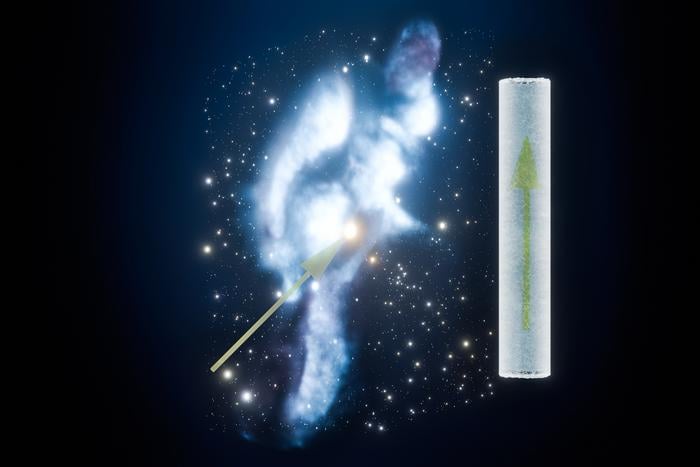
Three hundred kilograms of Antarctic ice, shipped from a freezer in Bremerhaven to a laboratory in Dresden, reduced by weeks of chemical processing to a few hundred milligrams of dust. That dust then sorted, atom by atom, until only a handful of iron nuclei remain out of an initial ten trillion. What the researchers were hunting, buried in ice laid down between 40,000 and 80,000 years ago, was the faint chemical fingerprint of a star that exploded millions of years before the first modern humans walked the earth. They found it. And what it tells us about the region of space our solar system currently inhabits is, frankly, rather strange.
The finding, published this week in Physical Review Letters by an international team led from the Helmholtz-Zentrum Dresden-Rossendorf (HZDR), confirms something scientists had long suspected but couldn’t prove: that the wispy cloud of gas and dust our solar system is presently passing through carries within it the chemical residue of an ancient stellar explosion. The cloud itself, called the Local Interstellar Cloud, has apparently been quietly accumulating this radioactive debris for tens of thousands of years. We have, in effect, been swimming through the aftermath of a supernova.
A Radioactive Isotope and Its Unlikely Journey
Iron-60 is not the sort of element you encounter in everyday chemistry. A radioactive isotope of ordinary iron, it forms only in the hearts of massive stars and gets flung into space when those stars detonate. It has a half-life of about 2.6 million years, which means it decays relatively quickly by cosmic standards; any iron-60 that formed alongside our solar system four and a half billion years ago is long gone. So when researchers began finding iron-60 in geological archives on Earth, specifically in deep-sea crusts and sediments, the implication was uncomfortable: something exploded nearby. The evidence pointed to at least two supernova events within the last ten million years, one about two to three million years ago and another around seven million years ago. These ancient blasts, detected chemically rather than visually, had left their mark on the ocean floor.
Then a few years ago came the first hint of something odder. Iron-60 turned up not just in old sediments but in Antarctic surface snow less than 20 years old. No recent supernova could account for it. Where was it coming from?
“Our idea was that the Local Interstellar Cloud contains iron-60 and can store it over long time periods,” says Dr. Dominik Koll from HZDR’s Institute of Ion Beam Physics. “As the Solar System moves through the cloud, Earth could collect this material. However, we couldn’t prove this at the time.”
The Local Interstellar Cloud is one of perhaps fifteen or so warm, diffuse cloudlets drifting through our immediate galactic neighbourhood, each embedded within a much larger hot void called the Local Bubble, probably carved out by a succession of supernovae in the Scorpius-Centaurus association starting around 10 to 15 million years ago. Our solar system entered the Local Interstellar Cloud somewhere in the last 40,000 to 124,000 years, depending on which model you trust, and will exit it within roughly the next two to six thousand years. Something between a fly-through and a long camping holiday.
Searching 50,000 Stadiums of Hay
To test whether the cloud was the source, the team needed ice from precisely the right period: old enough to predate or straddle the solar system’s entry into the cloud, but not so old that it was beyond reach. The Alfred Wegener Institute provided samples from the EPICA project’s drilling station in Dronning Maud Land, Antarctica, capturing atmospheric conditions from 40,000 to 81,000 years ago. Processing it was a feat of patience. Three hundred kilograms became a chemical concentrate; then came accelerator mass spectrometry at a facility in Dresden to verify no material had been lost, using beryllium-10 and aluminium-26 as integrity markers. Only then could the critical measurement begin, at a machine that exists nowhere else in the world.
The Heavy Ion Accelerator Facility at the Australian National University uses overlapping electric and magnetic filters to sort atoms by mass, progressively eliminating everything that isn’t iron-60 until just a few atoms remain from an initial sample of ten trillion. “It’s like searching for a needle in 50,000 football stadiums filled to the roof with hay,” says Annabel Rolofs, a researcher at the University of Bonn. “The machine finds the needle in an hour.” Seven detector events, against zero in a background measurement. Statistically, that’s enough.
What the team found was an iron-60 deposition rate about five times lower in the older ice than in either recent Antarctic snow or Indian Ocean sediments from the last 33,000 years. The signal was weaker when the solar system was outside the cloud (or near its edge), stronger once it was fully inside. The pattern strongly suggests the cloud is indeed storing and releasing iron-60. “This means that the clouds surrounding the Solar System are linked to a stellar explosion,” says Koll. “And for the first time, this gives us the opportunity to investigate the origin of these clouds.”
The variation in the signal also rules out some competing explanations. A gradual fade-out of the two-to-three million-year-old supernova influx, for instance, couldn’t easily account for such a rapid change over just tens of thousands of years. The Local Bubble doesn’t appear to be uniformly filled with iron-60. Something about the cloud itself, perhaps density variations within it, or the timing of the solar system’s entry, is driving what we see. “This suggests that we were previously in a medium with lower iron-60 content, or that the cloud itself exhibits strong density variations,” says Koll.
The Cloud as Cosmic Archive
What the study opens up is a new way of reading our local galactic environment. If the cloud stores supernova products, geological records on Earth become its index. Future measurements on even older ice could trace the solar system’s full passage through the Complex of Local Interstellar Clouds. The Beyond EPICA project is already drilling for ice potentially 800,000 years old. Whether the iron-60 signal persists through those depths, and captures what things were like before we entered these clouds at all, remains to be seen.
There are deeper puzzles too. The amount of iron-60 deposited during our passage through the cloud is roughly ten times less than what landed during the supernova event two to three million years ago. If the cloud is a fragment of a supernova remnant, as some models suggest, you’d perhaps expect closer parity. The discrepancy hints that much of its dust may be old interstellar material swept up by supernova ejecta rather than freshly synthesized debris, or that the cloud was already present and simply seeded with new iron afterward. “Through many years of collaboration with international colleagues, we have developed an extremely sensitive method that now allows us to detect the clear signature of cosmic explosions that occurred millions of years ago in geological archives today,” says Prof. Anton Wallner.
Within the next few thousand years, our solar system will drift out of the Local Interstellar Cloud, possibly into a region where it merges with a neighbouring structure called the G-cloud. The iron-60 signal should shift when that happens. If someone is measuring geological archives then, they’ll be able to mark the transition the way you’d mark a border crossing on a map. A chemical timestamp, laid down atom by atom in the deep Antarctic cold, recording not where we are but where we’ve been.
https://doi.org/10.1103/nxjq-jwgp
Frequently Asked Questions
Is it dangerous that Earth is passing through a cloud filled with supernova debris?
Not in any immediate sense. The iron-60 reaching Earth arrives at minuscule concentrations, measured in atoms per square centimetre per year, far too sparse to pose any biological risk. The real significance is what the isotope reveals as a tracer: it’s a chemical signal from long-dead stars, allowing scientists to reconstruct the structure of the interstellar environment our solar system has been moving through.
How does iron-60 in Antarctic ice prove anything about interstellar space?
Iron-60 is only produced in significant quantities inside massive stars and during supernova explosions; there’s no meaningful natural source on Earth. When researchers detect it in ice or ocean sediments, they can rule out terrestrial or solar origins using isotope ratios, specifically the ratio of iron-60 to manganese-53. The variation in its deposition rate over tens of thousands of years then maps directly onto changes in the interstellar environment the solar system was passing through at the time.
How long will Earth continue collecting this interstellar dust?
The solar system is thought to be near the edge of the Local Interstellar Cloud and will exit it within roughly the next 2,000 to 6,000 years. After that, the iron-60 influx should drop, or change character depending on what region of space we enter next. Some models suggest a transition toward a neighbouring cloudlet called the G-cloud, though there’s evidence the two may already be mixing at the solar system’s current location.
Could studying older ice tell us even more about our galactic history?
That’s precisely the aim of the Beyond EPICA project, which is working to recover ice cores potentially 800,000 years old. If iron-60 signals survive at those depths with enough resolution, they could in principle trace the solar system’s journey through the entire Complex of Local Interstellar Clouds, including the period before we entered any of these cloudlets. It would effectively give us a geological record of our neighbourhood in the galaxy.