

When marine biologists pull a beached dolphin from Florida’s Indian River Lagoon, they are increasingly finding something unexpected: brains riddled with the same toxic proteins that destroy human minds in Alzheimer’s disease. The culprit appears to be microscopic organisms thriving in warming waters, producing neurotoxins that accumulate season after season.
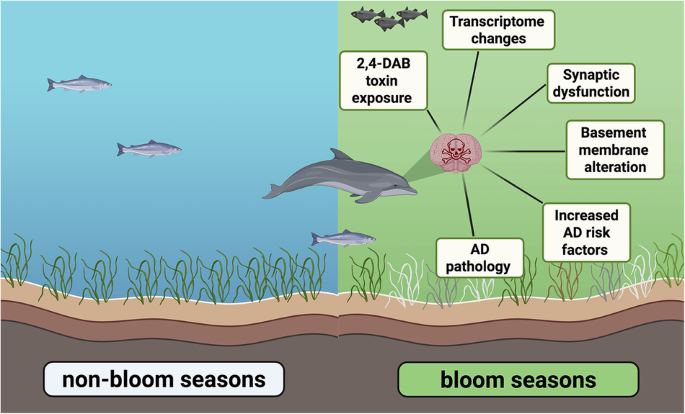
A decade-long study of twenty common bottlenose dolphins stranded along Florida’s east coast has revealed a troubling pattern. Dolphins beached during summer bloom seasons, when cyanobacteria flourish in warm waters, contained brain concentrations of the neurotoxin 2,4-diaminobutyric acid that were 2,900 times higher than dolphins stranded in cooler months. These same animals displayed the telltale pathology of Alzheimer’s: beta-amyloid plaques, hyperphosphorylated tau proteins, and TDP-43 inclusions.
A Natural Experiment in Neurotoxicity
The research team, spanning institutions from Florida to Wyoming, analyzed brain tissue from dolphins that died between 2010 and 2019. They did not set out to study Alzheimer’s. They were investigating why dolphins strand themselves on beaches in the first place. What they discovered was a real-world experiment in how environmental toxins might trigger dementia.
Since dolphins are considered environmental sentinels for toxic exposures in marine environments, there are concerns about human health issues associated with cyanobacterial blooms.
Dr. David Davis at the University of Miami Miller School of Medicine explains the significance. The Indian River Lagoon sits less than 200 miles from Miami-Dade County, which recorded the highest prevalence of Alzheimer’s disease in the United States in 2024. The connection may not be coincidental.
Dolphins beached during bloom seasons showed 536 differentially expressed genes compared to those stranded in winter months. The genetic signatures pointed to impaired GABAergic synapses, alterations in basement membranes, and multiple Alzheimer’s risk factors. The apolipoprotein E gene, the best predictive biomarker for Alzheimer’s in humans, was elevated up to 6.5-fold in some dolphins.
Climate Feedback Loop
The neurotoxin at the center of this story, 2,4-DAB, is produced by cyanobacteria, diatoms, and dinoflagellates during harmful algal blooms. These blooms are intensifying with climate warming and nutrient runoff from agriculture and sewage. Lake Okeechobee regularly releases cyanobacteria-laden water down the St. Lucie River into the Indian River Lagoon, creating perfect conditions for toxin production.
Originally described as causing tremors and convulsions within hours of exposure, 2,4-DAB also acts as a non-competitive inhibitor of GABA transaminase, disrupting the delicate balance of neurotransmitters in the brain. It appears to be more toxic than its structural cousin BMAA, which has already been linked to Alzheimer’s in studies of Guam villagers exposed through their diet.
The dolphins displayed decreased expression of glutamate decarboxylase, the enzyme responsible for converting glutamate to GABA. In humans, reduced function of this enzyme is implicated in mental disorders, neurodegenerative disease, and dyskinesia. The animals also showed increased expression of laminin-3 complex proteins, which in high concentrations are toxic to neurons and have been found in the amyloid plaques of Alzheimer’s patients.
What makes this study particularly compelling is the temporal pattern. Genes associated with Alzheimer’s disease increased with each sequential bloom season the researchers examined. The advanced glycosylation end product receptor gene and other dementia markers rose year after year, suggesting cumulative damage from repeated exposures.
Although there are likely many paths to Alzheimer’s disease, cyanobacterial exposures increasingly appear to be a risk factor.
The research raises uncomfortable questions about human vulnerability. If chronic dietary exposure to cyanobacterial toxins can trigger Alzheimer’s-like pathology in long-lived marine mammals, what about people who recreate in or consume fish from bloom-affected waters? The neurotoxins biomagnify up the food chain, concentrating in top predators.
Surface temperatures on Earth in 2024 were the warmest recorded in modern times. Florida’s Indian River Lagoon has experienced severe harmful algal blooms for the last 25 years, paralleled by a 3.3 degree Celsius increase in average annual temperature statewide. The duration and intensity of these blooms will continue to increase as the planet warms.
The study cannot definitively prove that disoriented dolphins with Alzheimer’s-like brain damage are stranding themselves because they have lost their way. But the hypothesis is plausible. Some adult humans with dementia wander far from home, similarly disoriented. Perhaps dolphins suffering neurological decline lose their ability to navigate, swimming into shallow water from which they cannot escape.
The findings were published in Communications Biology by researchers from Hubbs-SeaWorld Research Institute, Blue World Research Institute, University of Miami, and Brain Chemistry Labs. They analyzed only dolphins with the highest quality brain RNA, achieving a median RNA integrity number of 9.1, ensuring their genetic findings reflect true biological changes rather than tissue degradation.
Whether we are witnessing an early warning system remains an open question. Dolphins live in the same waters where humans swim, fish, and sometimes drink. They eat from the same contaminated food webs. As environmental sentinels, their brains may be telling us something we need to hear.