Skip to content
ScienceBlog.com
  • Featured Blogs
    • EU Horizon Blog
    • ESA Tracker
    • Experimental Frontiers
    • Josh Mitteldorf’s Aging Matters
    • Dr. Lu Zhang’s Gondwanaland
    • NeuroEdge
    • NIAAA
    • SciChi
    • The Poetry of Science
    • Wild Science
  • Topics
    • Brain & Behavior
    • Earth, Energy & Environment
    • Health
    • Life & Non-humans
    • Physics & Mathematics
    • Social Sciences
    • Space
    • Technology
  • Our Substack
  • Follow Us!
    • Bluesky
    • Threads
    • FaceBook
    • Google News
    • Twitter/X
  • Contribute/Contact

Alzheimers disease

Professor Ruth Fabian-Fine has mentored groups of summer research students for years in her ongoing work studying the neurology of spiders (Credit: St. Michael's College)

Spider Brain Research Leads to Groundbreaking Discovery in Understanding Alzheimer’s

Obese man illustration from Pixabay

Deep Belly Fat Linked to Early Signs of Alzheimer’s Decades Before Symptoms

mouse

AI System Spots Early Warning Signs of Alzheimer’s Through Mouse Behavior

primates

Insights from Non-Human Primates Shed Light on Alzheimer’s Resistance

spinal fluid

Brain Fluid Analysis Reveals Potential Drug Targets for Alzheimer’s

In the Alzheimer’s affected brain, abnormal collections of the tau protein accumulate and form tangles (seen in blue) within neurons, harming synaptic communication between nerve cells. Credits:Image: National Institute on Aging, NIH

How Key Enzyme Transforms Brain Protein in Alzheimer’s

Brain MRI images.

Major Update: Experts Revise How Alzheimer’s Disease Should Be Diagnosed

Suspicious protein molecules and fibrils aggregate on nerve cells in dementia. Illustration: Empa

Scientists Identify ‘Superspreader’ Proteins That May Drive Alzheimer’s Progression

This inoculated MacConkey agar culture plate cultivated colonial growth of Gram-negative, small rod-shaped and facultatively anaerobic Klebsiella pneumoniae bacteria. K. pneumoniae bacteria are commonly found in the human gastrointestinal tract, and are often the cause of hospital acquired, or nosocomial infections involving the urinary and pulmonary systems.

Gut bacteria implicated in Alzheimer’s

Rong Xu

Popular diabetes and weight-loss drug may reduce risk of Alzheimer’s disease

From left to right, the experts Leticia Pérez-Sisqués, Genís Campoy-Campos, Almudena Chicote-González, Cristina Malagelada, Júlia Solana-Balaguer, Jordi Alberch and Pol Garcia-Segura, from the Institute of Neurosciences of the University of Barcelona (UBneuro).

Researchers identify a new molecular mechanism that could help design future therapies to treat Alzheimer’s disease


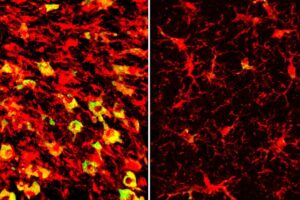
Lipid deposits (green) in brain immune cells (red) from mice with Alzheimer’s-like disease all but disappear (right) after the mice are treated with an experimental drug. Researchers at Washington University School of Medicine in St. Louis have found that a form of cholesterol known as cholesteryl esters builds up in the brains of mice with Alzheimer’s-like disease, and that clearing out the cholesteryl esters helps prevent brain damage and behavioral changes.

Quality, not amount, of ‘good’ cholesterol contribute to first sign of Alzheimer’s in women

Nur Jury-Garfe, PhD

Study Reveals Key Mechanisms Protecting Against Cognitive Decline in Asymptomatic Alzheimer’s

The brain of a 7-day-old fruit fly with Tau expressed in a neuronal circuit used by the fly in olfactory memory. The green outlines the neurons, which are starting to swell and degenerate due to the Tau protein. The red shows where Tau is building up in clusters along the neurons, starting to form the clumps that eventually become rope-like fibrils.

Promising ‘first’ in Alzheimer’s drug development

Older posts
Newer posts
← Previous Page1 Page2 Page3 … Page10 Next →
Substack subscription form sign up

Comments

  • Tom on The Serotonin Circuit That Makes Tinnitus Louder
  • Josh Mitteldorf on Red States and Blue States Are Becoming the Same Unhappy Country
  • Josh Mitteldorf on Scientists Have Written the Rules for First Contact, and Step One Is Don’t Panic
  • John E on A New Theory Says DMT Entities Might Be Real, and Proposes How to Test It
  • ScienceBlog.com on A New Theory Says DMT Entities Might Be Real, and Proposes How to Test It
© 2026 ScienceBlog.com | Follow our RSS / XML feed