Skip to content
ScienceBlog.com
  • Featured Blogs
    • EU Horizon Blog
    • ESA Tracker
    • Experimental Frontiers
    • Josh Mitteldorf’s Aging Matters
    • Dr. Lu Zhang’s Gondwanaland
    • NeuroEdge
    • NIAAA
    • SciChi
    • The Poetry of Science
    • Wild Science
  • Topics
    • Brain & Behavior
    • Earth, Energy & Environment
    • Health
    • Life & Non-humans
    • Physics & Mathematics
    • Social Sciences
    • Space
    • Technology
  • Our Substack
  • Follow Us!
    • Bluesky
    • Threads
    • FaceBook
    • Google News
    • Twitter/X
  • Contribute/Contact

Astrophysics

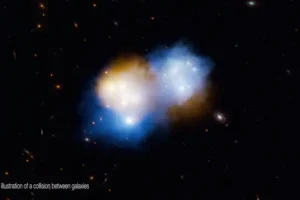
This artist's concept shows what happened when two massive clusters of galaxies, collectively known as MACS J0018.5, collided: The dark matter in the galaxy clusters (blue) sailed ahead of the associated clouds of hot gas, or normal matter (orange). Both dark matter and normal matter feel the pull of gravity, but only the normal matter experiences additional effects like shocks and turbulence that slow it down during collisions.

Dark matter flies ahead of normal matter in mega galaxy cluster collision

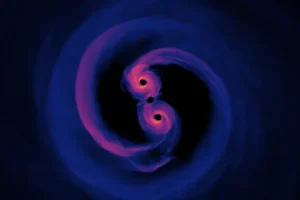
Simulation of the light emitted by a supermassive black hole binary system where the surrounding gas is optically thin (transparent). Viewed from 0 degrees inclination, or directly above the plane of the disk. The emitted light represents all wavelengths.

Astrophysicists uncover supermassive black hole/dark matter connection in solving the ‘final parsec problem’

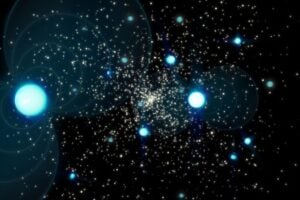
Terzan 5, located in the constellation Sagittarius, is a crowded globular cluster home to hundreds of thousands of stars.Ten unusual and exotic pulsars were recently discovered by an international team of astronomers from the U.S. National Science Foundation National Radio Astronomy Observatory, the Max Planck Institute for Gravitational Physics (Albert Einstein Institute) (AEI), and the Max Planck Institute for Radio Astronomy

Telescope Tag-Team Discovers Galactic Cluster’s Bizarre Secrets

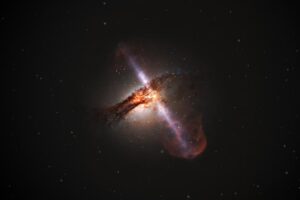
An artist’s impression showing bi-polar jets of gas originating from a supermassive black hole at the centre of a galaxy.

How the ‘heart and lungs’ of a galaxy extend its life

Ohio State logo

A cosmic tool for studying twisters and other severe storms

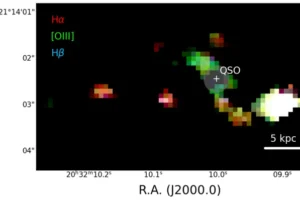
Here's a clearer version of the image caption: Colored map of the PJ308-21 system showing gas emissions: - Hydrogen: Red and blue - Oxygen: Green The central quasar's light has been masked out. Color variations in the quasar's host galaxy and its companions indicate different gas properties in each region.

Webb Space Telescope captures staggering quasar-galaxy merger in remote universe

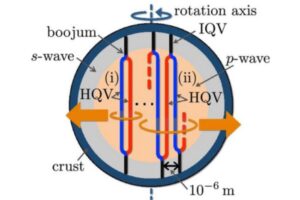
The image shows the quantum vortex network model proposed by the study authors. The p-wave inner core (pink) surrounds the s-wave outer core (grey).

Study reveals twisted origin of dead stars’ mysterious ‘heartbeats’

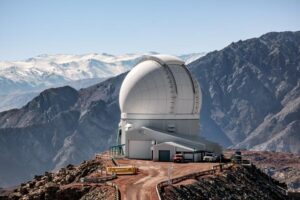
The SOAR Telescope on Cerro Pachon in Chile.

Revived technology used to count individual photons from distant galaxiesRevived technology used to count individual photons from distant galaxies

The Cosmic Gems arc as observed by the JWST. Credit: ESA/Webb, NASA & CSA, L. Bradley (STScI), A. Adamo (Stockholm University) and the Cosmic Spring collaboration.

Star clusters observed within a galaxy in the early Universe for the first time

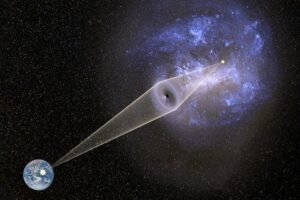
Artist's impression of a microlensing event caused by a black hole observed from Earth toward the Large Magellanic Cloud. The light of a background star located in the LMC is bent by a putative primordial black hole (lens) in the Galactic halo and magnified when observed from the Earth. Microlensing causes very characteristic variation of brightness of the background star, enabling the determination of the lens's mass and distance. Credit: J. Skowron / OGLE. Background image of the Large Magellanic Cloud: generated with bsrender written by Kevin Loch, using the ESA/Gaia database

Is dark matter made of black holes?

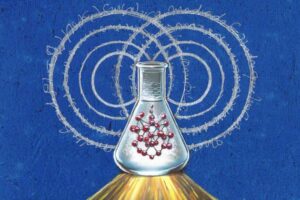
Illustration of pair plasma in a beaker

Pair plasmas found in deep space can now be generated in the lab

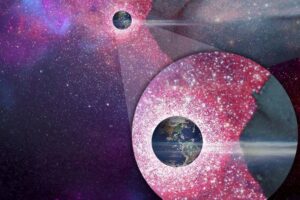
For a brief period of time millions of years ago, Earth may have been plunged out of the sun’s protective plasma shield, called the heliosphere, which is depicted here as the dark gray bubble over the backdrop of interstellar space. According to new research, this could have exposed Earth to high levels of radiation and influenced the climate. Photo courtesy of Opher, et al., Nature Astronomy

Earth’s Climate May Be Shaped by the Sun’s Galactic Journey

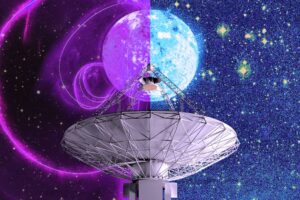
Artist’s depiction of CSIRO’s ASKAP radio telescope with two versions of the mysterious celestial object: neutron star or white dwarf

Astronomers Discover Slowest Spinning Neutron Star, Defying Expectations

Composite colour image of the interacting galaxy cluster El Gordo, showing X-ray light from NASA's Chandra X-ray Observatory in blue, optical data from the European Southern Observatory's Very Large Telescope in red, green, and blue, and infrared emission from NASA's Spitzer Space Telescope in red and orange.

Study Suggests Dark Matter May Be Self-Interacting in Massive Galaxy Cluster Collisions

Older posts
Newer posts
← Previous Page1 Page2 Page3 … Page7 Next →
Substack subscription form sign up

Comments

  • Sue Ann Hayes on Hidden Nuclear Protein Fuels Pancreatic Cancer’s Deadly Aggression
  • Curtis Webber on The GPS-Killer? This Quantum Device ‘Feels’ Motion Like a Brain—Down to the Atomic Level
  • Ran on How the Age You First Had Sex Could Shape How You Age Decades Later
  • Sparty on How the Age You First Had Sex Could Shape How You Age Decades Later
  • Josh Mitteldorf on A Single TV Segment Sent Leucovorin Prescriptions for Autistic Children Soaring 2,000 Percent
© 2026 ScienceBlog.com | Follow our RSS / XML feed