Skip to content
ScienceBlog.com
  • Featured Blogs
    • EU Horizon Blog
    • ESA Tracker
    • Experimental Frontiers
    • Josh Mitteldorf’s Aging Matters
    • Dr. Lu Zhang’s Gondwanaland
    • NeuroEdge
    • NIAAA
    • SciChi
    • The Poetry of Science
    • Wild Science
  • Topics
    • Brain & Behavior
    • Earth, Energy & Environment
    • Health
    • Life & Non-humans
    • Physics & Mathematics
    • Social Sciences
    • Space
    • Technology
  • Our Substack
  • Follow Us!
    • Bluesky
    • Threads
    • FaceBook
    • Google News
    • Twitter/X
  • Contribute/Contact

Astrophysics

gliese 12 b

Astronomers Discover Potentially Habitable Earth-like Exoplanet Just 40 Light-Years Away

Volcanic exoplanet illustration.

NASA’s TESS Discovers Fiery, Lava-Covered Exoplanet in Distant Star System

[Image: A computer-generated visualization of a galaxy, with visible matter represented in bright colors and dark matter represented as a translucent halo surrounding the galaxy, accompanied by a graph showing the relationship between visible and dark matter in the simulations.]

Astronomers’ Simulations Bolster Case for Dark Matter’s Existence

Artist's impression of a magnetar. Magnetars are the cosmic objects with the strongest magnetic fields ever measured in the Universe.

Rare Magnetar Flare Spotted in Nearby Galaxy M82

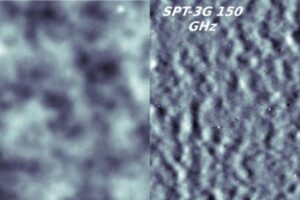
Comparison between CMB data resolution collected by Planck and SPT-3G

Cosmologists Grapple with Growing Tension in Understanding Universe’s Expansion

PENTATRAP

Scientists Take a Step Closer to Solving the Mystery of Neutrino Masses

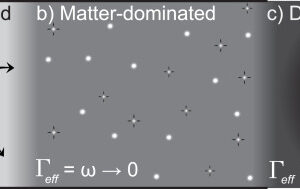
Representations of universe eras – (a) radiation, (b) matter, (c) dark energy – with the respective values of the equation of state ω = Γeff, where Γeff is the effective Grüneisen parameter. As dark energy becomes dominant, Γeff changes sign and emulates a phase transition in condensed matter physics (image: Results in Physics)

Scientists Uncover New Clues About the Universe’s Mysterious Expansion

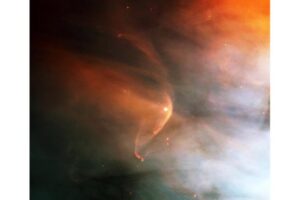
Infrared image of the shockwave (red arc) created by the massive giant star Zeta Ophiuchi in an interstellar dust cloud. The tenuous winds of sun-like main-sequence stars are much more difficult to observe

Stellar winds of three sun-like stars detected for the first time

The attached image shows the sky goddess Nut, covered in stars, is held aloft by her father, Shu, and is arched over Geb, her brother the Earth god. On the left, the rising sun (the falcon-headed god Re) sails up Nut’s legs. On the right, the setting sun sails down her arms towards the outstretched arms of Osiris, who will regenerate the sun in the netherworld during the night.

The hidden role of the Milky Way in ancient Egyptian mythology

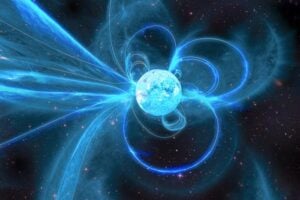
Artist’s impression of a magnetar.

Mysterious Radio Signals from Nearby Magnetar Baffle Scientists

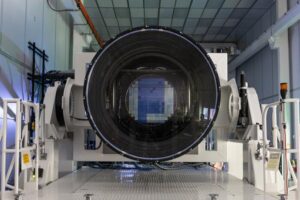
A front view of the completed LSST Camera, showing the 3,200-megapixel focal plane within.

SLAC completes construction of the largest digital camera ever built for astronomy

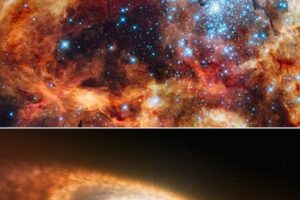
The ULLYSES program studied two types of young stars: super-hot, massive, blue stars and cooler, redder, less massive stars than our Sun. The top panel is a Hubble Space Telescope image of a star-forming region containing massive, young, blue stars in 30 Doradus, the Tarantula Nebula. Located within the Large Magellanic Cloud, this is one of the regions observed by ULLYSES. The bottom panel shows an artist's concept of a cooler, redder, young star that's less massive than our Sun. This type of star is still gathering material from its surrounding, planet-forming disk.

Hubble Telescope’s Ambitious Survey Provides Unprecedented Insights into the Lives of Stars

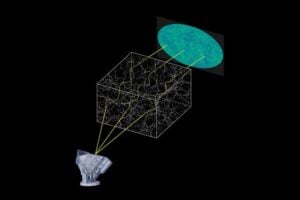
The cosmic microwave background — the universe’s oldest light — has traversed vast distances before reaching us. During its extended journey, gravitational forces from massive cosmic structures caused its trajectory to bend before being captured by the South Pole Telescope.

Results from South Pole Telescope’s new camera emerge

Star region illustration/photo

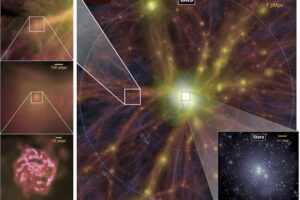
Researchers seek to understand how regions of ‘cosmic web’ influence behavior of galaxies

Older posts
Newer posts
← Previous Page1 Page2 Page3 Page4 … Page7 Next →
Substack subscription form sign up

Comments

  • Sue Ann Hayes on Hidden Nuclear Protein Fuels Pancreatic Cancer’s Deadly Aggression
  • Curtis Webber on The GPS-Killer? This Quantum Device ‘Feels’ Motion Like a Brain—Down to the Atomic Level
  • Ran on How the Age You First Had Sex Could Shape How You Age Decades Later
  • Sparty on How the Age You First Had Sex Could Shape How You Age Decades Later
  • Josh Mitteldorf on A Single TV Segment Sent Leucovorin Prescriptions for Autistic Children Soaring 2,000 Percent
© 2026 ScienceBlog.com | Follow our RSS / XML feed