Skip to content
ScienceBlog.com
  • Featured Blogs
    • EU Horizon Blog
    • ESA Tracker
    • Experimental Frontiers
    • Josh Mitteldorf’s Aging Matters
    • Dr. Lu Zhang’s Gondwanaland
    • NeuroEdge
    • NIAAA
    • SciChi
    • The Poetry of Science
    • Wild Science
  • Topics
    • Brain & Behavior
    • Earth, Energy & Environment
    • Health
    • Life & Non-humans
    • Physics & Mathematics
    • Social Sciences
    • Space
    • Technology
  • Our Substack
  • Follow Us!
    • Bluesky
    • Threads
    • FaceBook
    • Google News
    • Twitter/X
  • Contribute/Contact

Astrophysics

galaxy seen from the side

Stars travel more slowly at Milky Way’s edge

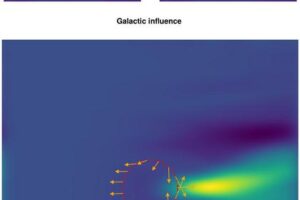
Dynamical friction. The panels depict sparse areas of the universe with dark colour and dense areas with light colour. The upper panels show the density around a galaxy if the galaxy's gravity bends (left) or does not bend (right) the trajectories of dark matter particles. The lower panel shows the difference between them, or how the galaxy affects the distribution of dark matter. The arrows represent the acceleration caused by the overdensity behind the galaxy, from which the friction on the centre of the galaxy is deducted. Since the arrows have different directions and strengths in different areas, the tidal forces are able to change the shape of a galaxy.

Lopsided galaxies shed light on the speed of dark matter

Wormhole illustration

Astrophysicists say they’ve proven passable wormholes possible

Sample shapes of distant galaxies identified by the James Webb Space Telescope’s Cosmic Evolution Early Release Science (CEERS) survey. [(Credit: NASA, ESA, CSA, STScI, Steve Finkelstein (UT Austin), Micaela Bagley (UT Austin), Rebecca Larson (UT Austin)]

Most early galaxies looked like breadsticks rather than pizza pies or dough balls

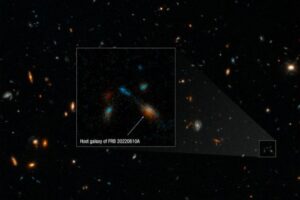
galaxies

‘Blob-like’ home of farthest-known fast radio burst is collection of seven galaxies

Illustration of a star and space rocks

Extreme conditions in stars produce the universe’s heaviest elements

Neutron Star Merger

First hints of nuclear fission in cosmos revealed by models, observations

Top space telescope from Europe seeks to solve riddles of the universe

Artist’s illustration of the extremely energetic cosmic ray observed by a surface detector array of the Telescope Array experiment, named “Amaterasu particle.”

Mysterious Cosmic Ray Defies Origins and Energies

Panchromatic view of MACS0416, a galaxy cluster about 4.3 billion light-years from Earth. The image was created by combining infrared observations from NASA’s James Webb Space Telescope with visible-light data from NASA’s Hubble Space Telescope. The resulting prismatic panorama of blues and reds give clues to the distances of the galaxies.

NASA’s Webb, Hubble telescopes combine to create most colorful view of universe

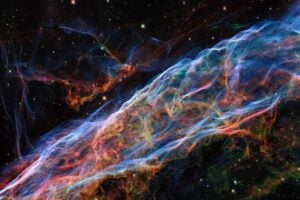
Nebula

NASA rocket to see sizzling edge of star-forming supernova

Meteors help answer riddles about water

Artist conception of early starbursting galaxies. The image is rendered from FIRE simulation data used for this research that can explain recent JWST results. Stars and galaxies are shown in the bright white points of light, while the more diffuse dark matter and gas are shown in purples and reds.

Bursts of star formation explain mysterious brightness at cosmic dawn

Ohio State logo

Study sheds new light on strange lava worlds

Older posts
Newer posts
← Previous Page1 … Page3 Page4 Page5 … Page7 Next →
Substack subscription form sign up

Comments

  • Sue Ann Hayes on Hidden Nuclear Protein Fuels Pancreatic Cancer’s Deadly Aggression
  • Curtis Webber on The GPS-Killer? This Quantum Device ‘Feels’ Motion Like a Brain—Down to the Atomic Level
  • Ran on How the Age You First Had Sex Could Shape How You Age Decades Later
  • Sparty on How the Age You First Had Sex Could Shape How You Age Decades Later
  • Josh Mitteldorf on A Single TV Segment Sent Leucovorin Prescriptions for Autistic Children Soaring 2,000 Percent
© 2026 ScienceBlog.com | Follow our RSS / XML feed