Skip to content
ScienceBlog.com
  • Featured Blogs
    • EU Horizon Blog
    • ESA Tracker
    • Experimental Frontiers
    • Josh Mitteldorf’s Aging Matters
    • Dr. Lu Zhang’s Gondwanaland
    • NeuroEdge
    • NIAAA
    • SciChi
    • The Poetry of Science
    • Wild Science
  • Topics
    • Brain & Behavior
    • Earth, Energy & Environment
    • Health
    • Life & Non-humans
    • Physics & Mathematics
    • Social Sciences
    • Space
    • Technology
  • Our Substack
  • Follow Us!
    • Bluesky
    • Threads
    • FaceBook
    • Google News
    • Twitter/X
  • Contribute/Contact

Binary Stars

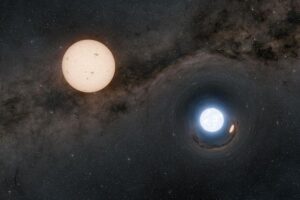
This illustration depicts a binary star system consisting of a dense neutron star and a normal Sun-like star (upper left). Using data from the European Space Agency's Gaia mission, astronomers found several systems like this one, in which the two bodies are widely separated. Because the bodies in these systems are far apart, with separations on average 300 times the size of a Sun-like star, the neutron star is dormant—it is not actively stealing mass from its companion and is thus very faint. To find these hidden neutron stars, the scientists used Gaia observations to look for a wobble in the Sun-like stars caused by a tugging action of the orbiting neutron stars. These are the first neutron stars discovered purely due to their gravitational effects.

Sun-like stars found orbiting hidden companions

Substack subscription form sign up

Comments

  • Karoly Mirnics on Common Prescription Drugs May Disrupt Cholesterol Pathways in the Womb and Raise Autism Risk
  • Aizen on Laziness helped lead to extinction of Homo erectus
  • Norwood johnson on Electrons in New Crystals Behave as If They Live in Four Dimensions
  • ScienceBlog.com on Hidden Geometry Could Finally Fix Quantum Computers
  • Theo Prinse on America Is Going Back to the Moon. This Time, It Plans to Stay
© 2026 ScienceBlog.com | Follow our RSS / XML feed