Skip to content
ScienceBlog.com
  • Featured Blogs
    • EU Horizon Blog
    • ESA Tracker
    • Experimental Frontiers
    • Josh Mitteldorf’s Aging Matters
    • Dr. Lu Zhang’s Gondwanaland
    • NeuroEdge
    • NIAAA
    • SciChi
    • The Poetry of Science
    • Wild Science
  • Topics
    • Brain & Behavior
    • Earth, Energy & Environment
    • Health
    • Life & Non-humans
    • Physics & Mathematics
    • Social Sciences
    • Space
    • Technology
  • Our Substack
  • Follow Us!
    • Bluesky
    • Threads
    • FaceBook
    • Google News
    • Twitter/X
  • Contribute/Contact

Biomimicry

NTU scientists, in collaboration with local ecology and biomimicry design firm bioSEA, have developed ‘fungi tiles’ that could help cool buildings down without consuming energy.

Scientists create ‘fungi tiles’ with elephant skin texture to cool buildings

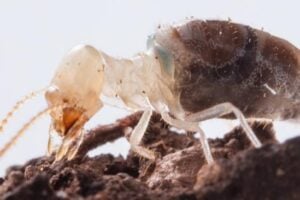
A termite of the species Neocapritermes taracua with a blue body on the back formed by laccase BP76.

Termite ‘Suicide Bombers’ Reveal Nature’s Explosive Secrets

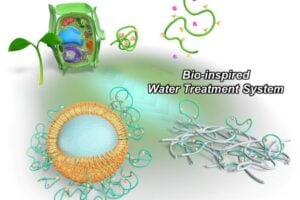
Conceptual illustration of this work on bio-inspired water treatment system

Plant-Inspired Polymer Transforms Heavy Metal Removal from Water

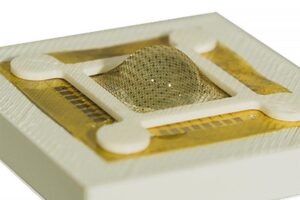
A photograph of the artificial compound eye prototype developed at the University of Virginia School of Engineering and Applied Science by associate professor Kyusang Lee.

New Artificial Eyes Mimic Praying Mantis Vision for Improved Machine Perception

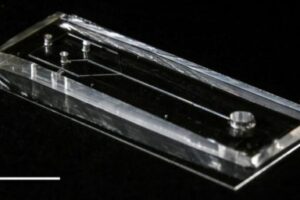
microfluidic device

Look out Spider-Man: Naturalistic silk spun from artificial spider gland

The shape-changing polymer ribbons can change their volume upon an environmental change, like temperature. Courtesy of Taylor Ware

Fire Ant ‘Rafts’ Inspire Engineering Research

Velvet worm

Velvet Worm slime could inspire sustainable synthetic materials

Centipede robot

Walking Robot Harnesses Instability for Navigation

Spiderweb with dew in the morning

Orb weaver spider glue properties evolve faster than their glue genes

Inspired by polar bears, this new textile creates an on-body “greenhouse” effect to keep you warm.

New cloth unravels warmth-trapping secrets of polar bear fur

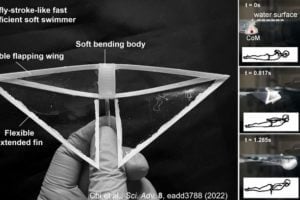
Inspired by the biomechanics of the manta ray, researchers at North Carolina State University have developed an energy-efficient soft robot that can swim more than four times faster than previous swimming soft robots. The robots are called “butterfly bots,” because their swimming motion resembles the way a person’s arms move when they are swimming the butterfly stroke.

‘Butterfly bot’ is fastest swimming soft robot yet

Substack subscription form sign up

Comments

  • Karoly Mirnics on Common Prescription Drugs May Disrupt Cholesterol Pathways in the Womb and Raise Autism Risk
  • Aizen on Laziness helped lead to extinction of Homo erectus
  • Norwood johnson on Electrons in New Crystals Behave as If They Live in Four Dimensions
  • ScienceBlog.com on Hidden Geometry Could Finally Fix Quantum Computers
  • Theo Prinse on America Is Going Back to the Moon. This Time, It Plans to Stay
© 2026 ScienceBlog.com | Follow our RSS / XML feed