Skip to content
ScienceBlog.com
  • Featured Blogs
    • EU Horizon Blog
    • ESA Tracker
    • Experimental Frontiers
    • Josh Mitteldorf’s Aging Matters
    • Dr. Lu Zhang’s Gondwanaland
    • NeuroEdge
    • NIAAA
    • SciChi
    • The Poetry of Science
    • Wild Science
  • Topics
    • Brain & Behavior
    • Earth, Energy & Environment
    • Health
    • Life & Non-humans
    • Physics & Mathematics
    • Social Sciences
    • Space
    • Technology
  • Our Substack
  • Follow Us!
    • Bluesky
    • Threads
    • FaceBook
    • Google News
    • Twitter/X
  • Contribute/Contact

blood conductivity

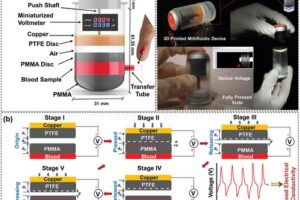
Vision of the proposed research for developing a self-powered, millifluidic lab-on-a-chip device to determine blood conductivity. a) Schematics and dimensions of the proposed device. The blood layer, copper electrodes, PTFE disc, and PMMA elements form a contact-separation mode TENG system. The blood sample is sandwiched between two PMMA layers and serves as one of the conductive layers. Any change in its electrical conductivity would theoretically change the voltage signal generated by the device. b) Operating principle of this blood-based TENG device. c) The 3D printed device and the type of voltage signal generated by it.

Novel blood-powered chip offers real-time health monitoring

Substack subscription form sign up

Comments

  • Norwood johnson on Electrons in New Crystals Behave as If They Live in Four Dimensions
  • ScienceBlog.com on Hidden Geometry Could Finally Fix Quantum Computers
  • Theo Prinse on America Is Going Back to the Moon. This Time, It Plans to Stay
  • george w on Hidden Geometry Could Finally Fix Quantum Computers
  • Tom Hughes on Years of Exercise, Blood Pressure Drugs Failed to Slow Cognitive Decline in Seniors at Dementia Risk
© 2026 ScienceBlog.com | Follow our RSS / XML feed