Skip to content
ScienceBlog.com
  • Featured Blogs
    • EU Horizon Blog
    • ESA Tracker
    • Experimental Frontiers
    • Josh Mitteldorf’s Aging Matters
    • Dr. Lu Zhang’s Gondwanaland
    • NeuroEdge
    • NIAAA
    • SciChi
    • The Poetry of Science
    • Wild Science
  • Topics
    • Brain & Behavior
    • Earth, Energy & Environment
    • Health
    • Life & Non-humans
    • Physics & Mathematics
    • Social Sciences
    • Space
    • Technology
  • Our Substack
  • Follow Us!
    • Bluesky
    • Threads
    • FaceBook
    • Google News
    • Twitter/X
  • Contribute/Contact

brain health

woman sleeping

Poor Sleep May Increase Markers of Poor Brain Health

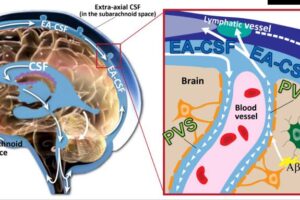
CSF normally flows continuously throughout the extra-axial and perivascular spaces, where it filters out inflammatory proteins, before draining efficiently from the extra-axial space. Credit: Dea Garic & Mark Shen.

Enlarged Spaces in Infant Brains Linked to Higher Risk of Autism, Sleep Problems

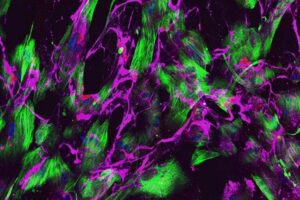
Disease mural cells stained for calponin (mural cells marker, green), collagen IV (magenta) and DAPI (nuclei, blue) Credit: Alessandra Granata/University of Cambridge

Lab-grown ‘small blood vessels’ point to potential treatment for major cause of stroke and vascular dementia


Ohio State logo

Saturated fat may interfere with creating memories in aged brain

Physician reads a color monitor brain scan. From University of Michigan

Diabetes linked to functional and structural brain changes through MRI

A collection of heathy foods from the MIND diet

MIND diet study shows ‘short-term’ impact on cognition

Woman posing in yoga

Older women at risk for Alzheimer’s disease may benefit from yoga

Anne-Julie Tessier, RD, PhD, postdoctoral fellow at the Harvard T.H. Chan School of Public Health

Opting for olive oil could boost brain health

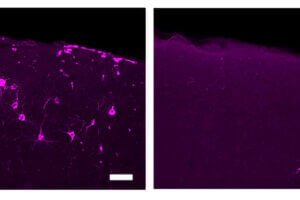
A new study presents evidence that 40 Hz vibration can reduce Alzheimer's disease pathology and symptoms in lab mice and improve their motor function. These images highlight reductions in the hallmark Alzheimer's disease protein phosphorylated tau (magenta) in primary somatosensory cortical neurons in Tau P301S model mice treated with 40 Hz tactile stimulation (right). An image from an untreated control is on the left.

40 Hz vibrations reduce Alzheimer’s pathology, symptoms in mouse models

Person holding test tube with blood. Credit Pixabay.

Blood test predicts if cognitively healthy elderly will develop Alzheimer’s

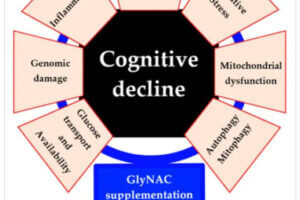
Model of cognitive decline and the effect of GlyNac

GlyNAC Supplementation May Help Reverse Cognitive Decline in Aging

Colorful illustration of two skulls and brains

Restoring Brain Rhythm Can Fight Depression

surreal dali painting

Lost in Time

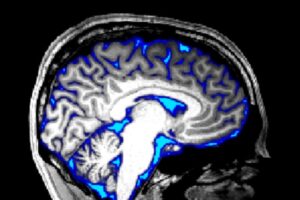
MRI image of adult brain, with regions of cerebrospinal fluid overlaid in blue.

MRI image of adult brain, with regions of cerebrospinal fluid overlaid in blue.

Older posts
Newer posts
← Previous Page1 Page2 Page3 Page4 Next →
Substack subscription form sign up

Comments

  • Simon on A New Theory Says DMT Entities Might Be Real, and Proposes How to Test It
  • Sue Ann Hayes on Hidden Nuclear Protein Fuels Pancreatic Cancer’s Deadly Aggression
  • Curtis Webber on The GPS-Killer? This Quantum Device ‘Feels’ Motion Like a Brain—Down to the Atomic Level
  • Ran on How the Age You First Had Sex Could Shape How You Age Decades Later
  • Sparty on How the Age You First Had Sex Could Shape How You Age Decades Later
© 2026 ScienceBlog.com | Follow our RSS / XML feed