Skip to content
ScienceBlog.com
  • Featured Blogs
    • EU Horizon Blog
    • ESA Tracker
    • Experimental Frontiers
    • Josh Mitteldorf’s Aging Matters
    • Dr. Lu Zhang’s Gondwanaland
    • NeuroEdge
    • NIAAA
    • SciChi
    • The Poetry of Science
    • Wild Science
  • Topics
    • Brain & Behavior
    • Earth, Energy & Environment
    • Health
    • Life & Non-humans
    • Physics & Mathematics
    • Social Sciences
    • Space
    • Technology
  • Our Substack
  • Follow Us!
    • Bluesky
    • Threads
    • FaceBook
    • Google News
    • Twitter/X
  • Contribute/Contact

Ecology

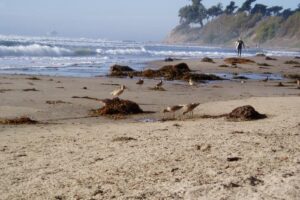
Shorebirds forage in kelp wrack on a beach in California.

The choreography connecting kelp forests to the beach

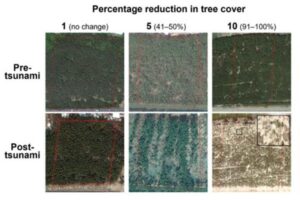
The upper panel depicts the coastal forest pre-tsunami, while the lower panel illustrates the forest post-tsunami. Each column represents the percentage decrease in coastal tree cover resulting from the tsunami event (1: no change, 5: 41-50%, 10: 91-100%). In cases where there was a 91-100% decrease in tree cover, indicated by the inset with the black frame in the bottom right image, nearly all trees were toppled by the tsunami. It is important to note that we magnified the satellite images/aerial photographs to assess the percentage decrease in coastal forest cover attributable to the tsunami event.

Mixed forests protect coastal areas from tsunami impacts better than monoculture forests

How some plant species evolved to make ants their servants

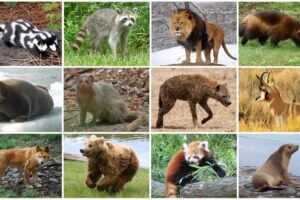
With access to a mammoth set of global-scale climate data and a novel strategy, a team from Utah State University identified several factors to help answer a fundamental ecological question: what an animal eats (and how that interacts with climate) shapes Earth’s diversity.

Raining cats and dogs: research finds global precipitation patterns a driver for animal diversity

Ground-up shot of redwoods

How to save plants from climate change? Just ask them

Ohio State logo

Ohio State leads new global climate center on AI for biodiversity change

Bamboo flowering

Flowering for naught: 120 years with nothing to show

Tractor tilling a field with spoil overturned

Can soil microbes survive in a changing climate?

Researchers found evidence that forests might have been far more important to native wildlife such as extinct dwarf hippos than the grasslands found in the same parts of Madagascar today.

Study Reveals Ancient Forests as Preferred Habitat for Extinct Dwarf Hippos in Madagascar

An unflanged migrant orangutan male feeding on Rotan Tikus leaves (Flagellaria indica) Orangutan species: Pongo abelii

When Orangutans Go Global: The Art of Jungle Assimilation 101

Monarch butterfly. Pixabay

Monarch Butterflies’ White Spots Aid Long-Distance Migration Success

Climate change could lead to "widespread chaos" for insect communities

Climate change could lead to “widespread chaos” for insect communities

A cute little critter

Blood on the Grasslands

Trees seen from overhead

Tree diversity increases storage of carbon and nitrogen in forest soils, mitigating climate change

Older posts
Newer posts
← Previous Page1 Page2 Page3 Next →
Substack subscription form sign up

Comments

  • Norwood johnson on Electrons in New Crystals Behave as If They Live in Four Dimensions
  • ScienceBlog.com on Hidden Geometry Could Finally Fix Quantum Computers
  • Theo Prinse on America Is Going Back to the Moon. This Time, It Plans to Stay
  • george w on Hidden Geometry Could Finally Fix Quantum Computers
  • Tom Hughes on Years of Exercise, Blood Pressure Drugs Failed to Slow Cognitive Decline in Seniors at Dementia Risk
© 2026 ScienceBlog.com | Follow our RSS / XML feed