Skip to content
ScienceBlog.com
  • Featured Blogs
    • EU Horizon Blog
    • ESA Tracker
    • Experimental Frontiers
    • Josh Mitteldorf’s Aging Matters
    • Dr. Lu Zhang’s Gondwanaland
    • NeuroEdge
    • SciChi
    • The Poetry of Science
    • Wild Science
  • Topics
    • Brain & Behavior
    • Earth, Energy & Environment
    • Health
    • Life & Non-humans
    • Physics & Mathematics
    • Social Sciences
    • Space
    • Technology
  • Our Substack
  • Follow Us!
    • Bluesky
    • Threads
    • FaceBook
    • Google News
    • Twitter/X
  • Contribute/Contact

Geology

Prehistoric sea creature of the Cambrian period. Photo: Getty

Life on Earth didn’t arise as described in textbooks

Unlocking the secrets to Mars

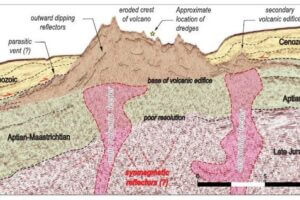
Annotated seismic cross-section of the Fontanelas volcano.

Extinct offshore volcano could store gigatons of carbon dioxide

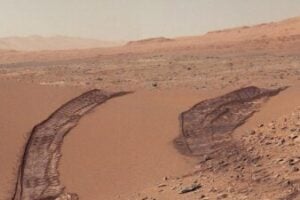
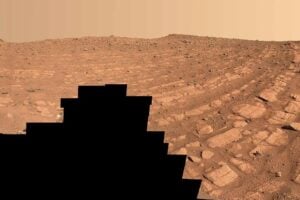
Bands of rocks may have been formed by a very fast, deep river – the first such evidence found for on Mars

Wild river on Mars emerges from images, rock evidence

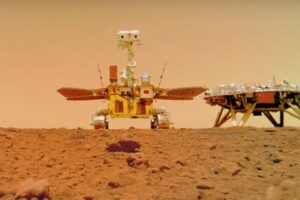
A selfie taken by the Zhurong rover alongside its landing platform, captured with a wireless camera. Source: CNSA.

Complex subsurface of Mars imaged by Chinese rover Zhurong

Boudinage in brecciated dolostone rocks of the Panamint Range (Wildrose Area, Death Valley National Park). New research shows that periclase is stronger than bridgmanite in earth's lower mantle, analogous to boudins developing in rigid ("stronger") rocks among less competent ("weaker") rocks.

What Are They Up To? Surprising Behavior of Minerals Deep in the Earth

Newer posts
← Previous Page1 Page2
Substack subscription form sign up

Comments

  • Foo on A New Theory Says DMT Entities Might Be Real, and Proposes How to Test It
  • John E on A New Theory Says DMT Entities Might Be Real, and Proposes How to Test It
  • Fully Whelmed on A New Theory Says DMT Entities Might Be Real, and Proposes How to Test It
  • Tom on The Serotonin Circuit That Makes Tinnitus Louder
  • Josh Mitteldorf on Red States and Blue States Are Becoming the Same Unhappy Country
© 2026 ScienceBlog.com | Follow our RSS / XML feed