Skip to content
ScienceBlog.com
  • Featured Blogs
    • EU Horizon Blog
    • ESA Tracker
    • Experimental Frontiers
    • Josh Mitteldorf’s Aging Matters
    • Dr. Lu Zhang’s Gondwanaland
    • NeuroEdge
    • NIAAA
    • SciChi
    • The Poetry of Science
    • Wild Science
  • Topics
    • Brain & Behavior
    • Earth, Energy & Environment
    • Health
    • Life & Non-humans
    • Physics & Mathematics
    • Social Sciences
    • Space
    • Technology
  • Our Substack
  • Follow Us!
    • Bluesky
    • Threads
    • FaceBook
    • Google News
    • Twitter/X
  • Contribute/Contact

Machine Learning

Photo via iStock/dem10, Courtesy of Boston University

AI Model Predicts Alzheimer’s Risk with 78.5% Accuracy from Speech Patterns

COLEMAN IS A MEMBER OF THE BIG PINE PAIUTE TRIBE OF OWENS VALLEY — HIS FATHER, DAVID, GREW UP ON THE TRIBE’S RESERVATION IN BIG PINE, CA, AND PAIUTE IS HIS ANCESTRAL LANGUAGE.

AI Tool Revives Endangered Paiute Language, Bridging Generations

Depressed woman in a tunnel

Brain Imaging and Machine Learning Identify Six Depression Subtypes

Depiction of a tokamak.

AI Tames Plasma Instabilities in Fusion Reactors, Boosting Performance

Female sittingon floor afraid of her phone which is on the carpet near her

AI saving humans from the emotional toll of monitoring hate speech

A University of Washington team has developed an artificial intelligence system that lets a user wearing headphones look at a person speaking for three to five seconds and then hear just the enrolled speaker’s voice in real time even as the listener moves around in noisy places and no longer faces the speaker. Pictured is a prototype of the headphone system: binaural microphones attached to off-the-shelf noise canceling headphones.

AI headphones let wearer listen to a single person in a crowd, by looking at them just once

Illustration of a puppet on a string

USC and MIT Researchers Develop Innovative Approaches to Combat Online Misinformation

Scientists use generative AI to answer complex questions in physics

Scientists use generative AI to answer complex questions in physics

A computer-generated image showing a compact, low-power MRI scanner with a patient inside, surrounded by visual representations of deep learning algorithms and data. The image conveys the concept of accessible, deep learning-powered MRI technology

Low-Power MRI Scanners Powered by Deep Learning Could Revolutionize Accessibility

Ohio State logo

New machine learning algorithm promises advances in computing

Ohio State logo

With huge patient dataset, AI accurately predicts treatment outcomes

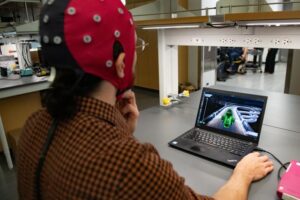
Hussein Alawieh, a graduate student in José del R. Millán's lab, wears a cap packed with electrodes that is hooked up to a computer. The electrodes gather data by measuring electrical signals from the brain, and the decoder interprets that information and translates it into game action.

Universal brain-computer interface lets people play games with just their thoughts

a man seen in profile, speaking, with an illustration of the sound waves coming directly out of his mouth

Machine learning tools can predict emotion in voices in just over a second

Ohio State logo

The role of machine learning and computer vision in Imageomics

Older posts
Newer posts
← Previous Page1 Page2 Page3 Page4 … Page9 Next →
Substack subscription form sign up

Comments

  • Marie Feret on The Silent Frequency That Makes Old Buildings Feel Haunted
  • Dax on The Silent Frequency That Makes Old Buildings Feel Haunted
  • Karoly Mirnics on Common Prescription Drugs May Disrupt Cholesterol Pathways in the Womb and Raise Autism Risk
  • Aizen on Laziness helped lead to extinction of Homo erectus
  • Norwood johnson on Electrons in New Crystals Behave as If They Live in Four Dimensions
© 2026 ScienceBlog.com | Follow our RSS / XML feed